Inexorable Stillness in the House the Glassblower Never Cooled
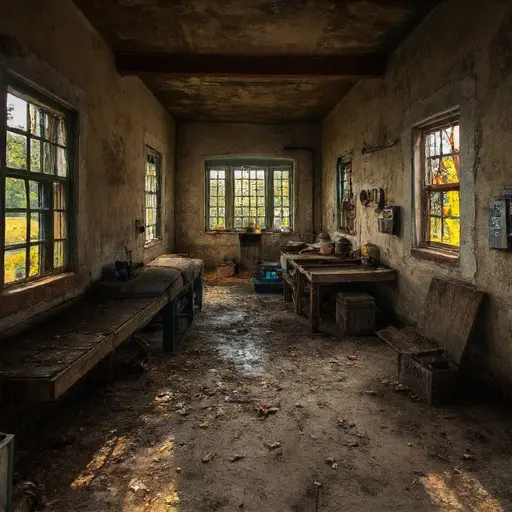
The glass is still warm to the touch.
Not molten.
Not liquid.
But trapped in that strange in-between state where form has settled but memory of heat has not fully left it.
This house belonged to Radu.
He worked as a hand glassblower, shaping laboratory vessels, stained glass pieces, and delicate architectural fixtures for workshops and small ateliers along the river towns.
The studio was built around the kiln room at the heart of the house.
Long iron pipes leaned against clay walls. Cooling shelves stretched beneath tall windows. Powdered minerals for color sat in sealed ceramic jars labeled by hand.
Everything in the house revolved around temperature, timing, and breath.
At the Kiln Breath Counter Table
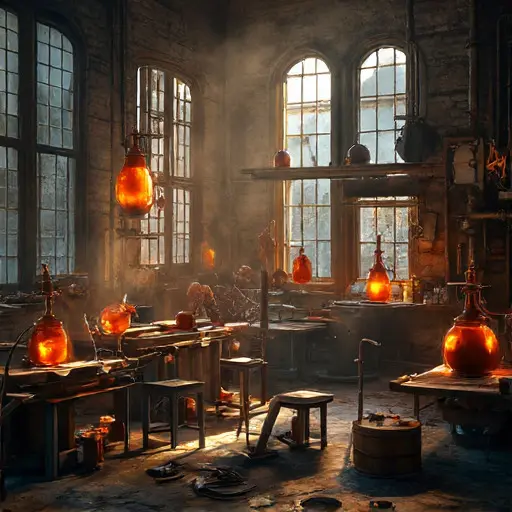
Radu worked most often at the Kiln Breath Counter Table.
The thick stone surface beside the furnace was where he timed cooling cycles, measured viscosity shifts, and determined when molten glass could safely be shaped without collapse.
His wife passed away during a winter respiratory outbreak years earlier.
After that, he stopped producing large commissions.
For a time, the profession still mattered.
Scientific laboratories, churches, and small artisan guilds depended on handcrafted glass components that required precision impossible to replicate in early industrial molds.
Then automation took over.
Factory glass production lines replaced individual artisans, producing uniform glass at scale while eliminating the need for hand-shaped work in most cities and workshops.
Radu continued anyway.
Even without contracts.
Even without demand.
But the decline deepened beyond industry.
The river valley itself changed.
Industrial expansion upstream altered sediment flow and air composition, increasing particulate levels that made traditional glassblowing increasingly unstable. Kiln conditions became harder to regulate, and material purity dropped below reliable crafting thresholds.
Then his body failed him.
Years of inhaling silica dust and furnace heat led to irreversible lung damage, slowly reducing his ability to work extended kiln sessions.
One final production cycle began during an unusually cold season when the furnace behaved unpredictably due to unstable fuel supply interruptions across the region.
Radu attempted to complete a final series of laboratory vessels meant for a medical workshop that had already closed by the time materials arrived.
He worked through fluctuating kiln pressure until oxygen levels in the studio became unstable during a ventilation failure caused by a blocked chimney system after heavy soot buildup.
He died inside the workshop before the final glass cooled.
No artisan guild reopened the studio.
The kiln went cold.
The river kept moving.
The silica jars remain sealed.
The cooling racks stay half-filled.
And at the Kiln Breath Counter Table, Radu’s unfinished glasswork continues waiting in silence—holding the last shape he never returned to cool into completion.