id=”v2m8le”
The House on the Climbing Hill
Hidden within an ancient mountainside forest, an abandoned family home rises through the trees like a vertical village assembled over generations. What began as a modest two-story residence at the center of the hillside gradually expanded upward and outward, responding to changing family needs, available space, and the contours of the terrain itself. Rather than following a master plan, the house grew organically over the course of a century, becoming a layered collection of living spaces connected by stairways, terraces, enclosed bridges, and suspended corridors.
The original structure remains visible near the center of the composition. Its faded pale turquoise siding peeks through newer additions, revealing the humble home from which everything evolved.
Around it, successive generations added glass sleeping rooms, enclosed porches, attic studios, reading lofts, observation balconies, and narrow stair towers that climb the slope in a complex but believable arrangement.
From a distance, the silhouette resembles a small hillside settlement rather than a single residence.
Every level occupies a slightly different elevation. Stone retaining walls emerge from the hillside to support garden terraces and foundations. Timber posts anchor elevated rooms between trees. Wooden walkways span gaps where the terrain became too steep for traditional construction. Nothing appears impossible; each addition reflects practical adaptation to the challenges of the landscape.
Time has softened the entire structure.
Muted teal walls, powder-blue window frames, pale sage balcony railings, and worn cream trim remain visible beneath decades of weathering. Rain, fog, and filtered forest light have faded every color into gentle pastel tones that harmonize naturally with the surrounding woodland. Moss gathers beneath eaves. Paint peels slowly along exposed edges. Moisture darkens timber supports without compromising their integrity.
The forest presses close from every direction.
Towering firs surround the home so densely that upper balconies extend directly into the canopy. Branches brush against railings and rooflines. Ferns fill forgotten planters. Moss blankets stone retaining walls and old garden steps. Narrow pathways weave between roots before disappearing beneath suspended walkways and elevated terraces.
Thin mist drifts quietly between the trees, softening distant details and enhancing the sense that the house belongs to the forest rather than merely occupying it.
Inside, the architecture reflects decades of gradual expansion.
Rooms overlap in ways that feel surprising yet entirely plausible. A narrow staircase may rise from a former family room into a sleeping loft built decades later. A small library connects unexpectedly to a glass garden room overlooking the valley. Hallways pass through multiple construction periods, revealing changing materials, colors, and architectural preferences from one generation to the next.
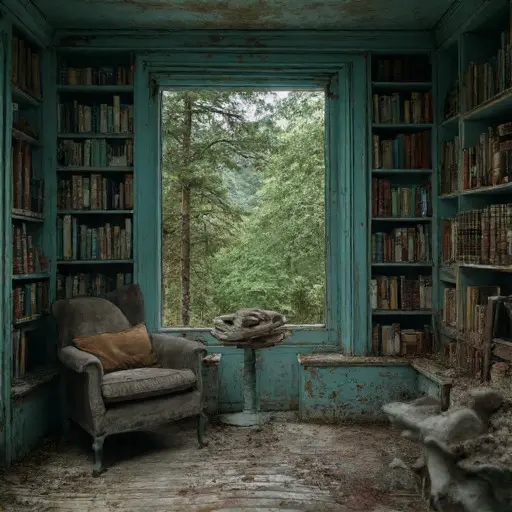
The library occupies one of the most charming additions. Built into an intermediate level along the hillside, it features floor-to-ceiling shelving, large windows facing the forest, and a reading alcove positioned beneath an asymmetrical roofline. Dust coats every surface, but the room remains intact, filled with the quiet atmosphere of long-abandoned study.
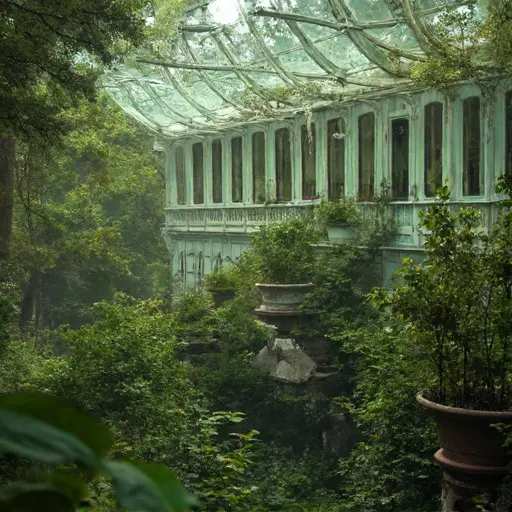
Further upward, enclosed garden rooms project from the structure like glass lanterns hidden among branches. Although no longer maintained, many still contain planters, climbing vines, and traces of carefully arranged indoor greenery.
Higher levels reveal the most dramatic aspects of the home’s evolution. Narrow stair towers connect elevated bedrooms hidden beneath steep roof sections. Small observation rooms occupy corners where later additions met older structures. Suspended walkways cross between wings built decades apart, allowing residents to move through the house without descending to lower levels.
Despite its complexity, the building never feels chaotic. Every addition appears motivated by practical needs, creating an architecture shaped by life rather than design.
Large windows provide uninterrupted views of the forest from nearly every room. The surrounding trees become an ever-present part of the interior experience. Morning mist drifts past glass. Branches sway gently beyond balconies. Filtered light changes subtly throughout the day.
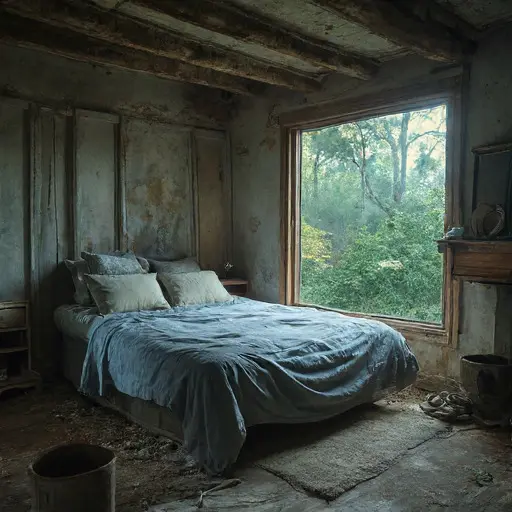
The atmosphere throughout the property remains cool and deeply tranquil. Overcast skies diffuse light evenly across the hillside, eliminating harsh contrasts and allowing details of weathering, vegetation, and architecture to emerge gently. No dramatic collapse or destruction interrupts the scene. Instead, abandonment manifests through stillness, dust, and the gradual integration of nature into human space.
Today, the house stands as a monument to incremental growth. Every staircase, balcony, corridor, and room tells the story of a family adapting its home over generations, building upward alongside the forest that surrounded them. Left behind but remarkably intact, the structure now exists in quiet partnership with the hillside—an architectural record of a century of life slowly merging with the timeless rhythms of the woods.