House of the Braided Floodplain Courtyard
Abandoned Victorian woodland house set within a vast seasonal floodplain forest where shallow waters periodically spread across the land, forming braided channels, damp sandbars, and reflective pools between scattered stands of alder, willow, and oak, the structure designed as a compact but carefully articulated residence organized around a central brick core with two slightly offset wings that step inward to form a protected inner courtyard.
The exterior is composed of layered, flood-adapted materials: a base of pale buff sandstone transitioning into upper levels of smooth lime-rendered masonry. The sandstone foundation appears in warm beige, pale honey, and muted ash-cream tones, slightly darkened at the base by repeated seasonal inundation. Above this, the lime render shifts gently between soft cream, pale jade green, and faded powder blue, its surface chalky and diffused, catching forest light in a muted, atmospheric glow. Subtle weathering marks trace previous flood lines across the lower elevations, giving the structure a quiet sense of geological memory.
The roof is a balanced hipped-and-gabled composition designed for heavy rainfall and humid seasonal cycles. Slate tiles vary in tone from deep slate gray and blue-black to occasional warm copper-brown patches where flashing has oxidized over time. A modest central chimney of red-brown brick rises from the ridge with understated precision, its surface softened by soot and rain exposure, emphasizing function over ornament.
The façade is organized through a calm, slightly irregular rhythm of openings: tall sash windows dominate the central floodplain-facing block, while paired narrower windows are set into the recessed wings that frame the courtyard. Window frames alternate between pale cream, softened sea-green, and muted slate blue, creating a restrained chromatic cadence that subtly responds to changing light and water reflections outside.
The main entrance is placed within the sheltered inner courtyard, accessed through a shallow arched passage that cuts directly through the central volume. The doorway is framed in pale sandstone and fitted with a heavy timber door painted deep moss green, its edges worn into darker olive tones by time and moisture. The courtyard itself is slightly elevated above surrounding ground levels, ensuring protection from seasonal flooding while maintaining a close visual connection to the landscape.
On the floodplain-facing side, a long glazed gallery runs along the upper level, constructed with slender matte-black iron framing and slightly irregular glass panes. These surfaces reflect shifting water channels, tree trunks, and sky fragments in fractured horizontal patterns that change with each seasonal rise and fall of the floodwaters.
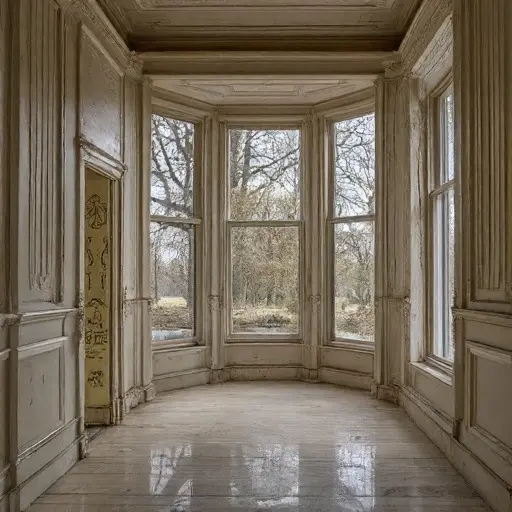
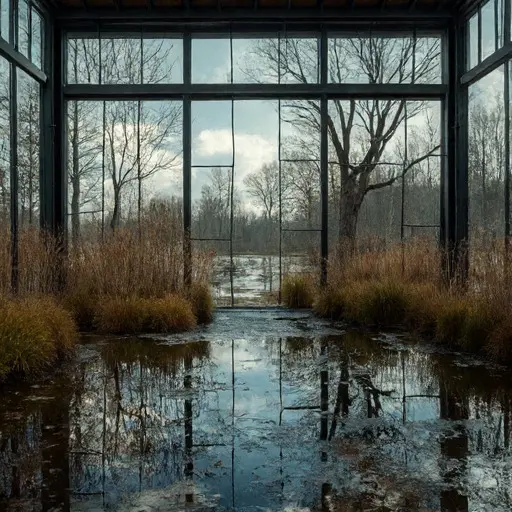
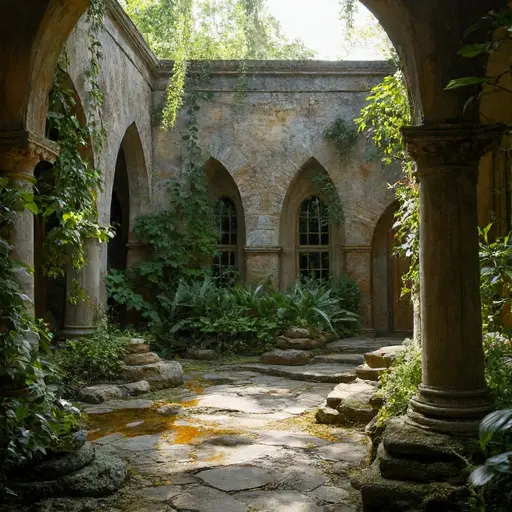
The surrounding landscape is open and fluid, with seasonal water spreading across the forest floor and retreating to leave behind braided channels and reflective basins. Trees rise in loose clusters, their trunks mirrored in shallow pools that shift with rainfall and drainage cycles.
The atmosphere is quiet, humid, and softly luminous, with diffused light filtering through canopy gaps and reflecting off water, stone, and glass. The result is a grounded Victorian woodland floodplain house that feels adaptive, seasonal, and gently integrated into a living hydrological forest system without repeating prior architectural compositions, spatial logics, or material palettes.