Hillsignal Terrace House
Abandoned Victorian hillside telegraph house embedded into a dense forest slope under soft overcast daylight, where evenly diffused light removes harsh shadows and renders every surface in muted, readable detail. The atmosphere is quiet and technical in feeling, with pale brick, white timber framing, and damp hillside soil forming a restrained, functional architectural presence rather than a decorative one.
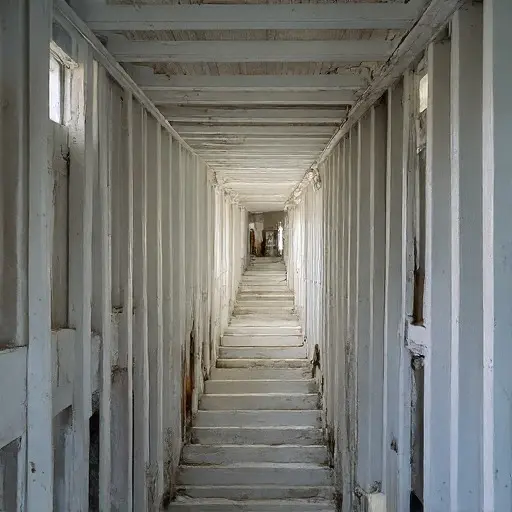
The structure is fully intact and precisely arranged along a steep terraced gradient cut into the forested hillside. Each level of the house is vertically offset in a stepped configuration, following the natural contour of the slope. Short internal staircases and small exterior landings connect the tiers cleanly, producing a layered but coherent geometry that feels engineered for communication work rather than domestic comfort.
The main façade faces downhill and is organized in strict horizontal bands of evenly spaced sash windows. The repetition suggests disciplined construction, but a subtle lateral shift appears in the uppermost row, where window alignment drifts a few inches relative to the lower levels. This misalignment remains structurally consistent, reading as a controlled adjustment rather than an error.
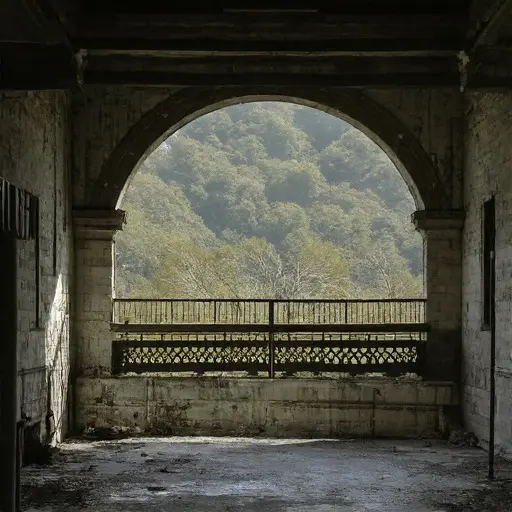
A narrow signal balcony projects from the upper floor, supported by iron brackets anchored into the timber frame. The balcony itself is straight and stable, but its railing pattern contains a quiet repetition anomaly—one decorative segment appears duplicated, continuing the rhythm without altering spacing, as if a fabrication template was reused without correction.
The roof is simple and functional, clad in dark slate with a long central ridge that tracks the building’s length. One end extends slightly further than expected, not due to damage but as a deliberate adaptation to the hillside’s angle. Chimneys rise cleanly from the roofline, evenly spaced and structurally intact, with no visible weather-induced deformation.
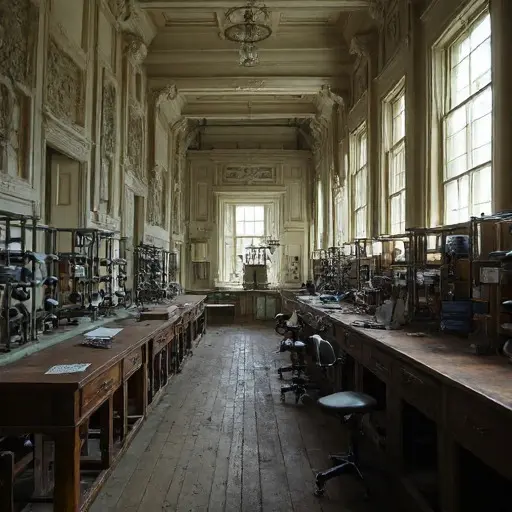
At the rear, a small annex houses the former telegraph room. Through tall windows, empty mounting frames and linear wall brackets are visible, arranged in strict sequences that suggest instrument placement and signal routing. The interior space appears slightly more elongated than the exterior footprint implies, consistent with equipment-driven spatial design.
Windows across the structure are clear but lightly dulled by interior dust. Curtains remain minimal and motionless, with some fully drawn back and others left partially closed. Inside, rooms are narrow, functional, and aligned along a linear communication axis, reinforcing the building’s role as a relay point rather than a residence.
The surrounding forest climbs the hillside in dense but orderly spacing. Trees approach the terraced edges without encroachment, respecting the engineered boundaries of the structure. Grass and low vegetation fill the stepped soil platforms between levels, softening the geometry without obscuring it.
No decay, no collapse, no supernatural elements. The house feels like an abandoned Victorian communication relay station—preserved mid-operation, quietly aligned with terrain logic and the silent expectation of signals that never returned.