Hidden Yamamoto and the Music Room That Misread His Silence
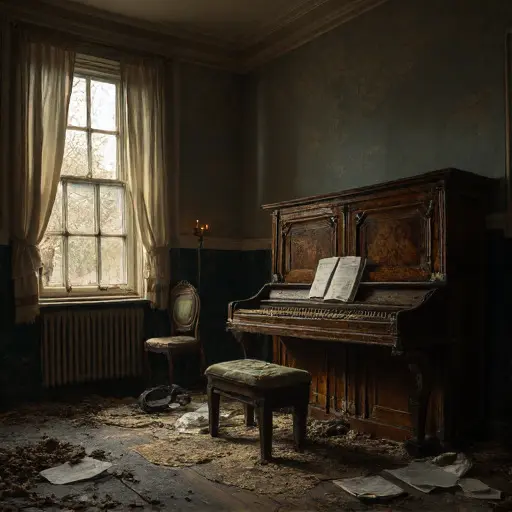
A tempered quiet folds through Yamamoto House, deepest in the abandoned music room, where Katsuro Saburō Yamamoto, a private composer of modest reputation, once layered melodies across domestic stillness. Now the hesitant echo on the open score suggests a final passage he never resolved, lingering like breath withheld between notes.
An Echo in the Composer’s Quiet Devotion
Katsuro, born 1878 in Osaka, learned early harmonics from his mother Yuri Yamamoto, whose cracked tuning fork lies beside the biwa case.
His days passed in gentle pattern: morning finger exercises at the piano, afternoons shaping melodies in pencil, evenings humming counterpoints while pacing the rug. Small disciplines remain—inkpots corked tight, brushes rinsed and laid across a folded cloth, scrolls of manuscript tied in careful knots. Even the cushions on the bench bear the faint imprint of his nightly lean toward the keys, body angled in habitual concentration.
Where His Melodies Slipped from Their Line
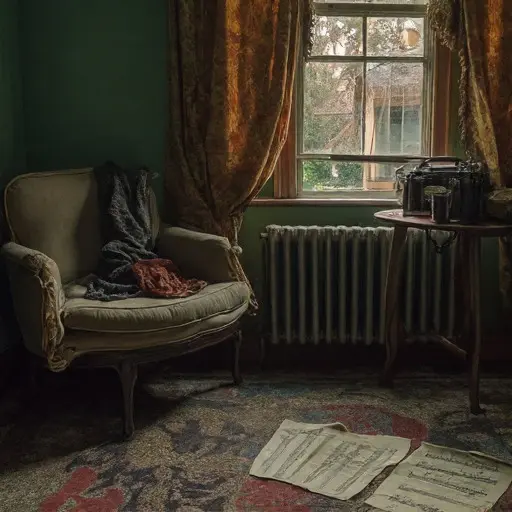
Rumor held that Katsuro’s commissioned piece for a local theater arrived dissonant, an error attributed to his growing disquiet rather than artistic boldness. In the narrow hallway, a music satchel slumps near the wall, its cords tangled. Yuri’s tuning fork shows a new dent along its slender prong. A candle stub has dripped into a hardened spiral on the console. A torn manuscript corner hangs from the banister, graphite smudged as though wiped by an unsteady hand. These fragments drift toward unease without naming what truly shifted inside him.
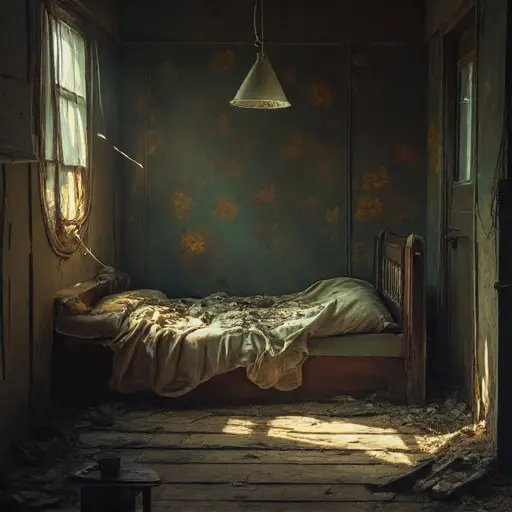
Only the wavering echo on the piano score remains—an unfinished gesture drifting into quiet. Whatever stilled Katsuro’s final composition lingers in these abandoned rooms.
Yamamoto House remains abandoned still.
