Hidden MacLeod and the Smoking Room That Misread His Intent
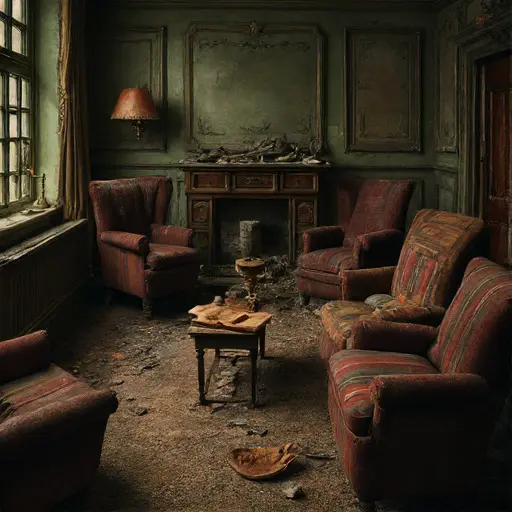
A muted heaviness settles across MacLeod House, deepest in the abandoned smoking room, where Ewan Alastair MacLeod, a modest Scottish poet of local affection, once arranged his drafts among pipes and hearth-embers for want of a calmer study. Now that single lifted page recalls a moment he never allowed himself to finalize.
A Whisper Threading the Poet’s Routine
Ewan, born 1875 in Inverness-shire, learned cadence and tonal restraint from his mother Mairi MacLeod, whose brass-handled penknife lies beside the scorched taper.
His evenings unfolded in gentle sequence: a small fire coaxed to life, a pipe tamped without haste, a verse tested aloud in hushed, rhythmic fragments. His order lingers—charcoal pencils lined by length, drafts weighted with stone coasters, annotated margins pressed flat by a chipped whisky tumbler. Even the worn armchair cushion remembers the slant of his posture, leaning inward as if to listen to the room’s quiet return of his words.
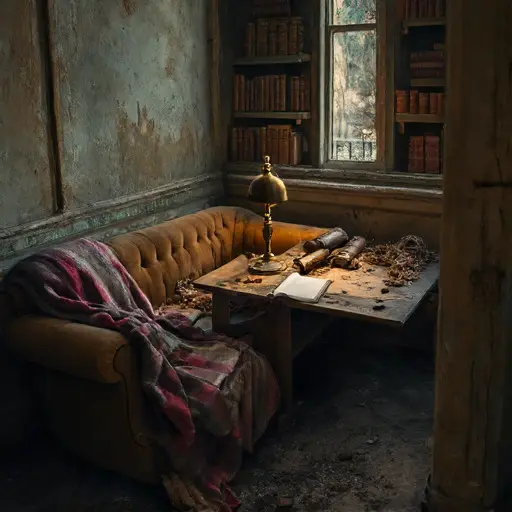
When His Composure Drifted from Its Line
Whispers drifted that Ewan submitted a poem to a cultural society mirroring too closely the phrasing of a revered elder, prompting accusations of dishonor. In the front corridor, a tweed coat lies slumped, cuff torn. Mairi’s penknife bears a new scratch across its handle. A letter sits half-open on the sideboard, seal cracked unevenly. A draft page has fallen against the stair rail, graphite smudged by what seems a restless thumb. These traces do not declare guilt, yet they gather into the suggestion of a man shaken from his steady inward compass.
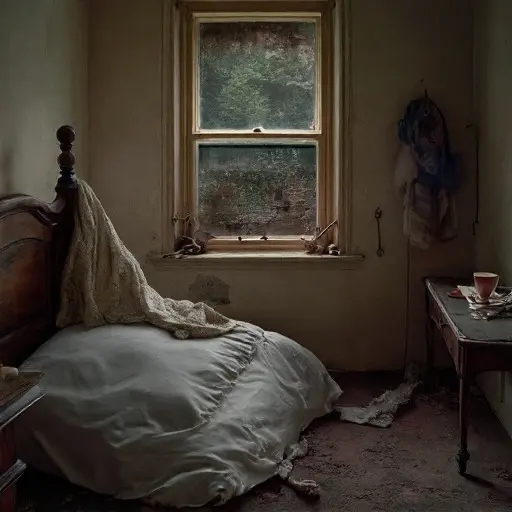
Only the lifted page on the low table remains—its edge raised toward something unresolved. Whatever stilled Ewan’s final verse lingers in these abandoned rooms.
MacLeod House remains abandoned still.
