Hidden Calloway and the Bedroom Where His Stars Went Quiet

A subdued calm drifts through Calloway House, deepening as it reaches the abandoned bedroom, where astronomy’s quiet companions—paper, brass, and lamplight—linger in stillness. Here Edgar Lionel Calloway, an amateur astronomer with fervor exceeding means, spent nights charting foreign constellations across domestic furniture. Now the hesitant arc beneath the fallen chart marks the last curve of thought he never traced to completion.
An Arc Beneath the Astronomer’s Nightly Patience
Edgar, born 1872 in Halifax, learned his earliest star lore from his aunt Winifred Calloway, whose cracked field compass now lies on the bedframe. His evenings opened with trimming lamp wicks; midnight found him charting faint points near window glass; dawn often caught him slumped in quilts, calculations incomplete. His discipline survives in the bedroom’s arrangement—compass needles aligned in a tin box, charts grouped by hemisphere, pencils sharpened to matching lengths. Even the quilt’s rumpled fold holds the memory of a man leaning into starlight rather than sleep.
When His Observations Lost Their Bearing
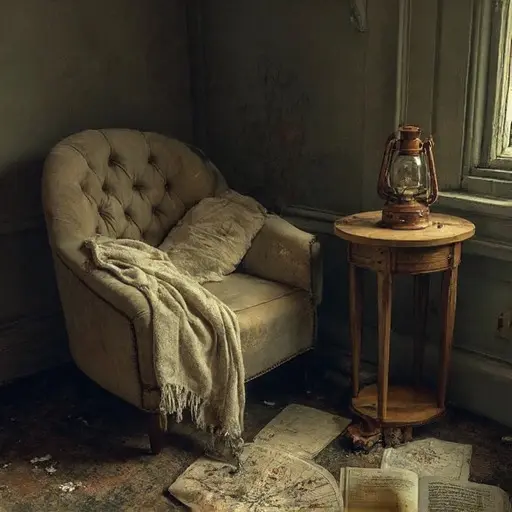
Neighbors whispered that Edgar misreported a navigational star to a shipping agent, indirectly guiding a vessel off course. He denied involvement, yet in the hallway alcove, his greatcoat remains crumpled beside a discarded notebook, its final page torn abruptly. Winifred’s field compass is missing its lid. A candle stub has melted across the floorboard in a wavering trail. A rolled celestial map sits unfurled, its margins smudged by trembling fingertips. None of it proves fault, but each detail leans toward a burden he carried alone.
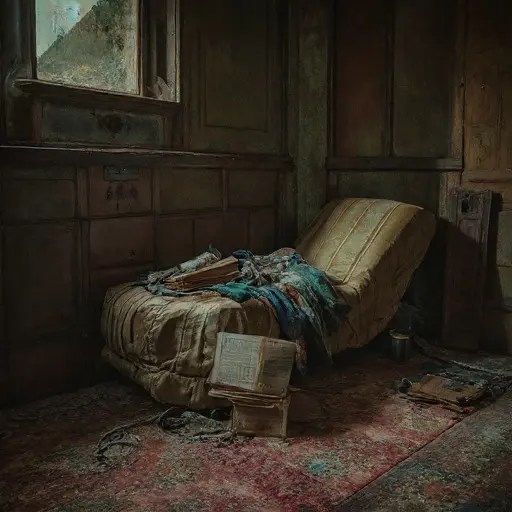
Only the faint arc beneath the fallen chart endures—an unfinished sweep of the heavens, stopped before meaning emerged. Whatever stilled Edgar’s final night among his scattered stars lingers in these abandoned rooms.
Calloway House remains abandoned still.
