Hawthorne Mansion Left Empty After an Inheritance Collapse
When Hawthorne Mansion was completed in 1908, it reflected the prosperity of textile manufacturer Charles Hawthorne, who relocated his family from a crowded industrial city to a secluded woodland estate. He lived there with his wife Margaret, their two sons, and Margaret’s widowed sister. The expansive Queen Anne residence quickly became the center of family life, with formal dinners, holiday gatherings, and business discussions filling its elegant rooms. Every fireplace was lit through winter, servants polished the woodwork daily, and household ledgers documented a carefully managed estate whose expenses were comfortably supported by the family’s thriving mills.
<img src=”https://beyondvisit.
com/wp-content/imagecontent/uploads/abandoned victorian house 73610790.webp” alt=”” />
The dining room reflected the confidence of a family whose future appeared secure. Yet beneath the orderly routines, economic conditions were beginning to shift. Textile contracts became less reliable after the First World War, while increasing competition steadily reduced profits. Charles postponed decorative renovations and delayed replacing aging heating equipment, believing business conditions would soon improve. Although little had visibly changed inside the mansion, financial pressure had quietly begun to reshape everyday decisions.
Decline Spreads Through the House
Following Charles Hawthorne’s death in 1926, ownership passed jointly to his sons, whose disagreements over the estate soon led to costly legal disputes. Estate taxes increased while maintenance bills accumulated faster than available income. Coal deliveries became irregular, several servants were dismissed, and portions of the upper floors were permanently closed to reduce heating expenses. Unopened invoices gathered on hallway tables, leaking pipes stained ceilings, and once-regular repairs were repeatedly postponed as the family struggled to preserve appearances despite mounting financial obligations.
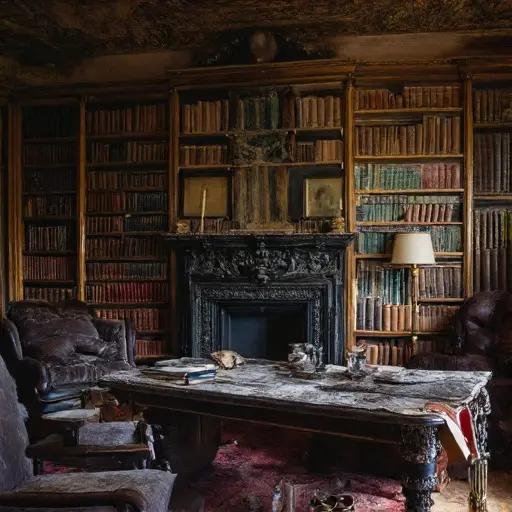
By the early 1930s, the family’s presence within the mansion had noticeably diminished. Entire guest suites remained locked for years, valuable furniture was quietly auctioned, and expensive decorative pieces disappeared one by one. Margaret occupied only a small group of rooms near the kitchen while the remainder of the house gradually fell silent. Rain entered through damaged roofing, encouraging dampness that spread behind decorative plaster and fine wood paneling. Deferred repairs multiplied faster than the estate could afford them.
The Final Departure
In 1941, after prolonged court proceedings and continuing financial losses, the remaining members of the Hawthorne family left the mansion permanently. Many belongings were removed, yet countless everyday objects remained exactly where they had last been used. With no caretaker, broken windows admitted moisture, birds, and insects. Seasonal weather accelerated deterioration inside the once-elegant residence, while legal uncertainty prevented any serious effort to restore or repurpose the increasingly neglected property.
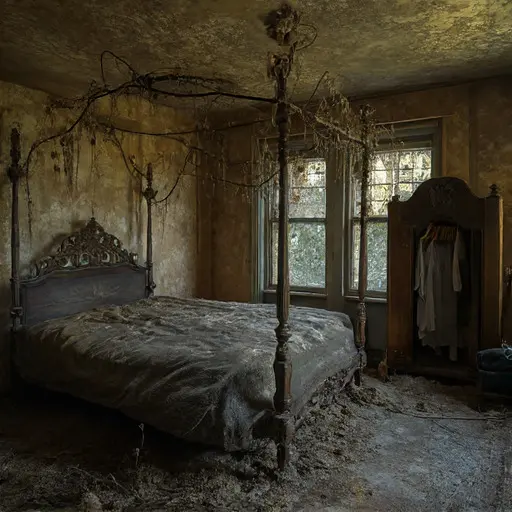
No restoration ever followed the mansion’s abandonment. Ownership remained unresolved through successive legal claims, leaving the property without meaningful maintenance or protection. Each passing year allowed water, vegetation, and structural decay to erase more evidence of the Hawthorne family’s former life. Today the mansion still stands alone within the surrounding woodland, its interiors slowly deteriorating in silence, with no descendants returning and no restoration ever begun.