Haunting Mazzini Glass-Room and the Shard That Shifted
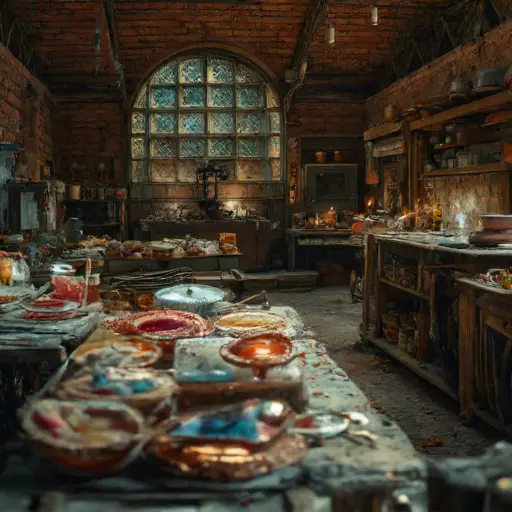
A muted gravity envelopes Mazzini House, heaviest in the glass-room, where heat once shaped breath into luminous forms. Here Lucia Amedea Mazzini crafted blown vessels for coastal traders and small cathedrals. Now the shifted shard glints softly, suggesting a final uncertainty left unresolved.
Even the furnace bricks seem to remember the cooling of a fire that ended abruptly.
Gleam in the Glassblower’s Devoted Pattern
Lucia, glassblower, born 1878 near Murano, learned her art from her uncle Giancarlo Mazzini, whose scorched apron still hangs beside the furnace. Each morning she sifted powders; by noon she marvered molten gathers; evenings she cooled fragile forms on padded boards. Evidence of her practiced rhythm remains—pipes sorted by length, jacks and paddles aligned with even spacing, annealing shelves orderly despite thin ash dust. The marks on the marver show her surety: long, steady pulls once etched into every surface, now still.
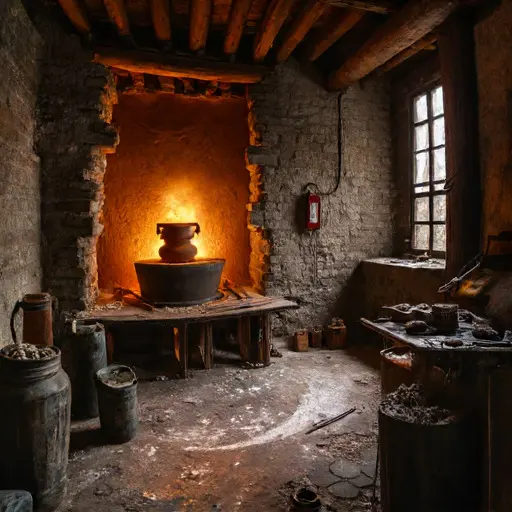
When Her Fire Lost Direction
Rumors murmured that Lucia’s latest commission—a chalice for a bishop—showed a warped lip, its rim refusing symmetry. In the cooling nook, padding cloths lie bunched, corners twisted. Giancarlo’s apron bears a fresh tear along its lower seam. A calcined batch of glass rests half-stirred in its crucible, as though she withdrew mid-turn. A blow mold stands ajar, its hinges strained beyond common wear. Even a tray of finishing powders is left uncapped, as if she could not bring herself to complete the last refining step.

Only the subtly shifted shard remains, catching the faintest glimmer as though absorbing her last hesitation. Whatever halted Lucia’s final shaping lingers in the glass-room’s hushed warmth.
Mazzini House remains abandoned still.
