Haunting Lefebvre and the Sewing Room That Forgot Her Touch
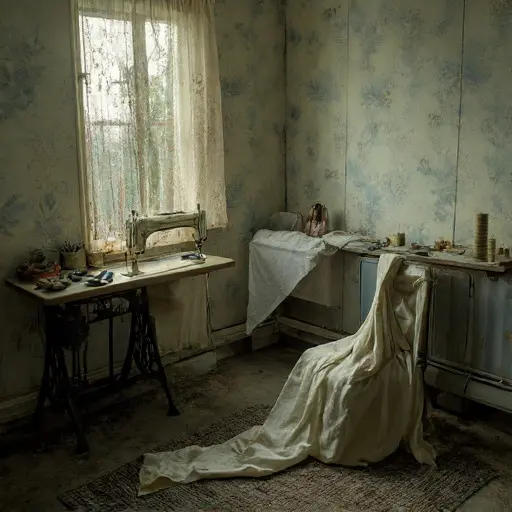
A gentle stillness gathers inside Lefebvre House, deepest in the abandoned sewing room, where the domestic hum of needle and thread once carried the quiet ambitions of Élodie Camille Lefebvre, a private costumer for charitable performances who worked without studio or stagecraft—only this modest room. Now the wavering shadow of stitches drapes the garment’s hem with a question left unanswered.
A Shadow Beneath the Seamstress’s Steady Habits
Élodie, born 1877 in Rouen, learned embellishment from her grandmother Lucienne Lefebvre, whose thimble—dent marked and dulled—lies in a teacup on the sill.
Her evenings followed a soft cadence: choosing trim by lamplight, marking hems with chalk dusted across her sleeves, pausing only when the cuckoo clock chimed from the hallway. Her order endures in the sewing room’s remains: ribbons sorted by rarity, shears wrapped in a linen scrap to blunt oxidation, needles aligned in a narrow case. Even the chair cushion’s worn corner recalls her habitual posture, leaning slightly forward in focus.
When Her Composure Lost Its Thread
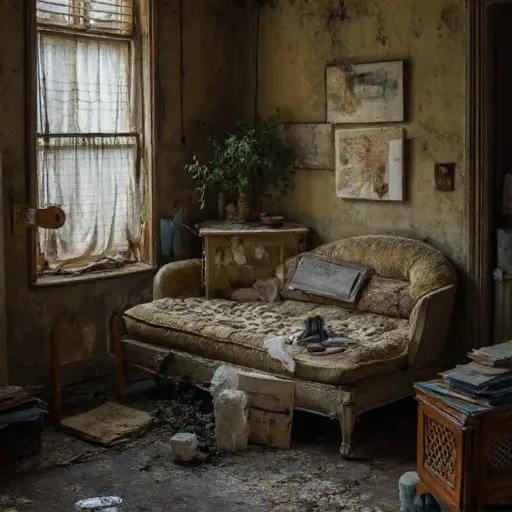
Rumors said Élodie altered a costume improperly for a charity matinée, causing embarrassment for a patron who blamed her rather than the hurried schedule. In the corridor outside, a tape measure lies half-coiled, as though dropped mid-step. Lucienne’s thimble pouch sits torn at the hinge. A basket of unused trim leans against the wall, ribbons spilling toward the floor. A chalk wheel lies cracked, powder trailing in a broken line. These hints gesture toward a burden she carried quietly, though no single mark reveals its root.

Only the wavering shadow of stitches remains—an abandoned seam drifting from its rightful line. Whatever stilled Élodie’s careful hand persists in the sewing room’s dusty hush.
Lefebvre House remains abandoned still.
