Gryphon-Gilt: The Cartographer’s Final Frontier
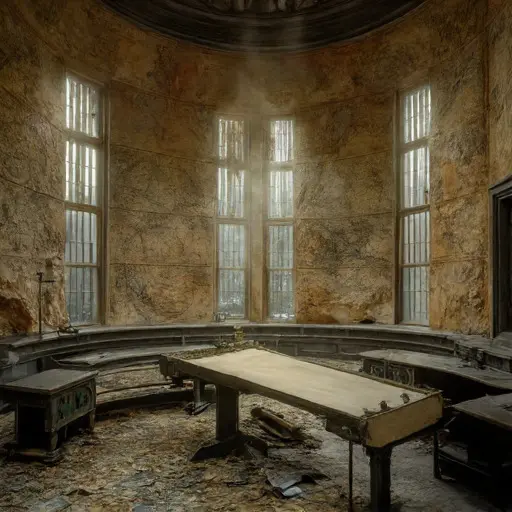
The atmosphere inside Gryphon-Gilt was crisp, dry, and surprisingly light, lacking the heavy scent of decay, instead smelling faintly of old paper, shellac, and brine. The name, combining a mythical beast with the concept of gold leaf, suggested both ambition and delicate art. This abandoned Victorian house felt like a vessel adrift, moored in time but constantly seeking to escape. The light, though dim, seemed to fall on surfaces in precise, geometric patches, giving the place an air of clinical, quiet scrutiny.
The last resident was Captain Arthur Bellamy, a wealthy, eccentric, and fiercely dedicated private cartographer. Bellamy’s profession was the mapping of uncharted territories—not of physical space, but of the minute, disputed corners of the British Empire’s influence, driven by a desire to bring perfect, objective order to the globe. He built Gryphon-Gilt to house his massive collection of maps and measuring instruments, viewing the manor itself as the central hub of a global network. His personality was relentlessly focused, introverted, and obsessed with the notion of boundary—the fixed line between the known and the unknown.
The Charting Chamber
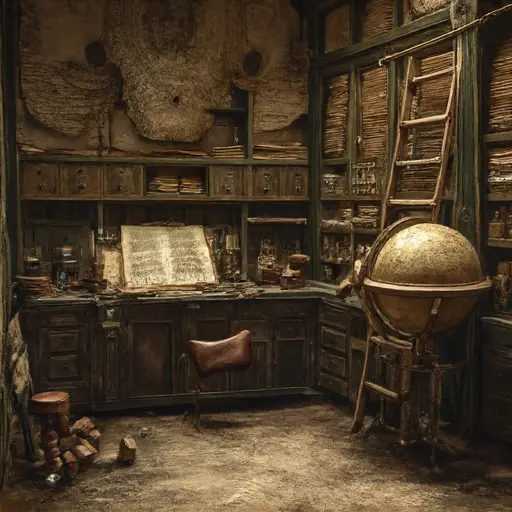
Bellamy’s private journals, hidden inside a hollowed-out drawer marked ‘Unverified Coordinates,’ reveal his descent. He grew tired of mapping the world’s physical boundaries and began attempting to map the unmappable: the flow of air currents, the migration paths of dreams, and the invisible lines of psychic influence. “The true limits are not shorelines,” one entry read, “They are here, in the static between thoughts. I must chart the final, silent boundary.” He spent his last months meticulously drawing blank white spaces on his charts, labeling them ‘Terra Incognita’—unknown land.
The house preserves his intense focus. In the library, hundreds of books are arranged not by title or author, but by the geographical location they reference, creating a bizarre, three-dimensional index of the world.
The Compass’s Final Rest in the Abandoned Victorian House
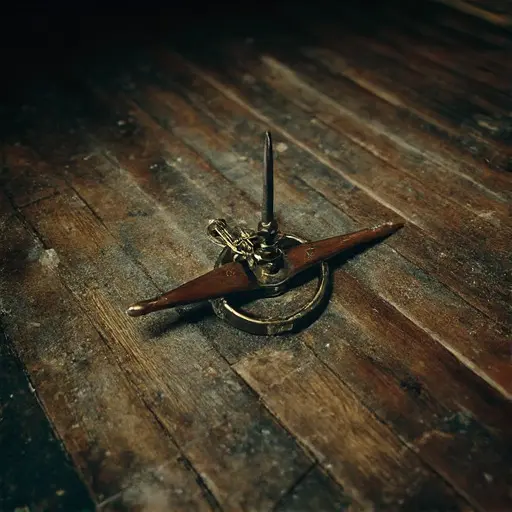
Captain Bellamy’s disappearance was noted only when the weekly delivery of mapping vellum stopped being collected. His house was locked from the inside. When they finally gained entry, they found the manor immaculate, every map in its place, every instrument accounted for—except one. His massive, personal brass surveying compass, the tool he used for all his initial coordinates, was missing from its stand.
The only remaining clue was found in the small, empty room near the turret: the compass, lying inverted, pointing directly into the floor. This abandoned Victorian house stands as a magnificent, silent tomb to the man who sought to map everything, but who ultimately, and perhaps deliberately, charted his own final, perfect vanishing point.
