Glassmere Greenhouse House Complex
Abandoned Victorian greenhouse-house complex resting in a quiet forest clearing under soft overcast daylight, where evenly diffused illumination creates a muted, glass-softened atmosphere with no harsh shadows. The structure is fully intact and carefully preserved, formed from pale iron framing and large arched glass panels that enclose an entire domestic Victorian residence within a controlled botanical shell. The scene feels suspended in a long pause of cultivation, where light, structure, and containment define the entire architectural logic.
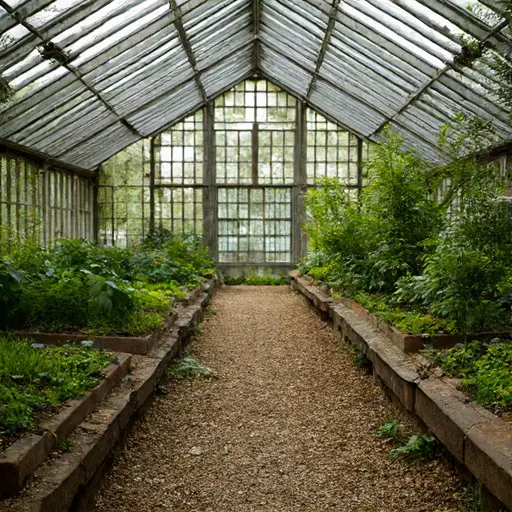
The greenhouse forms a long rectangular volume capped by a continuous vaulted glass roof that runs the full length of the structure. Tall iron ribs rise at regular intervals, holding clouded but unbroken panes that diffuse the gray sky into a uniform interior glow.
The geometry is disciplined and industrial, yet softened by age, producing a layered transparency where reflections and interior forms overlap without confusion.
At the center of this glass enclosure sits the Victorian residence itself, a compact two-story house built from pale siding and a simple stone foundation. It is fully embedded within the greenhouse volume, not attached but enclosed, as if the conservatory was constructed around it rather than added later. The house maintains its own architectural identity while existing entirely within a separate environmental system.
A subtle irregularity appears in the greenhouse structure: one section of the iron arch spacing tightens slightly, compressing the rhythm of the frame without breaking continuity or stability. This minor deviation creates a gentle visual tension in the glass canopy, though the internal house remains perfectly level and unaffected by the shift.
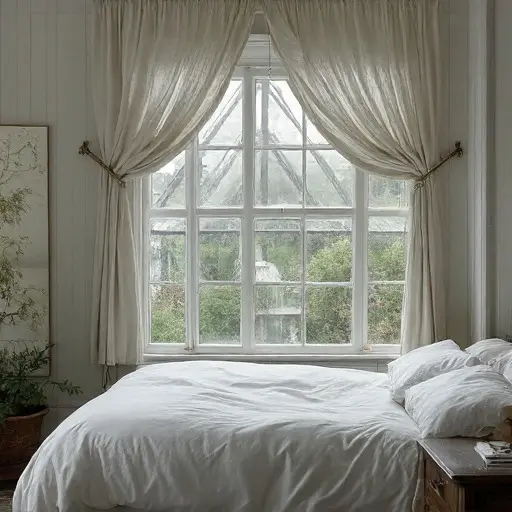
The residential portion features evenly spaced sash windows and a centered door opening onto an internal gravel walkway. The windows are clear but lightly dusted, with curtains that hang still and partially drawn. Interior rooms are empty and minimally furnished, with reflections from the greenhouse glass layering over the interior surfaces, creating a soft double exposure of domestic space and botanical enclosure.
The greenhouse floor is composed of pale gravel laid in strict rectangular plots, once used for organized cultivation. Most vegetation has long since disappeared, leaving behind faint soil boundaries and rusted irrigation channels embedded in the ground. The geometry of the planting system remains visible even in absence, reinforcing the structure’s original purpose.
Light filters through the vaulted glass roof in a uniform gray diffusion, producing a calm, ambient brightness that eliminates directional shadow. The transparency of the enclosure allows overlapping views of interior rooms, iron ribs, and exterior forest edges beyond the glass, creating a controlled visual layering without distortion.
The surrounding forest remains at a respectful distance, forming a natural perimeter outside the greenhouse shell. No vines penetrate the glass, and no vegetation disrupts the structure’s boundary. The clearing feels deliberately maintained by absence rather than intervention.
Inside the greenhouse-house, the residential rooms remain quiet and preserved.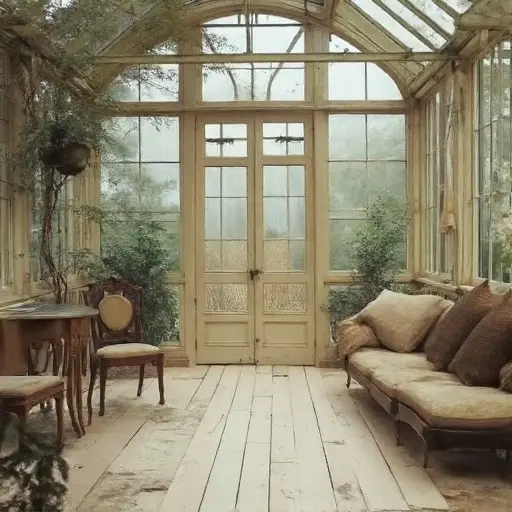
No decay, no collapse, no supernatural elements. The house feels like an abandoned botanical residence designed for controlled cultivation—preserved inside its own glass ecosystem, quietly suspended in functional stillness where domestic life and greenhouse structure share the same contained light. Cinematic realism, exploration-game environment aesthetic, grounded materials, and subtle enclosure-driven architecture focused on transparency, reflection, and containment rather than distortion or ruin.