Forgotten Echoes of the Kellen Hearthstone
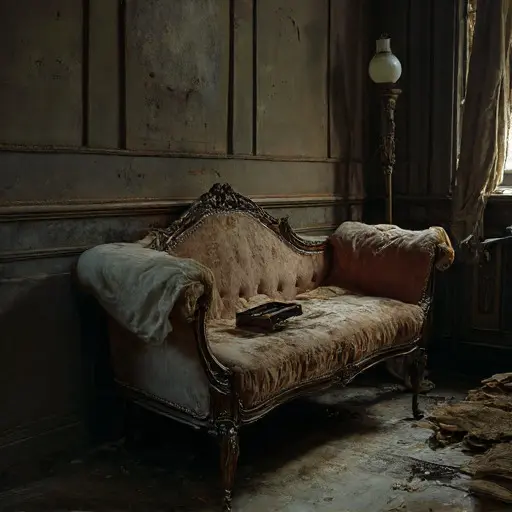
The air in the Kellen Hearthstone is thick with the sediment of time, a gritty, mineral dust that coats the tongue and obscures the fine detailing of the ornate plasterwork. Stepping into the house is to interrupt a century-long, unmoving scene. The Front Hall is an immediate declaration of the house’s abrupt abandonment; an oak hat rack still holds a woman’s dark felt bonnet and a silk-lined coat, the fabric brittle and clinging to the brass hooks.
The silence is profound, broken only by the faint, dry rustle of old papers shifting in the drafts that crawl through broken seals. The house holds the story of Dr. Alistair Kellen, a narrative told not through ghosts, but through the objects he left behind when he simply ceased to occupy his meticulously ordered world.
Dr. Kellen’s Private Ruin
The proprietor of the house, Dr. Alistair Kellen (1862–1905), was a respected but reclusive physician specializing in internal medicine. His professional life was defined by rigorous logic and a profound commitment to evidence; his social role was that of a quiet, influential bachelor who hosted infrequent but lavish intellectual gatherings in his formal Dining Room. Dr. Kellen’s temperament was studious, cautious, and intensely private, a facade of emotional restraint that hid a deep-seated fear of inherited illness. His family structure was minimal: only his younger sister, Eleanor, who lived abroad.
The house, a repository of his intellectual life, centered around the First Floor Medical Library. This room was less a library and more a private archive, where every medical journal and textbook was cataloged by hand. Dr. Kellen’s daily habits were rigid: mornings in the library, afternoons at his practice, and evenings spent meticulously polishing his scientific instruments in the small Back Laboratory adjacent to the kitchen. The house began to subtly change in 1903, evidenced by the increasing clutter of empty, labelled tonic bottles and discarded medical notes in his waste bins—evidence of his quiet, self-diagnosed battle with a debilitating condition he refused to acknowledge publicly. This self-denial and the refusal to seek help from a peer directly led to his incapacitation and the house’s abandonment.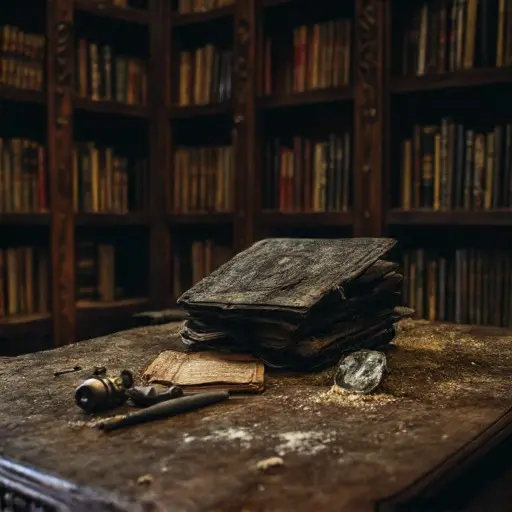
The Untouched Laboratory Bench
The most telling room is the small, sealed Back Laboratory. Dr. Kellen, refusing outside consultation, converted this space into his private sickroom. On the central, slate-topped Laboratory Bench, everything remains precisely where he left it. A small, brass microscope sits centered on the bench, focused on a blank slide. Surrounding it are racks of empty glass vials, a crucible containing a scattering of unidentifiable, burnt remnants, and a small, leather-bound notebook—his private medical log—open to a final, sparse entry dated late 1905. The entry contains no medical jargon, only three lines of highly disciplined, cursive script detailing his sister’s address and a single, final instruction: Do not enter the library.
The Stained-Glass Window in the Stairwell
The final evidence of the doctor’s struggle is not in the library, but in the large, beautiful, stained-glass window set high in the Stairwell Landing. This window, depicting Aesculapius, the god of medicine, is cracked across the face of the figure, a long, spidering fracture that seems to bleed light. Beneath the window, on the dusty landing floor, lies a stack of thick, unopened letters from his sister Eleanor, addressed from Paris. Dr. Kellen’s intense privacy meant he had long since cut off communication, convinced that any contact would expose his condition and compromise his public reputation. The letters, unopened and stacked neatly by a housekeeper who simply ceased to work there, represent the final, tragic severing of his human connection.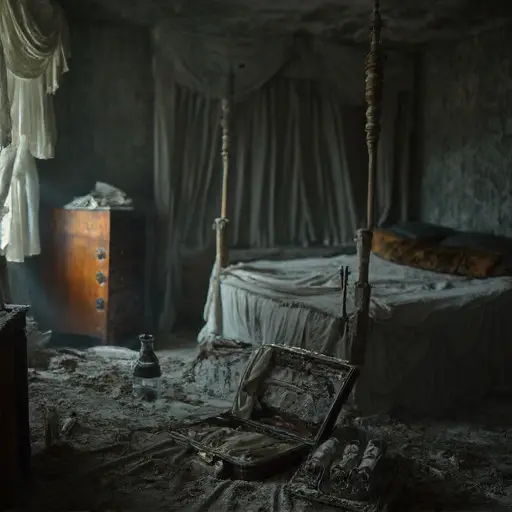
The doctor’s death was as private as his life. Eleanor, finding only silence and the ominous, locked front door on her eventual return, honored her brother’s strange final request—the note found on the laboratory bench—and made no attempt to inventory or enter the library. She quietly settled the estate, paying off creditors and instructing the local attorney to simply seal the doors. The Kellen Hearthstone has stood ever since, its costly possessions, its medical secrets, and its vast, silent library all locked inside, a monument to a lifetime of fear and self-imposed isolation.
