Forgotten Demir Map-Drafting Loft Where the Grids Would Not Hold
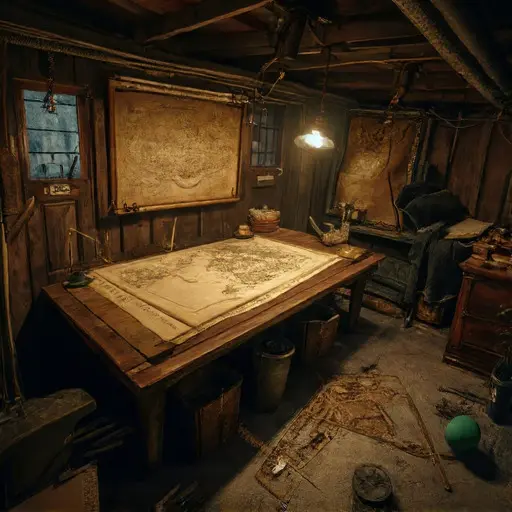
The loft lies steeped in the dry hush of old ink. Lines on the unfinished charts waver under the lamp’s thin glow, as if revised too many times. A reed pen clings to the lip of an inkstone, its nib cracked.
Faint smudges mark the drafting table where a trembling wrist must once have landed. Nothing here resolves: only beginnings, half-measures, and the suspicion of a choice never completed. In the quiet, the paper edges curl like a held breath.
A Cartographer’s World of Grids and Resolve
This map-drafting loft preserves the measured life of Kemal Hasan Demir, cartographic draughtsman and part-time surveyor, born 1876 in a coastal town near Izmir. Raised among modest clerks, he apprenticed under a traveling mapmaker who taught him the art of triangulation and respectful exactness. His sister, Leyla Demir, appears in a brass token tucked under a weight stone—its engraved tulip worn smooth.
Kemal’s routine was precise: dawn drafting under steady lamplight, midday comparisons with survey notes, evening corrections traced by compass. His tools remain arranged by discipline—straightedges sorted by length, plane-table alidades wrapped in linen, ink mixed to a walnut hue he trusted for clarity. In his best years, merchants and minor officials sought his coastal charts for safe travel through narrow inlets.
A Career Drawn True, Then Slanting
The loft once thrived with purposeful order. Vellum sheets from Istanbul shipping houses lie stacked beneath a weight carved with Ottoman crescents. A lacquered drafting box contains imported French protractors. Survey logs, bound in soft leather, rest on a stool, each entry penned in immaculate Ottoman Turkish script. Kemal’s early work shows crisp bearings, loyal triangulations.
But the careful geometry frayed. One chart of a harbor mouth shows an inlet drifting off its intended angle. A set of bearings has been crossed out, then restored, then replaced with hesitant strokes. A compass point is bent—slightly, but ruinously for precise work. A letter pressed beneath a chart reads only: “Requested revisions conflict with measured truth.” Its ink spreads into the fibers of vellum, the words smudged by a thumbprint.
Rumors stirred: officials questioning a disputed boundary line or demanding adjustments to better suit political needs. The charts themselves display the pressure—shorelines re-scribed, hills thickened to improbable prominence, bearings reversed then re-reversed.
The TURNING POINT That Distorted His Bearings
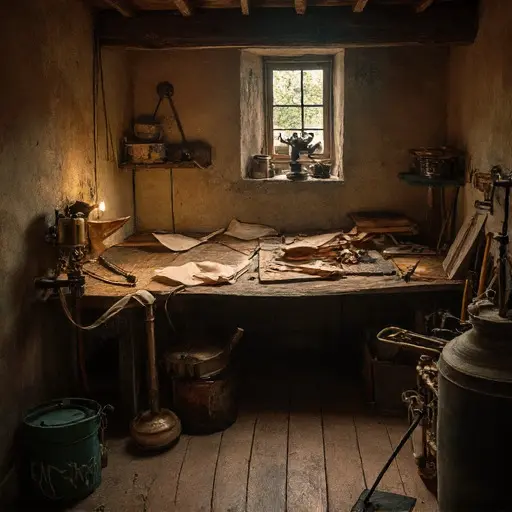
One late winter evening changed the tenor of the loft. A primary coastal chart lies half-pinned, its central meridian scored too deep, slicing the vellum fibers. Beside it, a set of triangulation notes is torn across the midpoint. A reed pen, splintered near the tip, rests in a shallow pool of ink spread like an erasure attempt.
Neighbors whispered of a heated exchange: a commissioner accusing Kemal of providing “inconvenient” measurements, insisting the coastline bend differently on paper than in real geography. Payment was threatened; reputation, too. Near the table’s edge, a slip of paper bears a trembling line: “They ask for the shape they want, not the one that is.”
A wooden straightedge lies warped, as if soaked too long. The compass set’s hinge is stiff with dried ink, as though he snapped it shut in haste. Even the lamp stutters, its wick trimmed unevenly, leaving soot smudges on the rafters.
A Small Cache Behind the Cabinet of Instruments
Behind the cedar cabinet, a thin board shifts with a dry creak. Inside the recess rests a folded vellum sheet. Unrolled, it reveals a private map—carefully rendered hills, clean coastlines, bearings true to his original measurements. But one segment ends abruptly: a cove left blank, its contours only ghosted.
Pinned to the vellum is a note in Kemal’s careful Ottoman script: “For Leyla—unaltered. Keep what they would not accept.” The writing dips near the final words, as though the quill hesitated at the truth he refused to bend.
Beside the vellum lies a small, beautifully sharpened graver for plate engraving—unused, gleaming in contrast to the rest of the room.
The Last Quiet Bearing
Inside a leather notebook slipped between atlas spines lies one final entry: a single bearing line, precisely drawn, ending without annotation. Beneath it he wrote: “Angle holds. I could not.”
Nothing more.
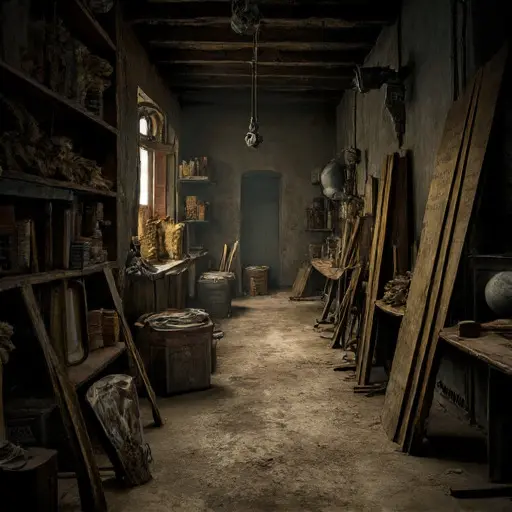
The map-drafting loft settles into aching stillness, parchment edges lifting in the faintest draft.
And the house, holding its abandoned cartographer’s room, remains abandoned.
