Forgotten Ben Youssef and the Sand Room Where His Measures Fell Quiet
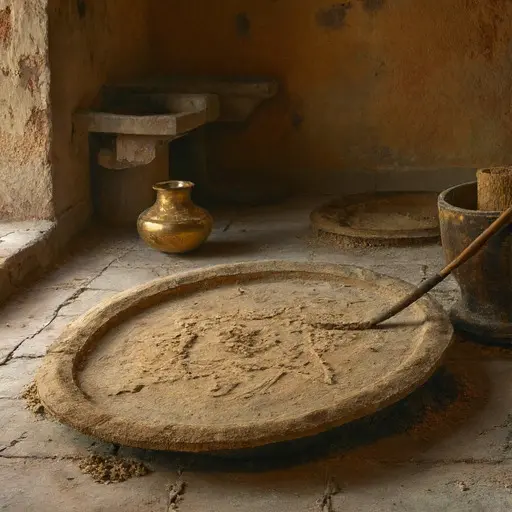
A muted, grain-soft hush fills Ben Youssef House, heaviest in the abandoned sand room, where Farid Abdelhak Ben Youssef, a Moroccan geomancer and amateur desert surveyor, once translated terrain into domestic rituals. Now the broken mark in a once-perfect pattern holds the only clue to a question he never resolved.
A Mark in the Surveyor’s Patient Patterning
Farid, born 1872 in Marrakesh, learned to read dunes and contours from his uncle Hassan Ben Youssef, whose dented compass rests on a ledge near the basin.
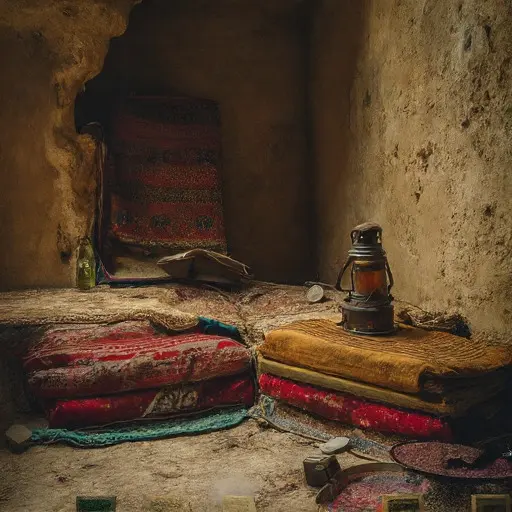
Farid practiced mapping and augury here each evening: smoothing sand into level fields, scoring lines of measurement, and testing angles by lantern glow. Order lingers in small traces—rods stacked by length, sketches tucked into ceramic jars, a coil of string stretched taut across a tray’s rim. Even the shallow dip at the center of the floor mats remembers the angle of his posture, kneeling to revise a design he seldom trusted.
Where His Certainty Slipped from Alignment
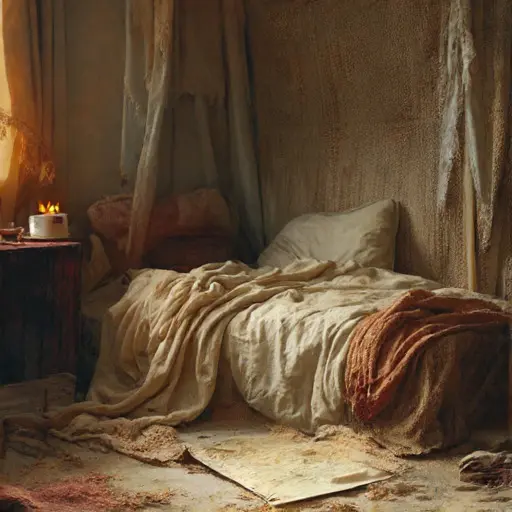
Neighborhood rumor claimed Farid misjudged a parcel of land for a merchant’s estate—an error in slope readings that led to costly corrections and lingering grievances. In the arched hallway, Hassan’s compass pouch lies torn, its clasp broken. A measuring cord curls in a loose spiral on the tiles. A folded sheet of coordinates bears smudged numerals along its final column. A small vial of colored sand has cracked, spilling grains in a thin trail to the threshold. None of these remnants clarify the miscalculation, yet together they lean toward quiet accusation.
Only the broken mark in the sand tray remains—an interrupted geometry, heavy with unspoken meaning. Whatever stilled Farid’s final survey lingers in these abandoned rooms.
Ben Youssef House remains abandoned still.
