Forgotten Al-Masri Calligraphy-Room and the Stroke That Strayed

A muted quiet inhabits Al-Masri House, heavy in the calligraphy-room, where fragrance of gum arabic lingers in the rafters. Here Karim Hassan Al-Masri once shaped ceremonial scripts sought by scholars and merchants alike. Now a wandering curve on the upper sheet stands as the thin dividing line between devotion and a thought he never completed.
A Curve in the Scribe-Painter’s Discipline
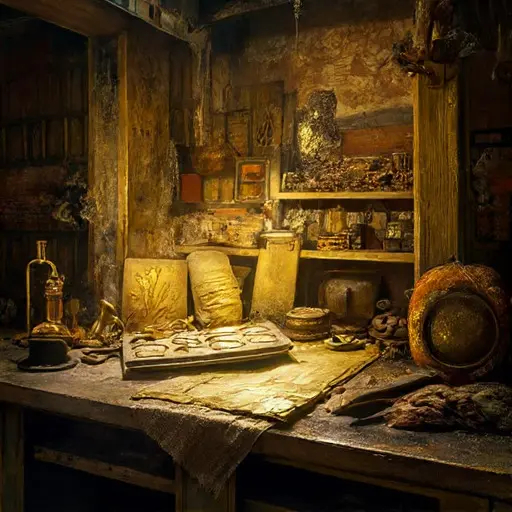
Karim, calligrapher, born 1877 in Fustat, trained under his aunt Shahira Al-Masri, whose carved burnisher rests atop a vellum stack. Each day he blended ink at dawn, practiced warm-up strokes by noon, and layered formal scripts well past lamplight’s rise. His precision remains visible: reed pens organized by thickness, gold leaf squares pressed between parchment slips, strokes aligned across hanging practice sheets. The room still holds the pulse of his steady craft—unhurried, devout, framed in quiet balance.
When His Line Lost Its Certainty
Whispers rose that Karim mis-rendered a patron’s ancestral motto—an error he would have deemed impossible. In the side cupboard, a vellum roll lies crushed at its center, its fibers strained. Shahira’s burnisher shows a fresh notch along its handle. A jar of soot pigment is left uncapped, grains scattered in an uneven crescent. A practice panel bears strokes smudged by an unsteady thumb. These shifts drift around a tension he never voiced, each clue softly brushing the edge of doubt without naming it.
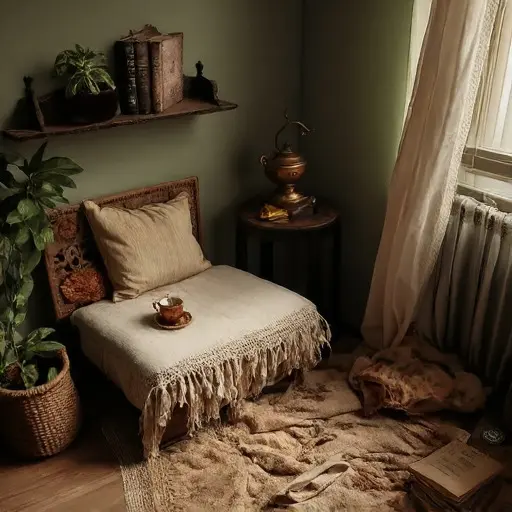
Only the wandering stroke remains, its fragile curve strayed from intention. Whatever stalled Karim’s final inscription lingers in the calligraphy-room’s softened hush.
Al-Masri House remains abandoned still.
