Floodplain Botanical Observatory
Abandoned Victorian house, pale kiln-bone stucco with fine sand aggregate visible under close light, deep smoke-tea stained cypress timber that has naturally grayed into layered browns and silvers, and forged ironwork in aged graphite with subtle crystallized rust patterns along structural stress points. A compact Victorian botanical research residence sits within a reclaimed floodplain where seasonal inundation once defined the building’s relationship to land, water, and plant life. The structure is slightly raised on a low stone plinth, giving it a restrained elevation above damp ground while maintaining a grounded, utilitarian presence within the open wetland basin.
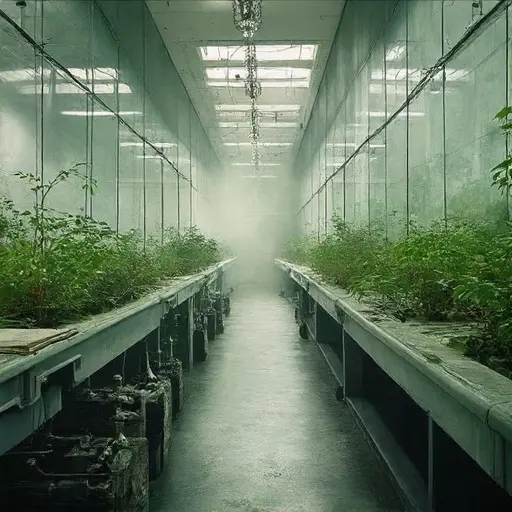
The architecture is organized with scientific clarity rather than ornamentation. A central rectangular main house forms the core working and living space, while a long glass study corridor extends along the southern exposure for continuous plant observation throughout changing daylight cycles.
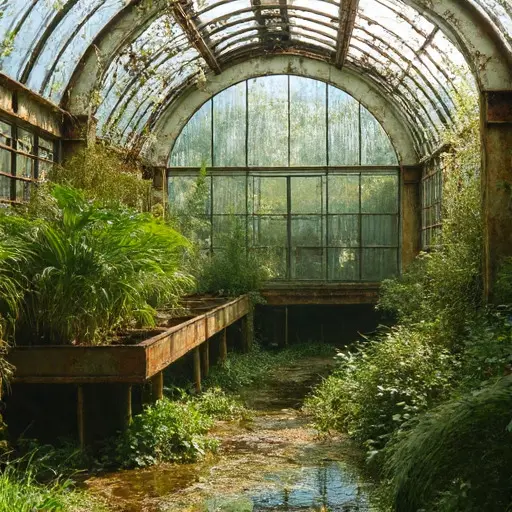
A curved greenhouse wing attaches to one side, subtly bending its footprint to maximize solar gain across the day. The roof is steep slate and heavily weathered, with uneven tonal stratification—deep charcoal near ridge lines where moisture collects, and softened ash-gray where rainfall has repeatedly leached mineral content. Copper drainage systems have oxidized into muted green-brown streaks that trace real water behavior down stucco surfaces.
The façade is fully exterior and materially precise. Kiln-bone stucco reveals fine erosion patterns caused by wind-driven moisture and seasonal flooding, with faint horizontal banding marking historic water levels across different years of inundation. Cypress timber framing is structurally exposed and functional, showing grain lift, slight warping, and layered weathering where protective finishes have thinned over time. Iron elements—brackets, hinge plates, greenhouse ribs, and anchoring fixtures—display realistic corrosion gradients, most intense near ground contact zones and gradually reduced higher on the structure where airflow accelerates drying.
The surrounding floodplain is wide, flat, and ecologically active rather than decorative. Shallow water channels weave through the terrain in irregular branching patterns, forming reflective surfaces that shift continuously with wind and atmospheric pressure. The ground alternates between saturated soil, reed beds, and low grasses, creating a complex hydrological mosaic that defines movement, growth, and decay. Reeds bend in unified directional flows, and surface water responds with slow, delayed ripples rather than immediate disturbance.
Vegetation distribution follows strict environmental logic. Dense reed clusters occupy permanent water channels, while moss spreads across consistently damp stone foundations and timber interfaces. Small wetland plants emerge in scattered, naturally occurring clusters: pale white marsh blossoms near shallow water edges, soft lavender-toned flowers in semi-dry transitional zones, and muted yellow blooms in slightly elevated ground that escapes full saturation. No ornamental garden structure remains—only ecological succession shaped by water cycles.
A partially collapsed wooden boardwalk extends from the greenhouse toward deeper floodplain areas. Its planks are unevenly submerged, tilted, or broken due to long-term ground shifting and seasonal erosion. Near the study corridor, a rusted iron water sampling frame remains fixed in place, once used for lowering instruments into seasonal channels, now immobilized by corrosion and sediment buildup. The greenhouse glass is partially intact but clouded and uneven, producing fragmented reflections of reeds, sky, and water surfaces that distort spatial continuity.
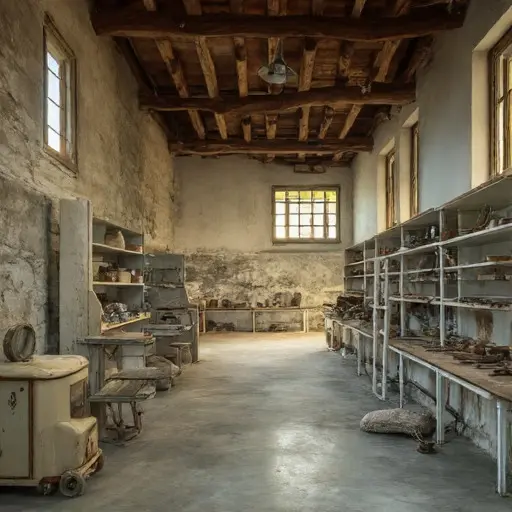
Interior visibility is limited to deep-set observational openings. Inside, only structural and functional remnants are visible—lab benches reduced to silhouettes, shelving outlines softened by dust, and empty plant observation frames aligned with corridor sightlines. No staged objects remain; the interior reads as spatial memory defined by geometry rather than detail.
Lighting is realistic overcast wetland illumination with soft sky diffusion and strong environmental bounce from water surfaces. Contrast remains moderate due to atmospheric humidity, and reflections are subdued yet physically accurate. The overall atmosphere is quiet, humid, and environmentally active despite the absence of human presence.
The entire composition reads like a scientific architectural field photograph of a Victorian botanical research residence—precise, hydrologically integrated, and shaped entirely by water cycles, plant ecology, and long-term environmental interaction rather than decorative intent or narrative framing. A structure defined by observation, measurement, and slow ecological return.