Fevered Silence Lived Beneath the Roof Where Mirek Harvested the Memory of Thunderstones
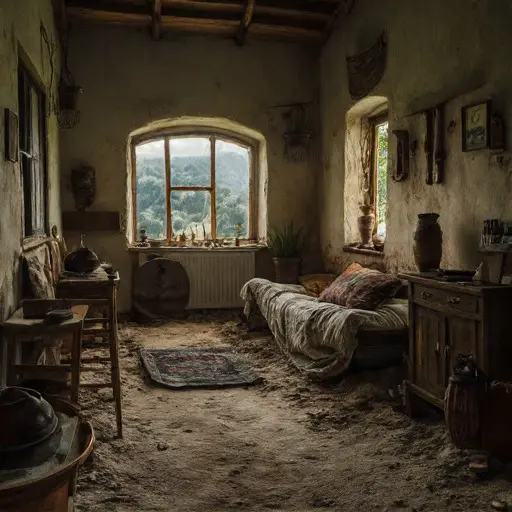
The stones are wrapped in cloth.
Not for protection.
For restraint.
Dozens of dark rocks rest throughout the room inside faded linen bundles tied with cord and marked by charcoal circles that resemble weather symbols more than labels.
Mirek claimed bare thunderstones grew restless.
The farmhouse belonged to him for nearly half a century.
He lived alone and practiced a profession that survived quietly between folklore and geology before modern science absorbed and abandoned its older language.
Mirek was a fulgurite custodian.
His work involved locating, preserving, and classifying glassy formations and electrically altered stones created by lightning strikes. Farmers, regional museums, and storm communities once relied on specialists like him to document strike histories and understand electrical patterns across the land.
He studied storms after they had already vanished.
The mineral room still carries his caution.
Earth brushes remain beside ash sieves. Strike ledgers lie beneath iron weights. Shelves hold wrapped specimens labeled by field, season, and lightning severity.
The room feels charged without movement.
Below the Static Root Alcove
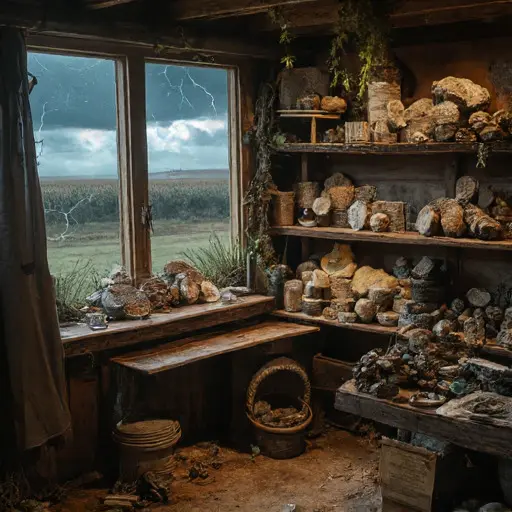
Mirek worked below the Static Root Alcove.
The recessed stone cavity stayed dry even during storms and allowed delicate fulgurite structures to rest without fracture during examination.
One unfinished catalog still rests there.
The specimen cleaned.
The strike genealogy unfinished.
Mirek inherited fragments of the profession through farming families who believed lightning remembered where it landed.
Children feared him slightly.
Adults trusted him completely.
For decades the work endured.
Agricultural regions and local historians still valued strike records shaped through direct observation and landscape memory.
Then prediction digitalized.
Lightning tracking systems, atmospheric satellites, and automated storm databases steadily displaced local custodianship. Strikes became coordinates rather than stories carried through land.
Mirek admired the precision.
He distrusted the distance.
Still, he continued crossing fields after storms and preserving fragile strike formations long after institutions stopped requesting them.
Then the towers arrived.
Expanding transmission infrastructure and lightning diversion systems altered natural strike distribution across surrounding farmland, reducing the unpredictable ground strikes his work depended upon.
The storms survived.
Their footprints changed.
Already living with advanced peripheral neuropathy and declining mobility from years spent traversing rough terrain, Mirek moved more slowly with each season.
One violent midsummer storm rolled across the hills after weeks of oppressive heat.
Against advice, he left before dawn carrying his brush satchel toward a field where lightning had struck unusually close to old granite outcrops.
Neighbors later found the satchel.
Not Mirek.
The funeral gathered farmers, weather-watchers, and elderly villagers who still remembered him touching soil before discussing thunder.
The farmhouse remained afterward.
The ash sieves remain beside the brushes.
The linen still wraps the stones.
And below the Static Root Alcove, Mirek’s unfinished thunderstone catalog continues waiting in silence—holding the last strike he never returned to teach the earth how to remember.