Fading Systems in the House of the Desert Water Auditor
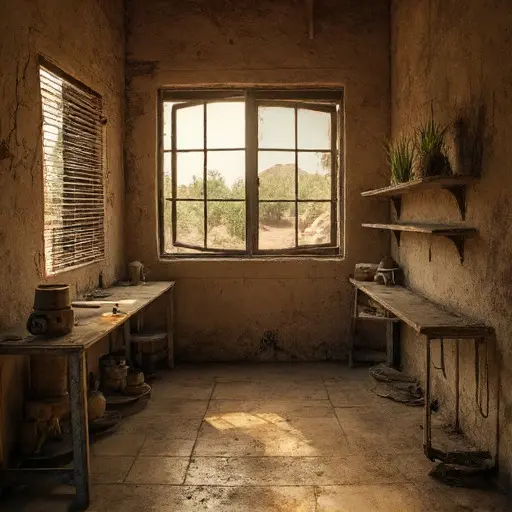
The water ledgers are still open on the table.
Most pages are filled with measurements written in careful columns: flow rates, reservoir pressure, evaporation loss, and canal usage by district.
This house belonged to Nabil.
He worked as a desert water auditor, inspecting and documenting water distribution systems that supplied isolated agricultural communities across arid regions.
The house doubled as a small field office connected to the canal network nearby.
Pipe schematics covered the walls. Brass pressure gauges rested beside maintenance forms. Large maps showed irrigation routes stretching across dry valleys and cultivated groves.
Everything inside the building was organized around water movement.
At the Reservoir Allocation Desk

Nabil worked most often at the Reservoir Allocation Desk.
The long steel desk near the back wall was where he tracked regional water usage and balanced allocation schedules between farms, storage stations, and emergency reserves.
His wife died during a severe heatwave years earlier after medical supply deliveries failed to reach the district on time.
After that, Nabil rarely traveled outside the canal sector he supervised.
For decades, the profession remained essential.
Agricultural regions depended on local water auditors to manually monitor canal losses, illegal diversions, and seasonal reservoir stability in areas where automated infrastructure was unreliable.
Then centralized utility systems replaced local oversight.
Remote-controlled distribution networks and digital monitoring systems reduced the need for field auditors stationed in isolated districts.
Nabil continued working anyway.
Even after staff reductions.
Even after the regional office stopped sending regular updates.
But the decline was not only technological.
The water supply itself began collapsing.
Long-term drought cycles reduced reservoir levels year after year, forcing repeated rationing programs that emptied entire farming zones and left many canal routes permanently dry.
Nabil remained in the house through increasingly severe summers, continuing to inspect abandoned irrigation channels and update allocation logs for districts that no longer had active farms.
During a final drought emergency, a major reservoir upstream failed after structural neglect and sediment overload damaged the containment system.
The last entries on the Reservoir Allocation Desk describe falling pressure levels and complete canal shutdown across several nearby sectors.
He died before outside crews restored access to the region during the prolonged water crisis.
The canal system was later abandoned.
Most of the surrounding groves dried out within a few years.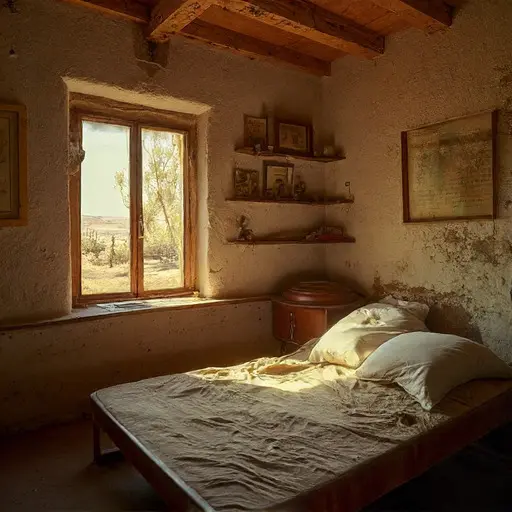
The pressure gauges remain mounted beside the wall.
The allocation ledgers are still stacked on the desk.
And at the Reservoir Allocation Desk, Nabil’s unfinished water records continue waiting in silence beside canals where nothing flows anymore.