Eternal Drift in the House the Time Librarian Never Finalized
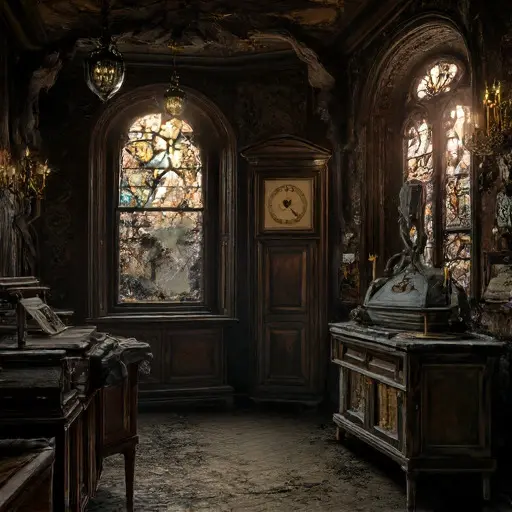
The clocks are still out of sync.
Not broken in the usual way.
But each one frozen at a different minute, as if time itself fractured into separate memories inside the room.
This house belonged to Ingrid.
She worked as a time librarian, cataloging historical time records, synchronization logs, and civic chronometry data used by municipal observatories and navigation councils.
The archive chamber occupied the central interior beneath reinforced beams designed to minimize vibration from the clocktower outside.
Brass chronometers lined rotating shelves. Sandglass registers were stored in velvet-lined drawers. Time ledgers recorded shifts in daylight calibration across seasons and decades.
The house did not store objects.
It stored moments.
Beneath the Chrono Index Vault
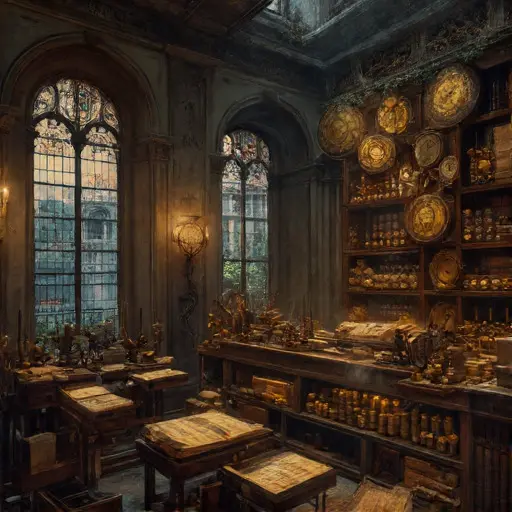
Ingrid worked most often beneath the Chrono Index Vault.
The circular brass-framed desk was where she cross-referenced municipal time drift records against celestial timing logs maintained by the observatory network across the region.
Her partner died during an earlier synchronization failure incident in the civic clock network.
After that, she stopped attending external calibration sessions.
For years, the profession remained vital.
City infrastructure, canal traffic systems, and railway coordination depended on precise temporal synchronization maintained by human oversight alongside mechanical chronometers.
Then global time standardization systems took over.
Automated atomic synchronization networks replaced local time librarians, eliminating regional adjustment roles and centralizing all civic timekeeping into remote infrastructures.
Ingrid continued anyway.
Even without official assignments.
Even without confirmation logs.
But the decline was not only institutional.
The region itself experienced temporal instability events.
Electromagnetic interference and infrastructure aging in older districts caused periodic clock desynchronization events across the city’s historic zones, making manual correction increasingly unreliable and officially discouraged.
Then her health deteriorated.
Years of working in low-light archival chambers combined with chronic stress from temporal anomaly monitoring contributed to severe neurological fatigue and progressive disorientation.
During a final civic time correction blackout caused by a network-wide synchronization collapse, Ingrid attempted to manually stabilize the Chrono Index Vault using legacy mechanical alignment procedures.
She collapsed at the desk before completing the final ledger correction.
No municipal authority retrieved the archive.
The clocktower continued running independently.
The house remained sealed in uneven time.
The chronometers remain misaligned.
The time ledgers stay half-updated.
And at the Chrono Index Vault, Ingrid’s unfinished temporal record continues waiting in silence—holding the last moments she never returned to finalize into continuity.