Eerie Haunting: The Curse of Ashworth’s Sablewood Crest
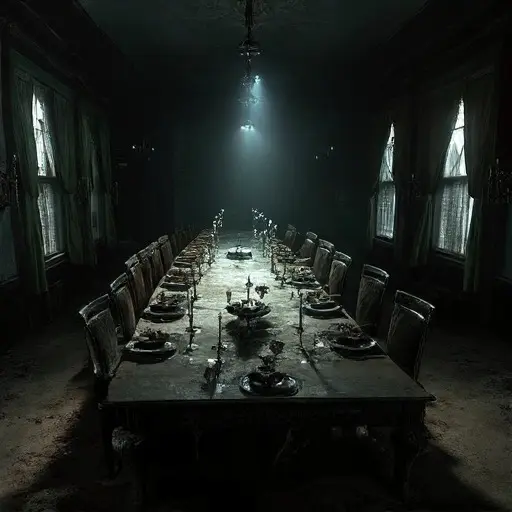
Sablewood Crest was never just a home; it was a sanctuary built on ambition and silence. Towering over the coastal cliffs, this abandoned Victorian house possessed an architecture that defied the elements but succumbed completely to memory. The entrance hall, vast and echoic, smelled perpetually of sea salt, damp plaster, and something sharper, metallic—like blood and old copper. Sunlight, when it dared to penetrate the thick layer of grime on the great arched windows, served only to illuminate the appalling scale of the dust, making the decay seem more deliberate, more observed. Every step on the mosaic tile floor was an intrusion, a noisy break in the house’s profound, centuries-deep stillness. The atmosphere was immediately unsettling, steeped in a history that felt less written and more physically embedded in the peeling gold leaf and fractured cornices.
The Architect’s Fatal Perfection
The man who commissioned and personally oversaw every detail of Sablewood Crest was Silas Ashworth, a celebrated, yet volatile, structural engineer. Silas was a genius of steel and mortar, famed for designing bridges that spanned impossible chasms. But his personality was rigid, obsessive, and ultimately, profoundly isolated. He saw the house not as a shelter, but as his ultimate, fixed equation—a structure of perfect, unyielding permanence. He designed the stairwells to be impossibly wide, the library ceiling to be geometrically flawless, and the great ballroom to possess acoustic perfection.
His fate, however, was as flawed as his designs were meant to be perfect. Silas vanished suddenly in 1910. The widely accepted story was a boating accident off the bluffs, but no body was ever recovered. The house, his monument to himself, was immediately sealed by his reclusive sister and never re-opened. He did not die in the house, but the house, it seems, has preserved his presence—his relentless pursuit of order—through its empty, flawless rooms.
The Library of Unread Chapters
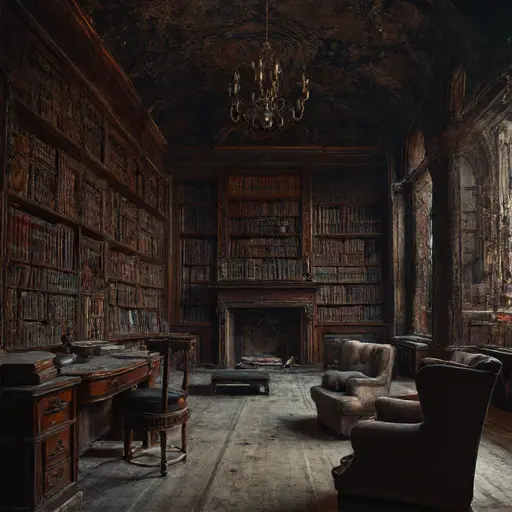
The library is perhaps the most eerie space. This chamber, intended for intellectual retreat, is a suffocating maze of books, all of which remain perfectly in place. Silas Ashworth had no interest in reading; he stocked the shelves for aesthetic uniformity and the feeling of impenetrable knowledge. Yet, on his massive, claw-footed desk, lies a single object that betrays his inner turmoil: a half-finished wooden model of a bridge, meticulously crafted, but snapped precisely in the center.
Underneath the desk blotter, slightly askew, is a single note, written in Silas’s precise, draftsman’s hand. It reads simply: “The weight of error is greater than the strength of steel.” This line, bolded by the weight of its context, suggests his disappearance was not an accident, but an escape from a catastrophic failure he could not publicly admit—a failure that drove him from his perfect creation. The entire room feels like a sealed tomb of unconfessed secrets.
The Ballroom’s Silent Dance
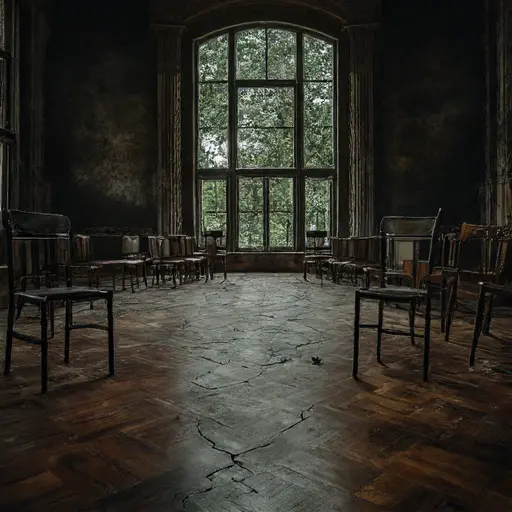
Upstairs, the ballroom dominates the entire wing. The parquet floor, once polished for extravagant events, is warped and pale. This room was Silas’s showpiece, where he would host parties to display his wealth and precision. Yet, like everything in the abandoned Victorian house, the current state suggests a sudden, panicked retreat. A single, small, faded silk slipper lies near a window, its heel snapped. The heavy silk curtains are ripped, and the atmosphere suggests not a gradual fading, but an instantaneous cessation of life and sound.
Sablewood Crest does not whisper of ghosts; it booms with the deafening silence of a life meticulously ordered, then suddenly, tragically, abandoned. The chilling truth is not what happened to Silas, but how perfectly he designed his house to hold the memory of his profound despair after he was gone. It is a monument to his fatal perfection.
