Eerie Brandt and the Parlour Laboratory Where His Measures Went Astray
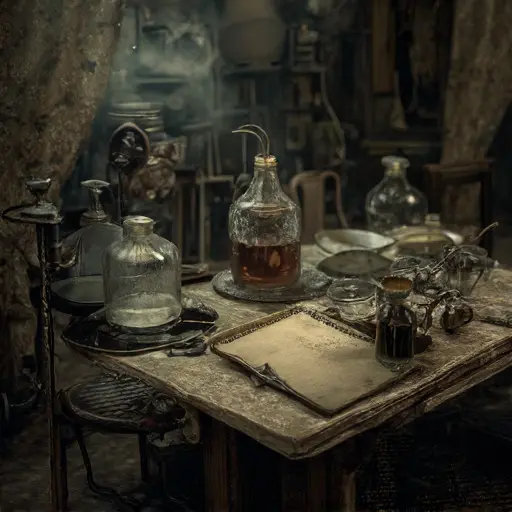
A muted hush lingers in Brandt House, deepest in the abandoned parlour laboratory, where Otto Friedrich Brandt, a Bavarian domestic chemist with academic ambitions he never fulfilled, once conducted meticulous home experiments. Now the faint trace marking his last page hints at a moment when precision bent into doubt.
A Trace Across the Chemist’s Measured Routine
Otto, born 1871 in Würzburg, learned his earliest techniques from his cousin Liselotte Brandt, whose cracked glass stirring rod now rests beside the settee’s embroidered cushion.
His evenings followed a dependable sequence: decanting solvents into mismatched teacups, heating tinctures over the small burner, and sketching results in his looping hand. Echoes of these rituals remain—corks lined in a perfect row, scales balanced with brass weights, filter papers folded into exact thirds. Even the rug’s worn patch by the table recalls the angle of his shoulders, hunched toward some elusive reaction.
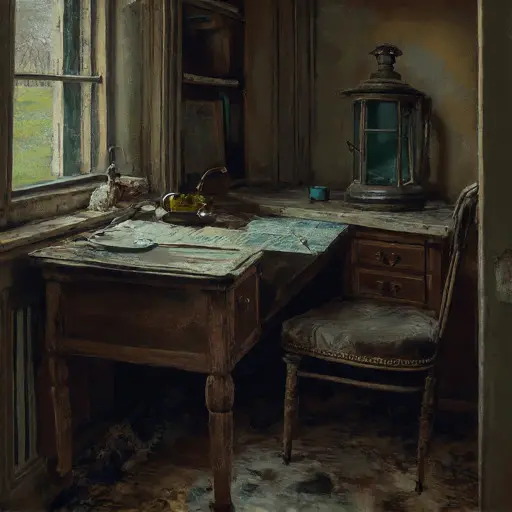
Where His Calculations Strayed from the Line
Neighbors whispered that Otto’s household disinfectant mixture—distributed in goodwill to several families—produced a noxious odor rather than the promised cleansing effect, prompting uneasy complaints. In the narrow corridor, Liselotte’s stirring rod lies snapped at its midpoint. A reagent bottle has rolled beneath a cabinet, leaving a white crust on the floorboards. A folded invoice sits torn, the ink blurred where a thumb dragged across it. A reaction grid hangs from the stair newel, many entries violently crossed out. Each hint leans toward a man shaken by his own margins of error.
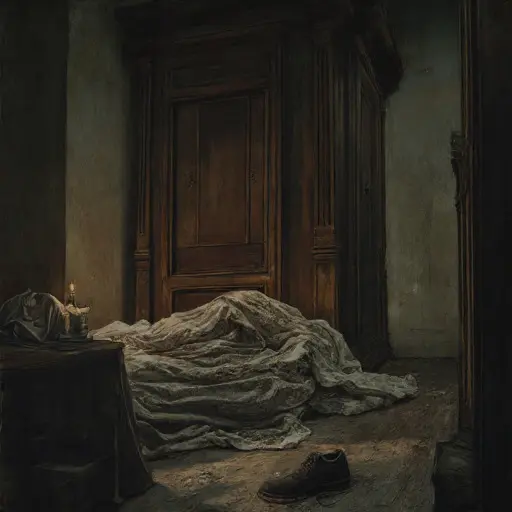
Only the dissolving trace on his last notebook page remains—an unfinished argument between intention and outcome. Whatever unsettled Otto’s final experiment lingers in these abandoned rooms.
Brandt House remains abandoned still.
