Delta Embankment Residence
Abandoned Victorian house, pale river-washed granite blocks with naturally rounded edges shaped by long-term hydraulic abrasion, deep umber-stained larch timber weathered into layered gray-brown gradients, and wrought ironwork in oxidized black with localized green patina concentrated around joints, anchor points, and water-facing surfaces. A compact Victorian river-delta residence sits on a raised stone embankment at the convergence of multiple slow-moving channels, where fragmented landmasses form narrow sediment islands shaped continuously by seasonal flooding and deposition cycles.
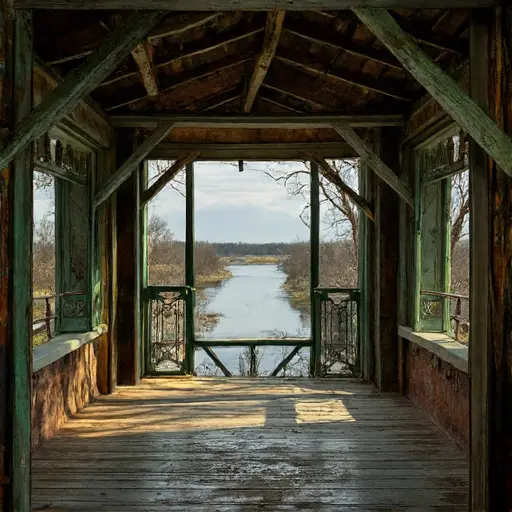
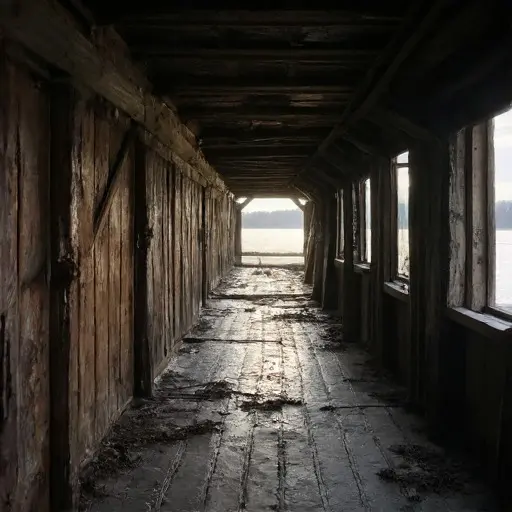
The architecture is elongated and subtly segmented, designed to respond to unstable terrain rather than impose rigid form. A central living block anchors the structure on the highest portion of the embankment, while two narrower wings extend outward along the river edge like stabilizing arms against flood pressure and shifting waterlines. A raised wooden walkway connects the residence to distant land paths, supported by stone pylons driven into the delta floor, now partially submerged depending on seasonal water levels.
The roof is steep slate, heavily weathered by repeated wet-dry cycles, showing tonal variation from deep slate-charcoal to softened steel-blue, with pale mineral streaking along drainage paths and irregular edge wear caused by wind and water interaction.
The façade is fully exterior and materially precise. Granite blocks display pronounced erosion smoothing along lower courses where water flow is most persistent, while upper courses retain sharper quarry tooling marks and stratified mineral texture. Larch timber framing is structurally functional rather than decorative, showing fiber separation, micro-cracking, and uneven darkening where repeated moisture penetration has occurred over time. Iron elements—brackets, flood shutters, and railing systems—are hand-forged and slightly asymmetrical, with corrosion patterns that intensify near water exposure zones and remain lighter in elevated, drier sections.
The surrounding environment is a dynamic river delta system defined by slow redistribution of sediment and water. Channels split and merge unpredictably, forming reflective corridors between low islands of mud, stone, and vegetation. Water movement is gradual but continuous, producing subtle ripples that carry fragmented reflections of sky, architecture, and embankment structures. Edges of land are soft and unstable, with occasional collapses revealing layered sediment profiles beneath.
Vegetation is dense but strictly hydrology-driven. Tall reeds dominate channel margins, bending in unified directional flow aligned with current and wind. Wetland grasses form thick mats on slightly elevated ground, while moss spreads across stone surfaces that remain consistently damp. Wildflowers appear only in ecologically suitable pockets: pale white river blossoms near slow water edges, soft lavender wetland flowers in transitional soil zones, and muted yellow blooms in raised sediment areas that escape full inundation.
A partially submerged stone loading platform extends from the rear of the house into one of the channels, its geometry eroded and fractured by long-term hydraulic action. Nearby, a collapsed iron winch mechanism lies half-buried in sediment, its gears corroded but still structurally readable as industrial form. Along the lower façade, wooden flood shutters hang unevenly—some warped outward by repeated water pressure, others missing entirely, leaving exposed structural openings.
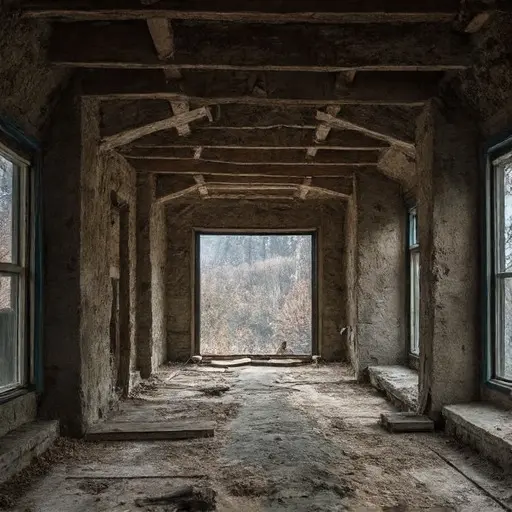
Window glass is irregular and aged, containing mineral inclusions and slight waviness that refracts water and sky into fractured optical patterns. Lower-level windows are heavily shadowed due to embankment elevation, while upper openings reflect shifting cloud movement and water shimmer across the delta surface. Interior spaces are only partially visible—reduced to structural outlines of beams, stair fragments, and empty rooms defined more by shadow geometry than detail.
Lighting is realistic river-delta overcast illumination, with diffuse sky brightness and strong environmental bounce from water surfaces. The scene maintains subdued contrast with high material clarity, where reflections introduce slow motion into an otherwise still architectural composition. Atmospheric humidity softens distant islands while preserving sharp foreground texture across stone, timber, and iron.
The entire composition reads like a high-resolution architectural survey photograph of a Victorian river-delta residence—hydrologically shaped, materially grounded, and continuously transformed by sediment flow, water movement, and seasonal flooding rather than decorative intent. A place defined by instability, adaptation, and long-term environmental negotiation between architecture and water.