Deliberate Ruin in the House the Storm Interpreter Never Closed
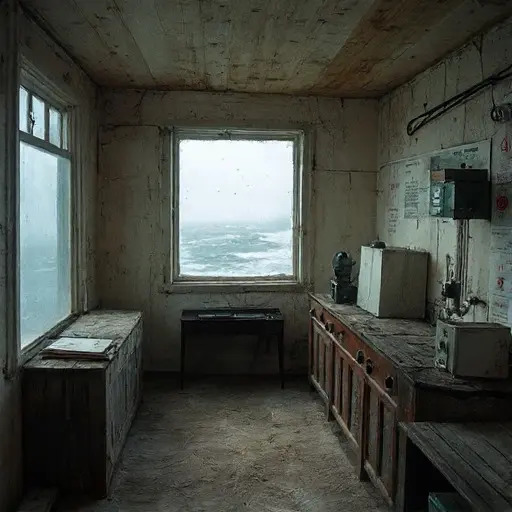
The pressure gauge still trembles.
Not from wind.
Not from movement.
But from residual tension trapped in the metal casing, as if the room refuses to forget the last system it tried to read.
This house belonged to Orla.
She worked as a storm interpreter, analyzing coastal pressure shifts, wind layering, and ocean-air collision patterns to forecast microstorm behavior for fishing fleets and cliff settlements.
The observation room faced directly into the Atlantic corridor where storms formed without warning.
Tables were bolted to the floor. Glass instruments were reinforced against vibration. Handwritten pressure logs filled drawers labeled by season and storm class.
The house was never meant to feel peaceful.
Only accurate.
At the Barometric Breakpoint Table
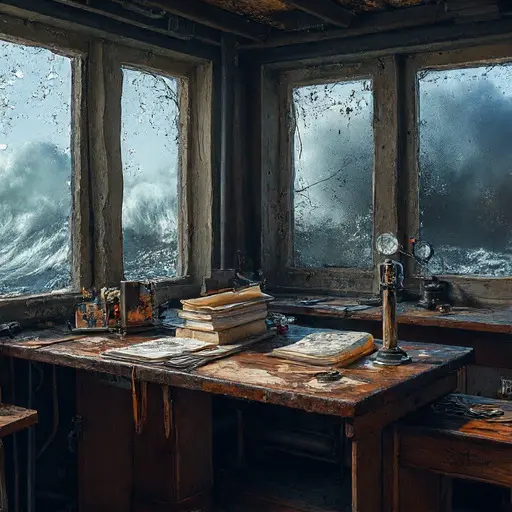
Orla worked most often at the Barometric Breakpoint Table.
The reinforced oak desk was where she plotted atmospheric collapse zones—points where pressure systems would fracture into sudden storms along the cliff coast.
Her partner disappeared at sea years earlier during an unpredicted storm surge.
After that, she stopped leaving the house during active weather.
For a time, the profession still held authority.
Fishermen, coastal engineers, and emergency coordinators relied on localized storm interpretation before satellite models fully replaced ground observation.
Then prediction centralized.
Global weather systems absorbed regional interpretation roles, replacing human coastal reading with aggregated atmospheric modeling that no longer accounted for microtopography.
Orla continued anyway.
Even without requests.
Even without acknowledgment.
But the decline wasn’t only professional.
The coastline itself began to change shape.
Erosion accelerated. Cliff collapses altered local wind corridors. Former observation points became unsafe or physically inaccessible, breaking continuity in her long-term data series.
Then the storm season intensified beyond historical structure.
Multi-cell systems began merging unpredictably, producing atmospheric behaviors that older classification systems could not fully categorize.
Already living with severe pulmonary fibrosis likely worsened by prolonged exposure to salt aerosol storms and damp conditions inside the cliff house, Orla reduced field observation and remained primarily indoors during peak weather cycles.
One late-season superstorm arrived earlier than forecast and refused to dissipate along the outer coast.
Orla stayed at the Barometric Breakpoint Table through the night recording pressure spikes as multiple instruments failed sequentially under atmospheric overload.
No evacuation reached the house in time due to communication blackout across the coastal grid.
The storm surge collapsed part of the cliff face before dawn.
The house remained partially intact, suspended above broken rock and sea foam.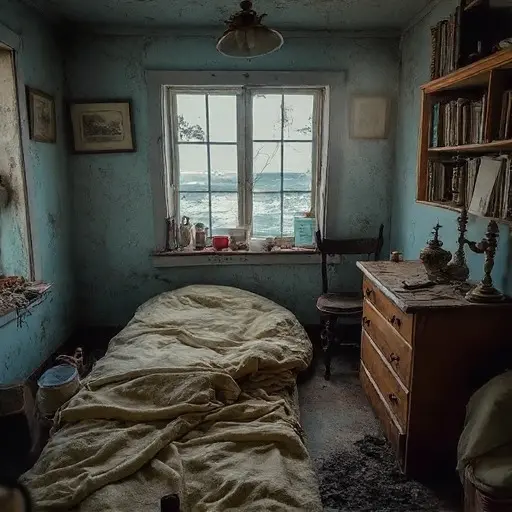
The barometric gauges remain frozen at divergent readings.
The storm charts are still pinned mid-analysis.
And at the Barometric Breakpoint Table, Orla’s final interpretation continues waiting in silence—holding the last storm system she never returned to close.