Cursed Relics: The Banker’s Doom at Silverbrook Keep
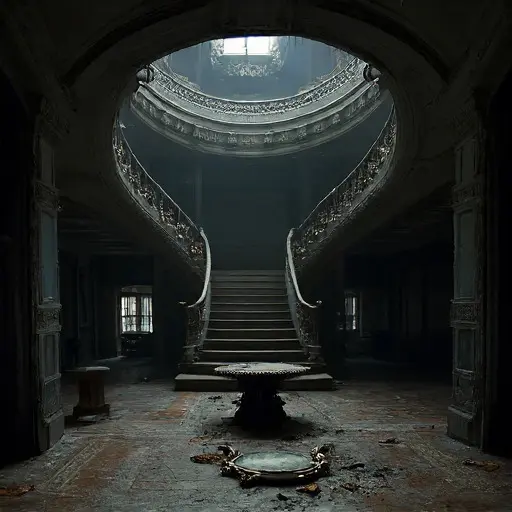
Silverbrook Keep was a name synonymous with wealth and iron-fisted control in the late 1880s, but today, it stands as a testament to hubris and decay. This abandoned Victorian house, a fortress of brownstone and slate, squats on a neglected hillside, its shadow long and ominous. The interior air is heavy, static, carrying the scent of dried leather, mildew, and the sharp, almost painful odor of undisturbed cold. The entry hall’s once-glittering mosaic floor is dull under a thick, uniform blanket of dust. To walk through the Keep is to feel the weight of its former occupant’s obsession with order and acquisition, now undone by time. Every room is a stage where silence has become the main character, telling the tale of what was lost.
Elias Thorne: The Collector’s Ruin
The master of Silverbrook Keep was Elias Thorne, a powerful, ruthless financier and collector whose reputation was built on his ability to acquire anything—money, art, and even secrets. Elias was known for his cold efficiency and an almost pathological attachment to physical objects of immense value. He believed that ownership equaled immortality, filling his grand house with artifacts from around the globe, creating a private museum of unparalleled, though questionable, provenance.
The mystery surrounding Elias is simple: his complete disappearance in 1901. He was last seen arguing violently with a dealer over a recent acquisition—a relic he insisted was priceless. His sister inherited the Keep, but refused to sell or occupy it, sealing the doors with the declaration, “Let the silence hold what he prized most.” The house now holds his memory—the memory of grasping ambition—in every dust-covered, priceless object left behind.
The Cabinet of Curiosities
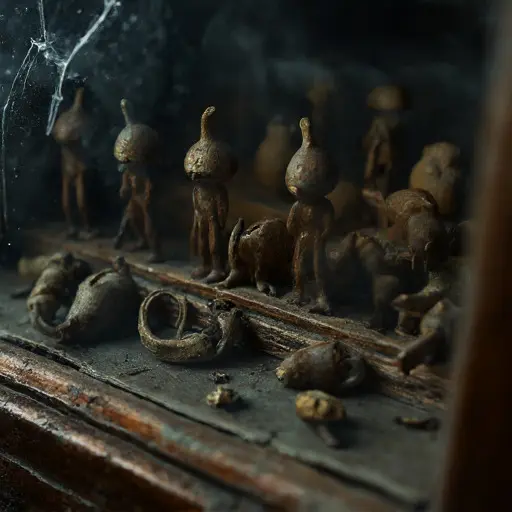
Deep within the Keep, off the main study, lies Elias’s private vault: the Cabinet of Curiosities. This small room, lined floor-to-ceiling with glass cases, feels significantly colder than the rest of the abandoned Victorian house. The air here is thick with a different scent—earth and sulfur—suggesting the truly unusual nature of its contents. Among the faded silks and decaying velvet linings are the objects Elias valued most: ancient, unmarked coins; a collection of taxidermied birds with unnervingly bright glass eyes; and in the center of the main display, the “relic” over which he had his final, fatal argument.
It is a small, heavy wooden box, bound by three rusted iron straps, bearing no discernible markings. The box itself is empty, though the velvet cushion inside is heavily indented, as if something substantial once rested there. Nearby, resting on a pedestal, is Elias’s leather-bound logbook, opened to the final entry. The script is frantic, almost illegible, ending with the chilling words: “The price is possession, not coin. I am now the relic.”
The Banker’s Empty Vault
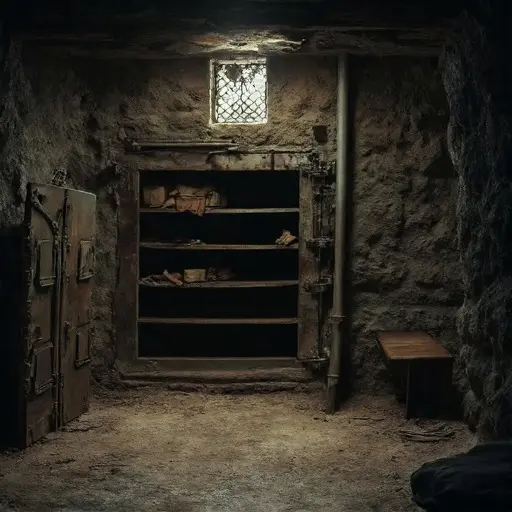
The final, telling location is Elias’s private safe room. This chamber, hidden behind a bookcase in the library, was where he stored his liquid assets and most sensitive documents. Today, the massive steel vault door stands open. The interior is stone-lined and surprisingly bare. Unlike the rest of the Keep, the dust here is not thick; it has been disturbed, then settled again. The shelves are empty, and the only item remaining is a small, hand-painted porcelain doll, its head cracked, lying face-up on the cold concrete floor.
This detail is strangely out of place in the banker’s austere world. The doll was a gift for his younger sister, the same one who sealed the house. The sight of it, forgotten or discarded in the empty vault, suggests that in the end, Elias Thorne lost not only his wealth but the capacity for human affection. Silverbrook Keep is now an eerie tomb, holding the heavy silence of a man who priced his objects above his own humanity, leaving behind a profound legacy of emptiness.
