Crest-Rune: The Heraldist’s Lost Lineage
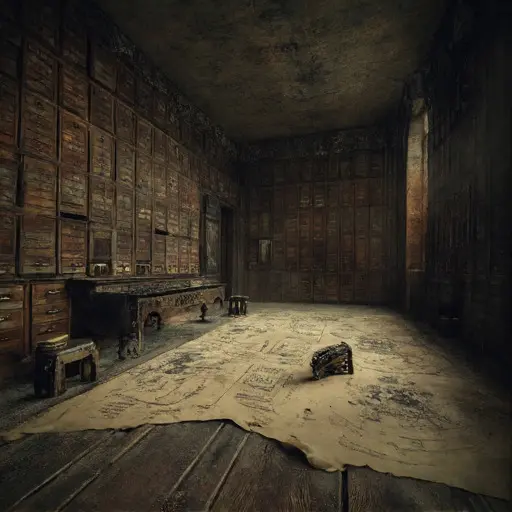
The moment the thick, heavy oak door to Crest-Rune creaked open, the air rushed out—cold, dry, and heavy with the pervasive, unsettling odor of old, brittle paper and a faint, acrid smell of dried paint. The name, combining a symbol of authority with a secret script, perfectly captured the manor’s function: a place dedicated to the creation and preservation of identity, now eternally silent. This abandoned Victorian house was structured not for warmth, but for meticulous, solitary research, its numerous small rooms built to secure and isolate fragile documents and precious artifacts.
The final inhabitant was Mr. Percival Vane, a brilliant, but intensely reclusive master heraldist and genealogist of the late 19th century. Mr. Vane’s profession was the intricate art of designing, tracing, and authenticating family crests and noble lineages. His singular obsession, however, was the creation of the ‘Primal Lineage’—the discovery of a single, foundational, perfect bloodline from which all legitimate human identity descended. After a critical genealogical error shattered his professional reputation, he retreated to the manor. He dedicated his final years to resolving this single, terrifying goal, believing that the truth of one’s origin dictated one’s entire existence. His personality was intensely rigorous, fearful of historical fabrication, and utterly consumed by the pursuit of absolute, uncorrupted identity.
The Blazon Chamber
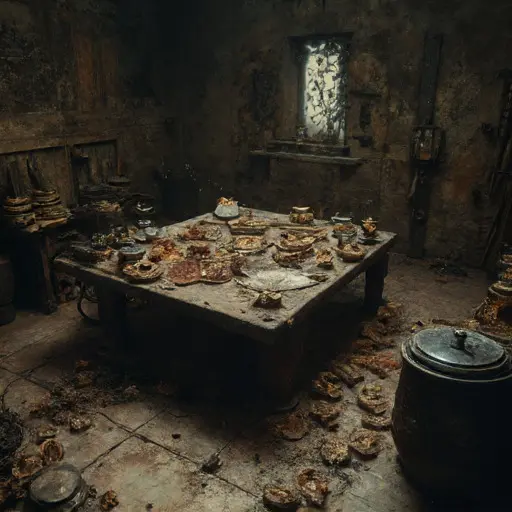
Mr. Vane’s mania culminated in the Blazon Chamber. This secure room was where he spent his final days, not painting commissions, but deconstructing and simplifying known crests, attempting to find the singular, original ‘First Mark’ that predated all lineage. His journals, written in an elegant hand that dissolved into frantic sketches of intersecting shields and obliterated lines, were found tucked inside a massive, hollow wooden staff bearing an illegible crest. He stopped trying to record history and began trying to invent the Primal Lineage, concluding that the truth of identity was not found in what was recorded, but in what was left unmarked. “The final ancestor has no name and no shield,” one entry read. “The truth is not in the line of ascent, but in the mark that starts the line.”
The house preserves his meticulous nature. Many internal door frames and archways are lightly carved with a series of repeating, simplified geometric shapes, his attempts to create a fundamental, universal grammar of symbolic representation.
The Final Seal in the Abandoned Victorian House
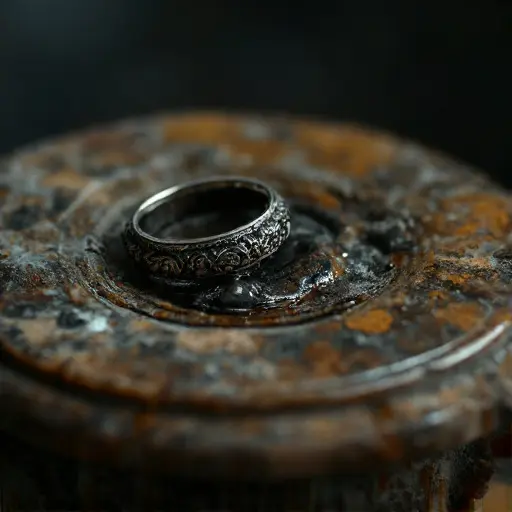
Mr. Percival Vane was last heard working in the archive, followed by the soft, audible crack of hardened wax. He did not leave the manor. The next morning, the Crest-Rune was locked, the archive silent, and the man was gone. No body was found, and the only evidence was the singular, physical alteration to his tools.
The ultimate chilling clue is the blank wax seal. It is perfectly smooth, utterly devoid of the crest, line, or identifying mark that defined his life’s work. This abandoned Victorian house, with its silent archives and fragmented shields, stands as a cold, imposing testament to the master heraldist who pursued the ultimate truth of identity, and who, in the end, may have successfully constructed the Primal Lineage—a line so pure and foundational that it begins with a name and a mark that are both perfectly, and terrifyingly, absent.
