Cliffward Edge House
Abandoned Victorian cliff-edge house resting in a dense forest under soft overcast daylight, where evenly diffused light removes harsh contrast and renders both stone and timber in muted, readable tones. The structure sits precisely at the boundary where the forest floor abruptly breaks into a sheer rock drop, creating a quiet architectural tension between stable woodland and vertical void. Despite its precarious position, the house remains fully intact and lightly weathered, anchored with deliberate precision into both soil and stone.
The building is compact and vertically grounded, formed around a strong rectangular footprint that integrates into the cliffside itself. From the forest approach, the house appears modest and orderly, with evenly spaced sash windows and a centered entrance framed in white timber and pale stone.
Its presence is calm and domestic from this angle, blending naturally into the surrounding trees.
From the cliff-facing side, however, the structure reveals an extended lower volume that projects deeper than expected into the rock edge. This hidden portion is supported by stone buttresses embedded directly into the cliff face, allowing additional interior rooms to exist beyond the apparent footprint seen from the forest side.
A subtle structural offset exists between these two perspectives: the forest-facing façade and the cliff-side extension do not fully align in depth. The rear volume is slightly deeper, creating a quiet spatial misregistration that remains stable and architecturally coherent, as if the building was adjusted to the terrain rather than forced into symmetry.
The roof is simple dark slate, clean and intact, with a straight ridge line running parallel to the cliff edge. One chimney sits closer to the cliff side, rising cleanly without deformation, while a second chimney is positioned above the main entry volume. Both are intact and evenly weathered, reinforcing the building’s structural balance.
Windows facing the forest are evenly spaced and clear, reflecting muted greens and pale sky. Cliff-facing windows are fewer and narrower, recessed slightly into thicker walls, with glass that reflects stratified rock layers and open air beyond the drop. All glazing remains intact with only light interior dusting.
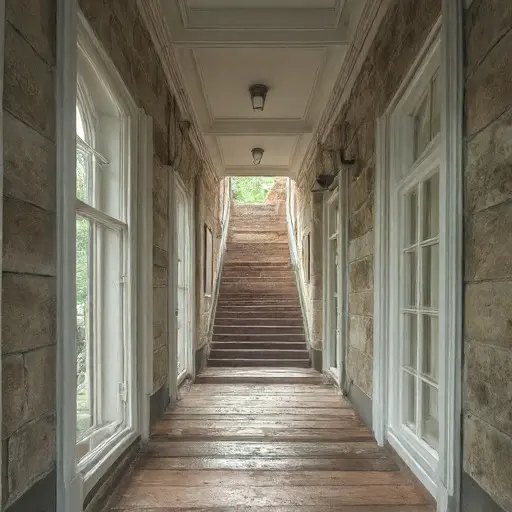
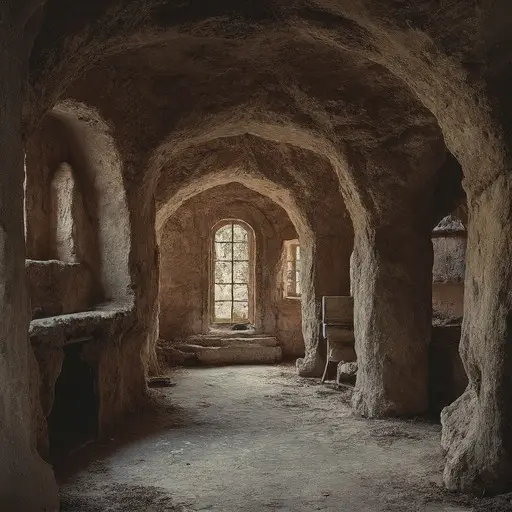
A narrow interior staircase descends from the main floor into the cliff-integrated lower level. This lower section consists of storage-like rooms partially carved into the rock, where smooth natural stone walls transition cleanly into constructed timber framing. The integration is precise, with no visible collapse or erosion despite proximity to open cliff exposure.
Outside, the forest halts just a few meters from the house, forming a clean boundary before the terrain falls away. Grass and small plants cluster around the foundation on the forest side, but vegetation does not extend to the cliff edge. The drop itself remains clear and exposed.
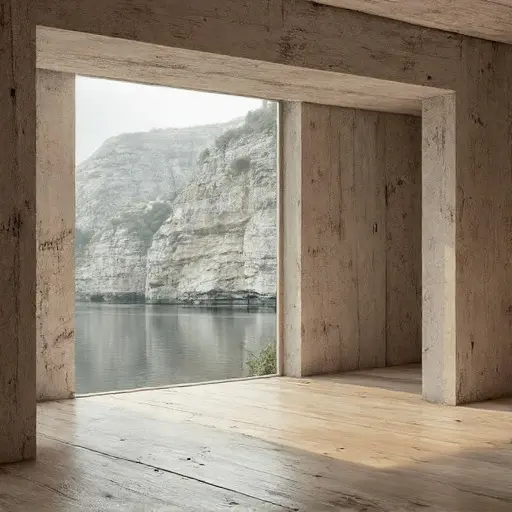
Through lower windows, the cliff face is visible in stratified layers of stone, descending into still air and depth without movement or debris. The house appears firmly engineered for this threshold, as if designed to occupy the edge between habitation and absence.
No decay, no destruction, no supernatural elements. The house feels like an abandoned boundary residence built to observe or inhabit the meeting point between forest and void, preserved in quiet equilibrium under a gray sky. Cinematic realism, exploration-game environment aesthetic, grounded materials, and subtle dual-volume architecture responding to extreme terrain rather than distortion or ruin.