Clavis-Void: The Locksmith’s Final Bolt
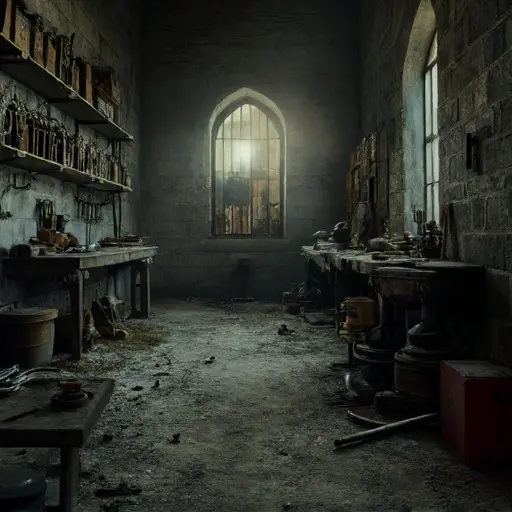
The moment the thick, triple-locked steel door to Clavis-Void was finally wrenched open, the air rushed out—cold, dense, and heavy with the pervasive, unsettling odor of burnt metal, machine grease, and the fine dust of pulverized iron. The name, combining the concept of a key with an empty space, perfectly captured the manor’s function: a physical embodiment of absolute security, now inexplicably empty. This abandoned Victorian house was structured not for warmth, but for industrial-level precision and defense, its internal layout a bewildering maze of reinforced walls, internal vaults, and heavy, segmented chambers.
The final inhabitant was Mr. Thaddeus Rook, a brilliant, but intensely paranoid master locksmith and mechanical engineer of the late 19th century. Mr. Rook’s profession was the design and creation of impenetrable locks and safes for banks and private collectors. His singular obsession, however, was the creation of the ‘Ultimate Security System’—a single, massive mechanism that would secure a space so absolutely that its contents could never be reached, and whose key would be so complex it could never be replicated or broken. After a devastating theft of his most prized personal designs, he retreated to the manor. He dedicated his final years to constructing this ultimate, final defense, believing that true peace lay only in absolute, unbreachable containment. His personality was intensely meticulous, deeply misanthropic, and utterly consumed by the pursuit of mechanical finality.
The Vault Core
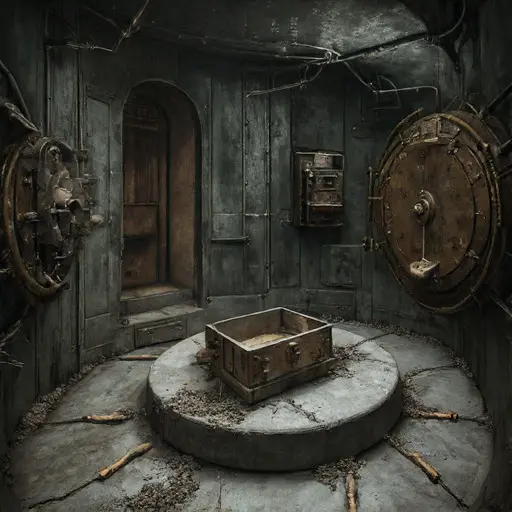
Mr. Rook’s mania culminated in the Vault Core. This secure, multi-layered room was where he spent his final days assembling the final pieces of his Ultimate Security System. His journals, written on thick, wax-coated paper and found sealed inside a hollowed-out file handle, detailed his terrifying conclusion: the only way to ensure the absolute security of the Vault was to remove the possibility of opening it entirely. He decided that the final, critical key must be structurally integrated into the lock itself, making it impossible to separate and use. “The contents are safe only when the mechanism is absolute,” one entry read. “The final bolt requires the complete surrender of the only thing that could ever violate it: the key. I must close the loop and seal the possibility of access forever.”
The house preserves his mechanical paranoia. Many internal doors are fitted with interlocking gear mechanisms that must turn in specific, sequential order, forcing anyone moving through the house into a constant, slow, and deliberate ritual of security.
The Final Key in the Abandoned Victorian House
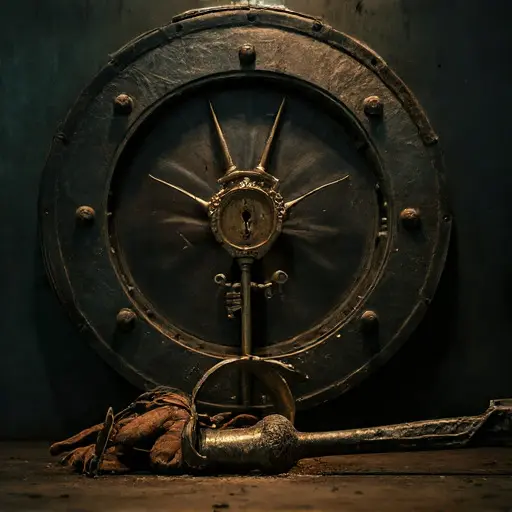
Mr. Thaddeus Rook was last heard working in the Vault Core, followed by a single, deafening CLANG of metal striking metal, and then immediate, absolute silence. He did not leave the manor. The next morning, the heavy Vault Core door was fully closed, the outer locks engaged, and the man was gone. No body was found, and the only evidence was the singular, physical alteration to the final lock.
The ultimate chilling clue is the broken key. It is the perfect, necessary tool, rendered permanently useless by being driven and snapped within the very lock it was meant to open. This abandoned Victorian house, with its intricate locks and impenetrable walls, stands as a cold, imposing testament to the master locksmith who pursued absolute security, and who, in the end, may have successfully completed his Ultimate Security System, vanishing into the absolute, unbreachable containment that he engineered as his final, most perfectly secured space.
