Cinderhaven Thermal Residence
Abandoned Victorian house, pale kiln-fired basalt brick with subtle crystalline flecking, deep faded claret-stained cedar timber that has weathered into desaturated burgundy and ash-gray tones, and wrought iron detailing in oxidized charcoal with localized mineral scaling from long-term geothermal moisture exposure. A compact Victorian geothermal valley residence sits within a narrow volcanic basin where warm ground vents and mineral-rich steam subtly shape the surrounding environment. The architecture is low-profile and thermally adaptive, designed to withstand fluctuating ground heat and humidity rather than conventional climate conditions.
The structure is arranged in a grounded, layered configuration: a central reinforced living block, partially embedded into the earth for thermal stability, flanked by two elongated wing sections that follow the natural contours of the valley floor. A shallow domed thermal observatory rises at the rear, originally used for monitoring atmospheric and geothermal conditions.
The roof is a combination of dense slate and reinforced stone slabs, heavily weathered with uneven coloration caused by mineral deposits, heat cycling, and condensation over decades.
The façade is fully exterior and materially reactive. Basalt brickwork shows fine micro-cracking patterns typical of thermal expansion, with faint white mineral streaks formed by evaporating subsurface moisture. Timber elements are structurally reinforced and heavily aged, showing layered staining where heat and humidity have repeatedly interacted with protective coatings. Iron fittings—vents, braces, and structural anchors—display uneven corrosion, with some areas mineral-encrusted rather than rusted in a traditional sense.
The surrounding environment is a volcanic valley floor with subtle geothermal activity. The ground is uneven but stable, composed of dark volcanic soil, compacted ash, and scattered basalt fragments. Occasional thin steam vents emerge from cracks in the earth, rising slowly and dissipating into the air. The landscape is quiet and still, but visually active through heat shimmer and faint atmospheric distortion.
Vegetation is sparse and specialized. Only hardy geothermal-tolerant plants survive here—low mosses in mineral-rich pockets, thin grasses adapted to warm soil, and small pale flowers that grow near cooler edges of the valley floor. Colors are subdued: muted green, soft gray-green, and occasional pale cream blossoms that contrast against dark volcanic terrain.
A partially collapsed stone heat-exchange conduit runs along one side of the residence, once used to regulate internal temperature by channeling subsurface airflow. Nearby, a rusted iron venting tower stands tilted, its internal mechanisms exposed and frozen in place, encrusted with mineral deposits rather than simple oxidation. Stone retaining channels that once guided geothermal runoff are cracked and partially filled with sediment.
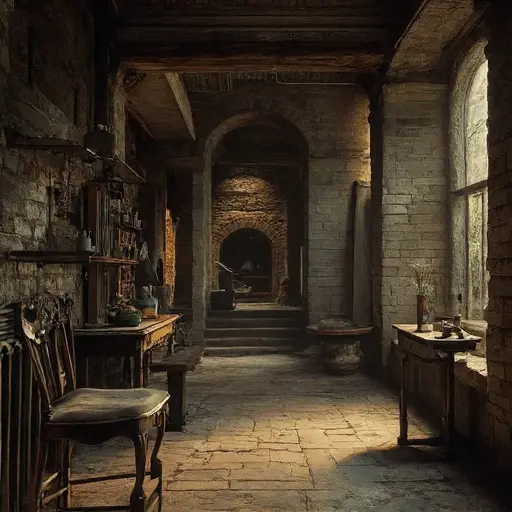
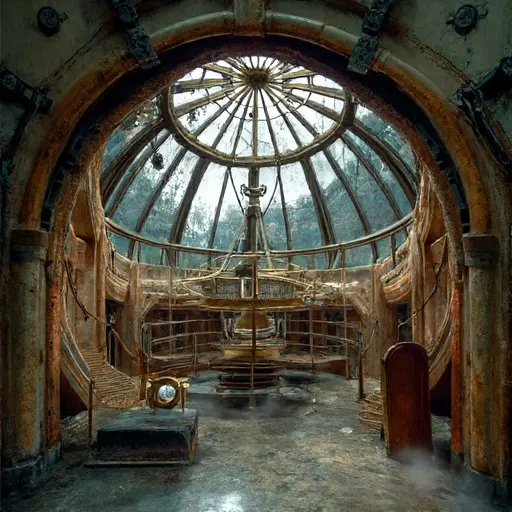
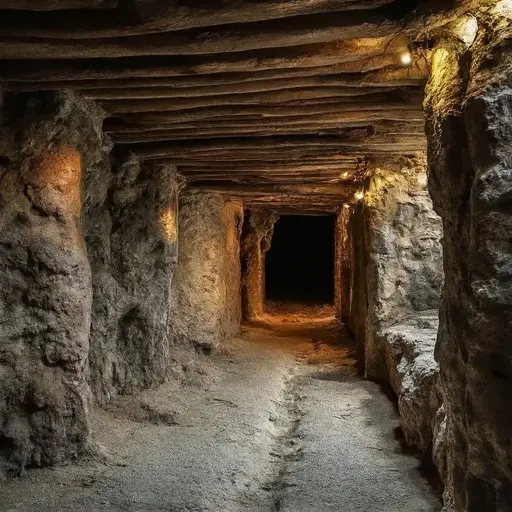
Window glass is thick, slightly opaque, and thermally treated, producing soft diffusion of interior silhouettes. Some panes show internal mineral fogging, distorting reflections into layered gradients. Interior spaces are minimally visible—only structural outlines of support beams, heat baffles, and empty observation frames can be discerned through the haze.
Lighting is diffused high overcast mixed with subtle ground-emitted warmth from geothermal activity. This creates a balance of cool sky illumination and faint underglow from the earth itself, producing soft, realistic gradients across stone and timber without stylization. Heat shimmer subtly distorts distant edges near vents.
The entire scene reads like a precise architectural field photograph of a Victorian geothermal valley residence—environmentally reactive, thermally engineered, and shaped by subsurface heat dynamics rather than traditional weather alone. A place defined by geology, heat flow, and long-term material adaptation.