Chrono-Fugue: The Historian’s Broken Past
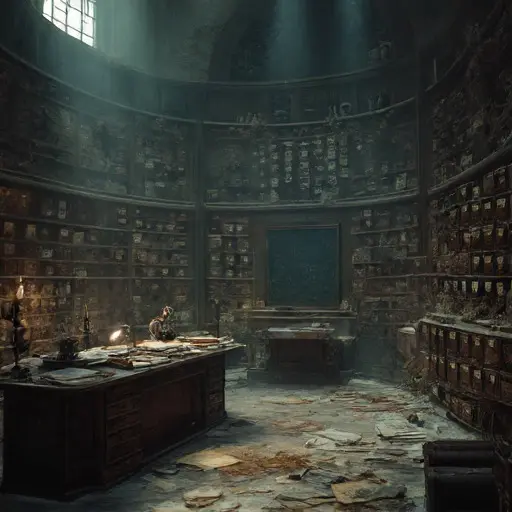
The moment the heavy, studded door to Chrono-Fugue creaked inward, the air was immediately cold, dry, and carried the specific, brittle scent of aged paper, leather bindings, and a faint, musty smell of forgotten ink. The name, combining a sense of time with a state of psychological flight or amnesia, perfectly captured the manor’s oppressive mood. This abandoned Victorian house was structured not for domestic life, but for the relentless, solitary pursuit of knowledge, its silence the heavy, suffocating quiet of a massive library after closing time, filled with the mute voices of history.
The final inhabitant was Professor Gideon Wells, a brilliant, but deeply reclusive and obsessive historian of the Victorian era. Professor Wells’s profession was the meticulous study and documentation of the past, focusing on bridging obscure, contradictory historical accounts. His singular obsession, however, was the creation of a ‘Perfect, Unifying Timeline’—a definitive narrative that would reconcile every single historical event into one flawless, logical sequence. After discovering a set of documents that violently contradicted the known timeline, he retreated to the manor. He dedicated his final years to resolving this single, terrifying paradox, believing that the truth of the past dictated the entire structure of the present. His personality was intensely rigorous, fearful of discontinuity, and utterly consumed by the pursuit of absolute chronological order.
The Anomaly Archive
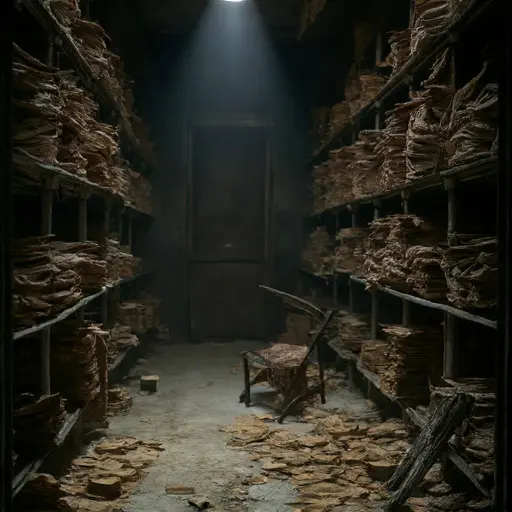
Professor Wells’s mania culminated in the Anomaly Archive. This small, secure room housed the contradictory documents he had discovered—the “anomalies” that threatened to unravel his entire life’s work. His private journals, written in a cramped, elegant hand and found inserted into the lining of an old, empty document box, charted his intellectual collapse. He stopped trying to reconcile the past and began trying to physically erase the anomalous documents from the Archive. “The Past is fissured. The present cannot stand the strain,” he wrote. “To save the timeline, I must eliminate the lie, even if the lie is true.”
The house preserves his anxiety structurally. In the main hallway, the wallpaper on a long section of the wall has been carefully, meticulously removed, leaving behind only the bare plaster, suggesting the Professor had searched even the fabric of the house for hidden, contradictory evidence.
The Final Date in the Abandoned Victorian House
Professor Gideon Wells was last seen in his study, surrounded by his charts, trying to glue torn fragments of paper back together. He did not leave the manor. The next morning, the study door was slightly ajar, the room cold, and the man was gone. No body was found, and the contradictory documents in the Anomaly Archive were missing.
The ultimate chilling clue is the final diary entry. The last written date, savagely scored out, suggests the Professor had finally isolated the precise moment of historical error. This abandoned Victorian house, with its silent archives and dusty timelines, stands as a cold, imposing testament to the historian who sought to fix the past, and who, in the end, may have succeeded in removing the single anomalous date from the timeline, along with himself.
