Catastrophic Stillness in the House the Shadow Archivist Left Half-Catalogued
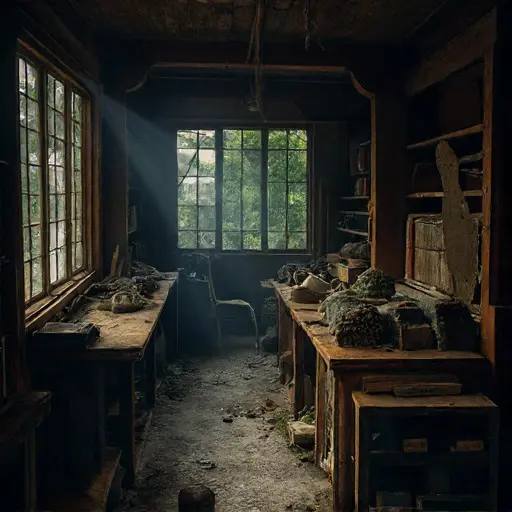
The labels are still drying.
Ink pooled slightly at the edges where the handwriting slowed.
Stacks of catalog boxes sit open as if someone stepped away mid-sentence and never returned.
This house belonged to Marek.
He worked as a shadow archivist, documenting displaced cultural artifacts, oral histories, and fragile regional records from abandoned settlements and remote communities.
The archive room was built into the back of the house, partially sunken into the hillside to keep humidity stable.
Wooden sorting trays lined the walls. Ink wells sat capped beside coded index sheets. Small lanterns hung from hooks above tables covered in classification slips written in multiple languages.
The house functioned less like a home and more like a memory engine.
Beneath the Grid Index Window
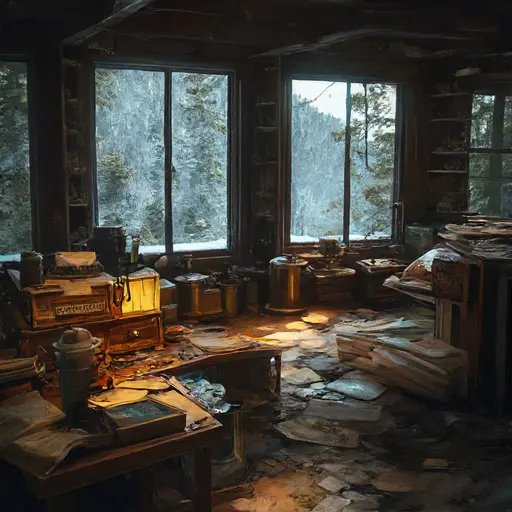
Marek worked most often beneath the Grid Index Window.
The wide desk under the northern glass was used for cross-referencing catalog entries against field notes gathered from abandoned villages and border settlements.
His partner left the region years earlier.
After that, Marek rarely spoke aloud inside the house.
For a long time, the profession still mattered.
Cultural preservation agencies depended on shadow archivists to document disappearing communities before relocation, modernization, or environmental abandonment erased them completely.
Then the programs dissolved.
Funding was redirected to centralized databases, and field archiving teams were dismantled in favor of automated scanning and satellite-assisted cultural mapping systems.
Marek continued manually.
Even when no one requested updates.
Even when submissions stopped being acknowledged.
But the decline of the field wasn’t the only collapse.
Entire forest-edge settlements began emptying due to slow economic withdrawal and infrastructure neglect. Roads were not maintained. Schools closed. Records became harder to verify as populations dispersed beyond traceable archives.
The archive room filled faster than it emptied.
Then stopped moving altogether.
Already suffering from progressive respiratory disease linked to years of damp fieldwork and long exposure to mold-heavy storage sites, Marek reduced his field visits and worked almost entirely inside the house.
One winter season, supply routes failed for weeks due to persistent snowfall isolating the region.
Marek remained inside the archive room attempting to finalize a classification series for a group of recovered village records that were already beginning to degrade.
He died quietly during that isolation period, surrounded by incomplete catalog systems and unsorted histories.
No institution came to retrieve the archive.
The house was left sealed by snow and later by administrative abandonment.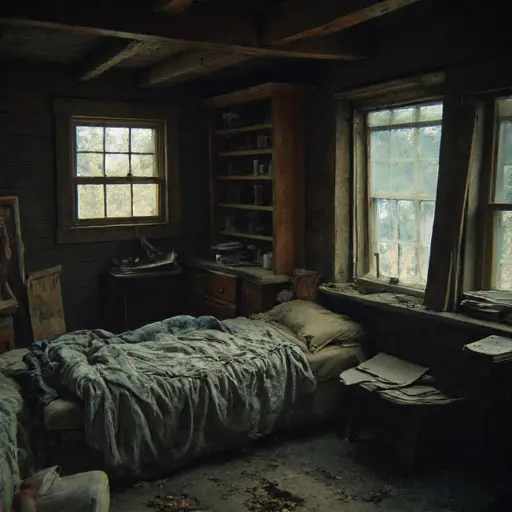
The index cards remain half-sorted.
The ink wells stay capped.
And beneath the Grid Index Window, Marek’s unfinished catalog continues waiting in silence—holding the last pieces of history he never finished placing into order.