Canyonlight Residence
Abandoned Victorian house, pale fired-clay plaster with uneven lime wash remnants, deep sepia-stained oak timber framing softened by decades of sun and wind abrasion, and matte graphite wrought ironwork with subtle hand-forged irregularities. A compact Victorian canyon-side residence sits embedded within a narrow geological cut where two towering rock faces rise in parallel, forming a natural corridor that compresses wind, echoes, and daylight into a constantly shifting vertical atmosphere.
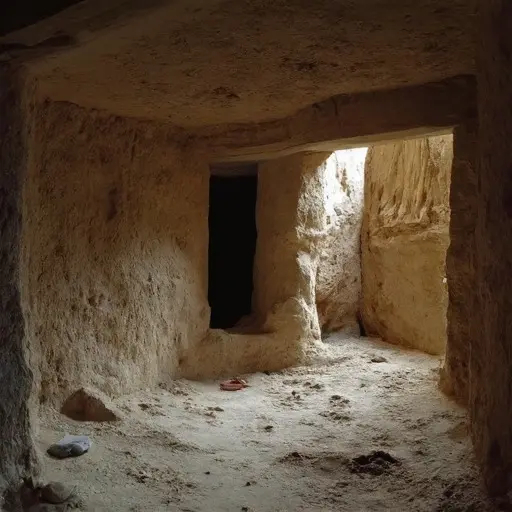
The architecture is tightly integrated into the canyon geometry, as if shaped by erosion as much as construction. A two-story main block anchors into the left rock wall, while the lower level is partially carved directly into stone, its edges softened by mineral dust and moisture. Above, a narrow upper study projects outward on reinforced timber brackets embedded into the cliff face, hovering slightly over the canyon floor like a quiet observation post for weather, water, and time.
The roof is steep slate, heavily weathered, with tonal variation from basalt gray to faded ash-blue, its surface subtly warped by decades of wind pressure and thermal cycling. Copper drainage lines have oxidized into muted green-brown streaks that trace natural runoff paths across plaster and timber.
The façade is fully exterior and materially honest. Fired-clay plaster shows fine structural cracking from long-term movement, with lime wash thinning unevenly so that raw substrate texture emerges beneath. Timber beams reveal compressed grain, repair seams, and slight twisting where moisture has penetrated over time, giving the structure a lived-in structural realism rather than decorative uniformity. Iron fixtures—brackets, anchors, and pulley mounts—are functional and weathered, with corrosion gathering in joints and sheltered undersides while exposed faces are naturally polished by wind-driven debris.
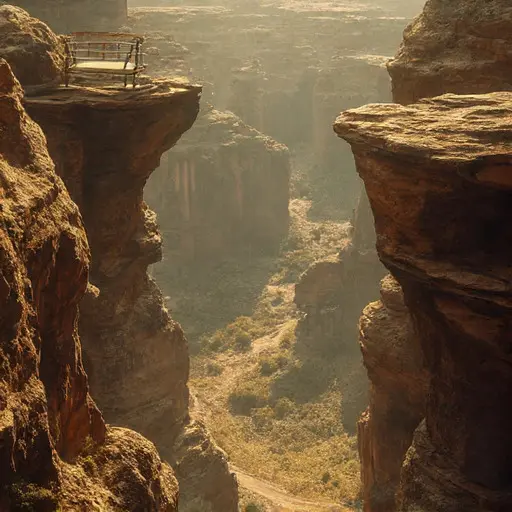
The canyon environment is the dominant spatial force. Rock walls on both sides display layered sediment bands, erosion grooves, and softened edges shaped by centuries of wind and intermittent water flow. Light enters as narrow vertical shafts depending on cloud cover, sliding slowly across plaster, timber, and stone surfaces in gradients that feel geological rather than atmospheric. The space feels enclosed but not artificial—an open-air chamber carved by time.
Vegetation is sparse and ecological rather than decorative. Moss grows only where moisture collects in stone seams and structural joints. Small hardy plants appear in isolated clusters: thin grasses rooted in sediment pockets, pale desert-toned shrubs clinging to cracks, and occasional muted wildflowers in dusty cream, faded violet, and softened yellow. Growth follows drainage and shelter patterns, not design intent.
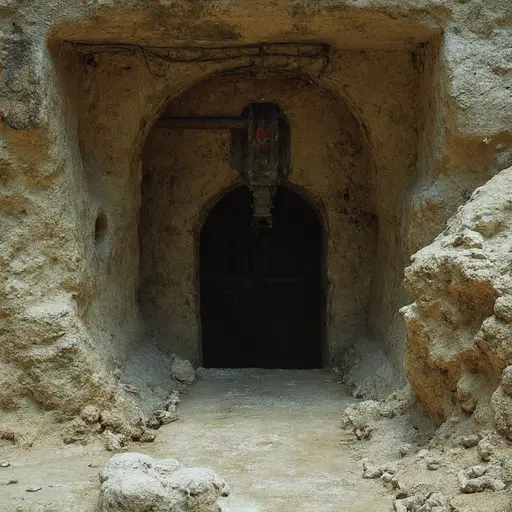
A collapsed timber wind-bridge once connected the upper study to the opposite canyon wall; only broken anchor beams remain, some still embedded in rock while others hang fractured into open air. Below, a rusted iron pulley system is fixed into the lower wall, its mechanism frozen and partially buried in dust and mineral buildup, hinting at former vertical supply movement through the canyon. Carved stone steps descend irregularly along one side toward a narrow runoff channel that appears only after rainfall.
Interior spaces are visible only in fragments. Deep-set window openings create strong shadow cavities within thick walls, with some panes intact but clouded and others missing entirely. Inside, only structural silhouettes are discernible—door frames, beam intersections, and empty recesses shaped by light rather than detail. No furnishings remain visible, only spatial geometry defined by depth and darkness.
Lighting is natural canyon overcast daylight, filtered through cloud cover above the ridge line. Illumination is soft but directional, with slow-moving tonal shifts as clouds pass overhead. Surfaces remain highly legible without dramatic contrast, emphasizing texture, erosion, and material behavior rather than theatrical lighting effects. Moisture in the air subtly softens distant rock edges while preserving crisp foreground detail.
The entire scene reads like a precise architectural field photograph of a Victorian canyon residence—geologically embedded, structurally compressed, and shaped entirely by wind, stone, and time. A dwelling defined not by ornament or narrative, but by environmental pressure and long-term physical adaptation within a narrow natural corridor.