Canalbound Silence of the Merchant Gables
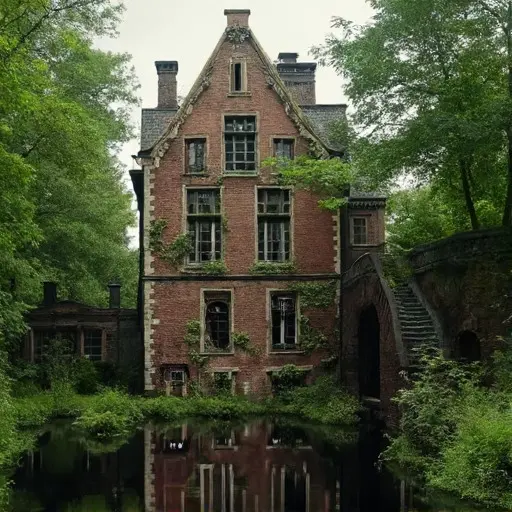
An abandoned Dutch Renaissance merchant estate stands at the edge of a canal-fed forest boundary, where trade-era precision has been slowly overtaken by water, vegetation, and time. The structure rises in a disciplined 3-story stepped composition, its dark red brick façade arranged in strict vertical and horizontal rhythm. Ornate stepped gables define the skyline, each one articulated with decorative sandstone cartouches that once signaled wealth and civic pride, now softened by erosion and shadow.
Cream stone window surrounds punctuate the brickwork in measured intervals, framing tall, narrow mullioned windows whose broken leaded glass no longer reflects life from within. The contrast between warm masonry and pale stone detailing remains sharply legible, reinforcing the estate’s original mercantile order even as nature presses closer from all sides.
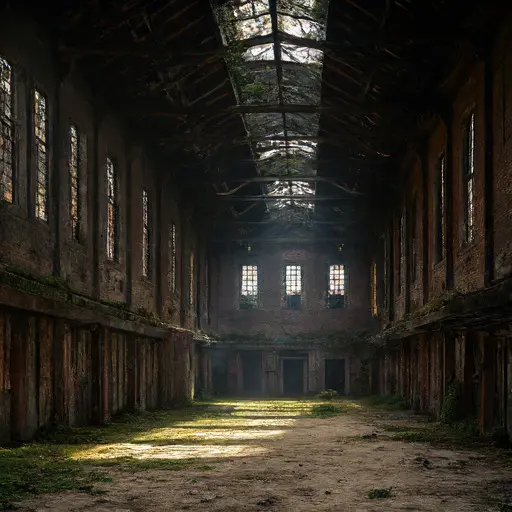
At the heart of the estate lies a warehouse-like manor hall integrated seamlessly into the residential wings. Its vast interior volume reflects its mercantile origins, with structural timber beams and brick arches spanning across a high, cavernous space. Light enters only through fractured windows and open breaches in the façade, falling in soft, broken shafts across the empty floor. There is no artificial illumination—only ambient daylight filtered through damaged glass and forest-filtered air.
Steep slate roofs run along the upper structure, their copper ridge caps dulled into deep brown-green patina after decades of exposure. The rooflines step and shift in a controlled rhythm, echoing the gabled geometry below. Along the canal edge, riverside quay structures have partially collapsed, their stone and timber foundations sinking unevenly into overgrown water channels.
Dense temperate forest now presses directly against the estate’s boundaries. Trees rise where trade paths once existed, and roots disrupt the geometry of cobblestone courtyards. The canal itself becomes a reflective corridor, mirroring fractured silhouettes of gables and trees in still, dark water.
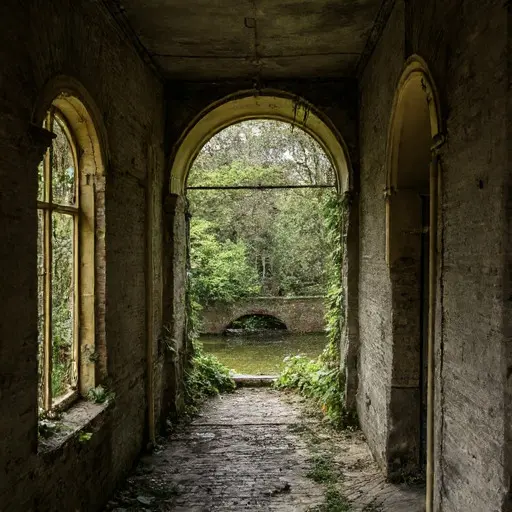
In the foreground, tilted wooden canal posts and wild grasses emerge from cracked cobblestone embankments, marking the threshold between engineered waterway and reclaimed wilderness. The composition moves in layered depth—from reflective canal surface to rigid brick gables and finally into dense forest backdrop—creating a gradual dissolution of human order into natural growth.
The overall atmosphere is calm and evenly lit under soft neutral daylight, with clear air and no atmospheric distortion. The estate remains structurally coherent yet emotionally hollow, a preserved fragment of mercantile history slowly absorbed by forest and water, where Dutch Renaissance precision persists as an architectural memory rather than an active presence.