Canal-span symmetry manor
Abandoned Victorian mansion, aurora-pear, ember-lapis, jade-coral
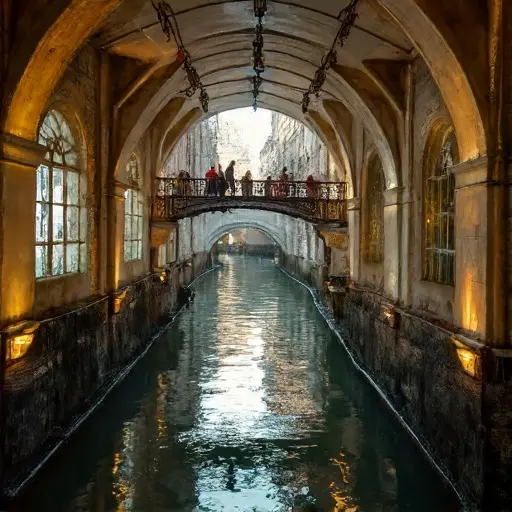
A compact courtyard bridge-manor designed as a single-span Victorian residence crossing a narrow canal, where the architecture is divided into two mirrored structural halves anchored on opposite banks and unified by a central arched bridge-room that functions as both circulation and primary architectural focal point. The silhouette is balanced and civic in composition, with left and right wings reflecting each other across the waterline, creating a restrained symmetry that emphasizes connection rather than expansion.
Rooflines are refined and gently arched, composed of continuous slate curves, fine copper seam accents, and evenly spaced chimney stacks that align visually across both halves and the central bridge span, forming a disciplined Victorian rhythm over water. The façade is fully exterior and ornamentally continuous: aurora-pear stucco surfaces, ember-lapis stone framing around tall canal-facing windows, and jade-coral wrought iron filigree that runs uninterrupted from one wing to the other, flowing across the bridge like a single architectural sentence.
The sky hangs in a clean river-blue overcast, naturally lit and soft, reflecting evenly on the canal surface and enhancing material clarity without haze or dramatic contrast.
The estate sits in a canal-garden biome where grass grows along stone embankments in uneven clusters and small floating vegetation gathers near the water’s edge, subtly softening the rigid geometry of the architecture with organic drift.
At the canal edge rests a broken stone mooring stair, partially submerged and worn smooth by water movement, once used for small boats approaching the manor’s central bridge entrance.
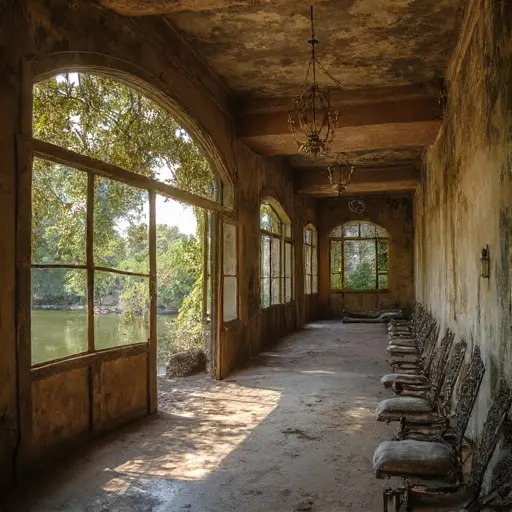
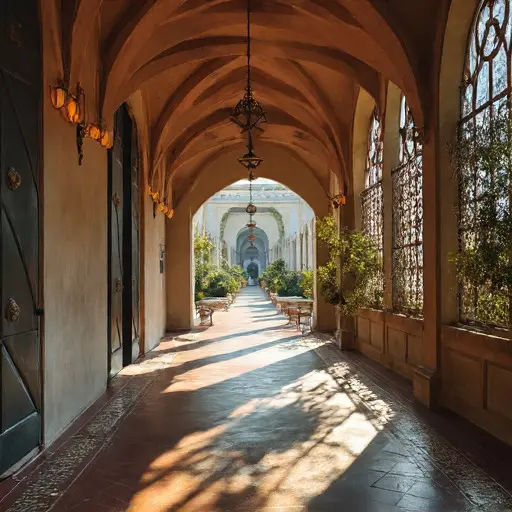
Inside, the manor remains abandoned yet structurally coherent, with interiors shaped by symmetry, reflection, and quiet architectural continuity.