Boulevard of glass and forgotten light
Abandoned Victorian mansion, aurora-lychee, sapphire-honey, jade-crimson
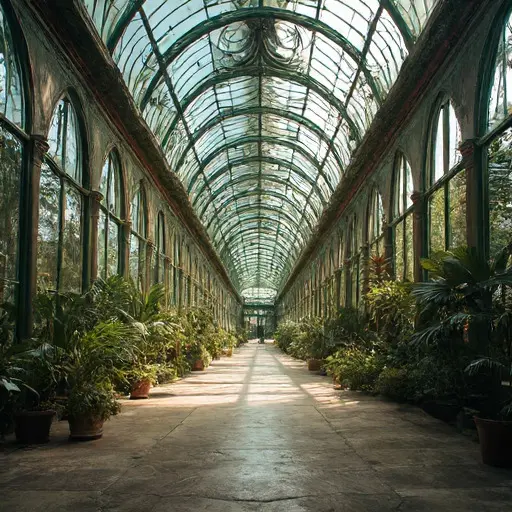
A compact greenhouse-boulevard manor designed as a long transparent Victorian conservatory residence, where the entire street-facing façade is formed as a continuous sequence of arched glass bays while a solid stone core sits recessed behind it like a restrained architectural spine. The silhouette is elongated yet controlled, emphasizing linear rhythm and transparency over mass, with the glass frontage functioning as both enclosure and public-facing architectural display.
Rooflines are minimal and precise, composed of narrow slate caps, thin copper drainage ribs, and segmented glass ridge vents that follow the conservatory’s linear progression with disciplined repetition. The façade is fully exterior and luminous: aurora-lychee timber framing that defines each structural bay, sapphire-honey glass panels etched with faint Victorian mullion patterns, and jade-crimson iron supports tracing arches, braces, and joints with ornamental structural clarity.
The sky hangs in a bright aquamarine overcast, naturally lit and clean, casting even daylight across the glass frontage so reflections, transparency, and interior layering remain legible without glare or dramatic contrast.
The estate sits along a garden boulevard biome where grass grows in neat linear strips between stone walkways and trimmed hedges that mirror the building’s extended rhythm, reinforcing its identity as both architecture and passage.
At the central walkway stands a broken glass thermometer column, fractured but upright, once part of a climate monitoring system for the conservatory façade, now dulled by time and exposure.
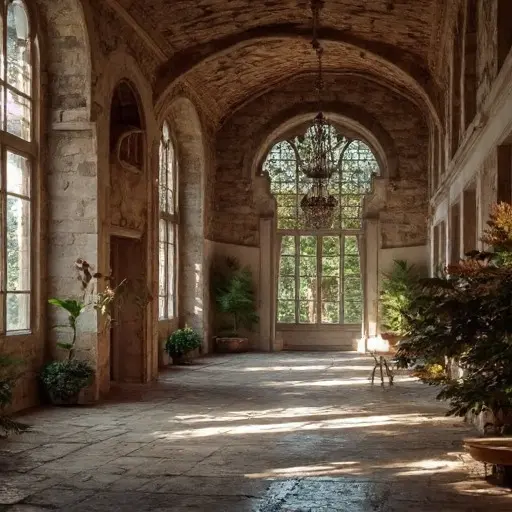
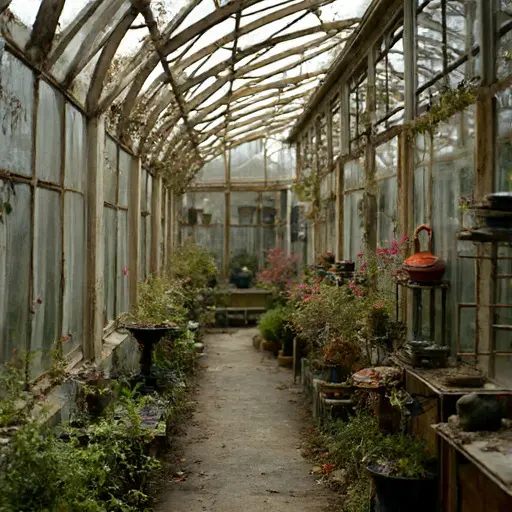
Inside, the manor remains abandoned yet structurally coherent, with interiors defined by layered light, botanical framing, and continuous glass-bound spatial rhythm.