Blooming Petal House of Forgotten Spring
Abandoned Victorian house shaped like a giant blooming flower, where every wing of the structure curves outward like a petal around a circular glass atrium. The exterior walls are painted in layered sapphire blue, burgundy red, emerald green, and warm cream, their pigments softened by time into a gentle patina of sun-faded vibrancy rather than decay. The entire composition sits in a bright, untouched meadow that feels almost too alive to belong to something abandoned, yet time has clearly passed through it like wind through tall grass.
The rooflines rise and fall in organic arcs, each “petal-room” capped with curved slate shingles that bend with the geometry of the building rather than resist it. Stained-glass bay windows sit within each colored segment, their panes fractured into floral motifs that scatter light into the surrounding vines.
Wisteria drapes from upper eaves in heavy lavender cascades, while climbing roses in soft pink, ivory, and deep crimson thread themselves through iron balcony frames and window arches. The architecture feels grown rather than built, as if the house once bloomed and simply never closed again.
At the heart of the structure, the circular glass atrium acts as both nucleus and memory core of the house, reflecting sky, garden, and color in layered symmetry. The surrounding meadow is dense with wild growth—daisies opening in white constellations, foxgloves standing like soft spires, lavender bending in slow wind waves, and scattered poppies burning in restrained red against the green field. The boundary between cultivated garden and wild landscape has dissolved completely, yet the original design still reads clearly beneath the overgrowth.
The façade is fully exterior and richly material. Painted woodwork retains visible brush textures beneath faded pigment layers. Iron railings curl around porches and balconies in elegant Victorian patterns, now softened by rust bloom and wrapped in living vines. The entire structure feels suspended between preservation and surrender, where nature has not destroyed form but extended it into something more fluid and organic.
The meadow surrounding the house rolls gently outward in every direction, uninterrupted except for narrow stone paths that still trace the original garden geometry. These paths are cracked but intact, softened by moss and flowering weeds. The air feels still, warmed by golden sunset light that turns every surface into a gradient of honeyed tones and long, delicate shadows.
Interior impressions:

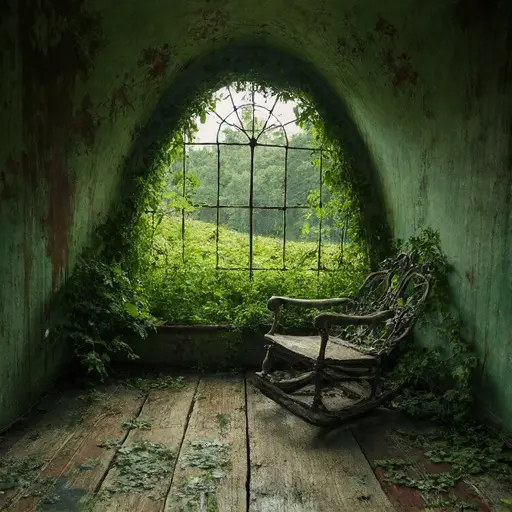
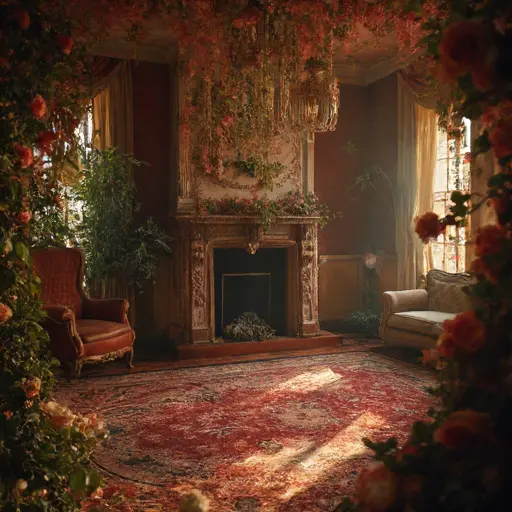
The entire scene reads like a high-resolution architectural photograph captured at golden hour after decades of gentle abandonment, where color, nature, and structure remain in quiet harmony. Nothing feels разруш or collapsed—only transformed. The house does not look lost, but remembered by the landscape itself.