Barbaric Quiet Had Already Claimed the Lodge Where Isolde Catalogued Forgotten Frost Patterns
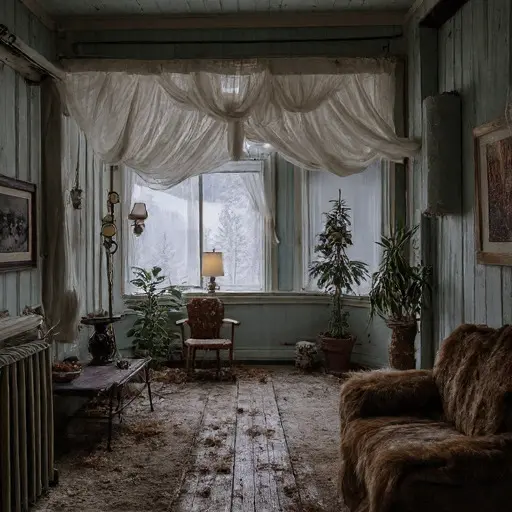
The windows remain marked.
Not dirty.
Marked.
Fine white tracings still cling to certain panes despite years of neglect—branching forms and feathered spirals so delicate they seem impossible to survive changing seasons.
Isolde never cleaned them away.
The lakeside lodge belonged to her.
She lived there alone and practiced a profession that disappeared alongside slower winters and patient observation.
Isolde was a frost morphology registrar.
Her work involved documenting, preserving, and classifying naturally occurring frost structures forming on glass, timber, and stone. Researchers, winter estates, and environmental observers once sought specialists like her to study atmospheric conditions through crystalline pattern behavior.
She read temperature through ornament.
The winter study still reflects her discipline.
Crystal sketchboards lean beside felt rulers. Preservation frames rest beneath shelves. Frost journals remain stacked beside shallow trays carrying mineral powders and glass fragments gathered across decades.
The room feels temporary.
As though winter might enter again at any moment.
Under the Pale Crystal Eave
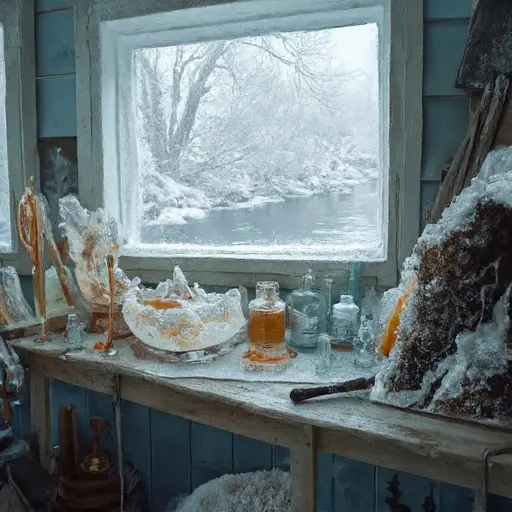
Isolde worked beneath the Pale Crystal Eave.
The overhanging beam near the northern windows held colder air longer than the rest of the lodge and preserved fragile frost formations during study.
One unfinished registry still rests there.
The crystal mapped.
The atmospheric conclusion absent.
Isolde inherited the craft through generations of winter caretakers and amateur meteorologists who believed frost carried information more intimate than snowfall or temperature alone.
Visitors remembered her breathing carefully near glass.
For decades the work survived.
Environmental stations and seasonal estates still valued direct frost observation tied to climate and regional weather behavior.
Then insulation improved.
Double glazing, central heating, and sealed modern architecture steadily eliminated the indoor frost conditions her profession depended upon. Windows stopped recording winter.
Isolde accepted comfort.
She grieved silence.
Still, she continued documenting exterior frost and preserving fragile formations long after institutions lost interest.
Then the winters fractured.
Erratic freeze cycles and increasingly unstable cold seasons disrupted the predictable conditions necessary for comparative frost study. Patterns appeared late, vanished quickly, or formed incompletely.
The cold survived.
Its handwriting altered.
Already living with severe Raynaud’s disease and declining circulation, Isolde spent longer mornings inside the study chasing increasingly rare formations.
One January she remained working before sunrise after a sudden freeze coated the lakeside glass in unusual structures she had never seen before.
A faulty stove released carbon fumes while she worked beneath the eave.
She never reached the door.
The funeral gathered teachers, anglers, and elderly neighbors who still remembered Isolde asking people to look at windows before landscapes.
The lodge remained afterward.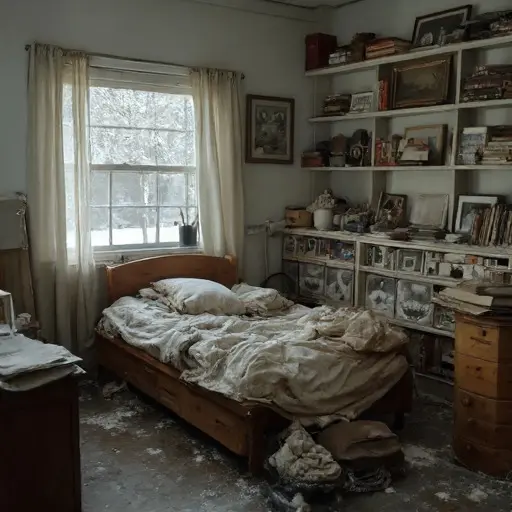
The sketchboards remain beside the frames.
The journals still rest beneath the shelf.
And under the Pale Crystal Eave, Isolde’s unfinished frost registry continues waiting in silence—holding a winter pattern she never returned to name.