Aurelia of the Drowned Horizon
A vast Victorian mansion rises from a tidal mangrove expanse like a fading imperial memory, its sapphire-azure façades and amber-opaline trims dissolving into a sunset-vermillion haze sky. The structure is not grounded in the conventional sense—it is half-rooted in wet earth and braided mangrove roots, as if the estate grew reluctantly out of the swamp and then forgot how to leave.
The main body of the mansion is a complex vertical composition of stacked wings, spiraling towers, and suspended bridge-turrets that curve upward in a horizon-spine silhouette. Rooflines shimmer in fuchsia-aurora tones, softened by atmospheric moisture and time-worn patina, their once-vivid pigments now dulled into layered gradients of rose, coral, and muted magenta. The architecture feels engineered yet loosening, as though gravity itself is gently persuading it to relax.
Across the façades, pearl-blackened brass latticework and lace-like Victorian iron filigree wrap balconies and corridors in ornate restraint. Salt air and wind have softened every edge, turning intricate craftsmanship into quiet silhouettes of its former precision. The metalwork remains intact, but visually subdued—more memory than ornament.
The windows are tall, narrow, and irregularly spaced across the mansion’s vertical stacks. Their glass is hollowed by wind and weather, reflecting only fragmented canopy movement and sky-toned gradients rather than interior life. No warm light escapes from within; instead, the structure reflects the surrounding mangrove world like a mirrored shell emptied of presence.
Mangrove roots weave directly through the estate’s architecture. Thick, dark tendrils pass through archways, colonnades, and lower terrace openings, binding the structure gently into the tidal earth. These roots do not appear destructive—they function like an organic scaffolding, holding the mansion upright against the slow pull of decay and time.
At the lower quay of the estate, a broken silver-gilt carriage rests half-sunken into moss-soft mud. Its fractured frame and ornate wheels are still legible beneath corrosion, suggesting ceremonial use long abandoned. It sits motionless, partially claimed by roots and sediment, like a relic left mid-journey.
The surrounding environment is a flooded mangrove garden, where emerald grasses persist in scattered islands of stone terraces and drowned courtyards. Water shifts slowly through the ground plane, reflecting warped fragments of architecture, roots, and sky in broken symmetry. The air is humid and heavy, carrying the softness of constant tidal breathing.
Lighting is natural and diffused—sunset vermillion haze filtering through dense atmospheric moisture. Every surface is bathed in matte, analogue softness without harsh glare, producing a painterly realism across stone, metal, and vegetation. Shadows are gentle, gradients are continuous, and the entire scene feels like it is being remembered rather than observed.
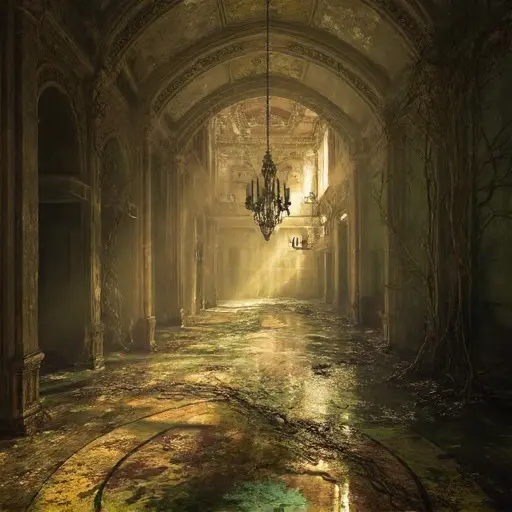
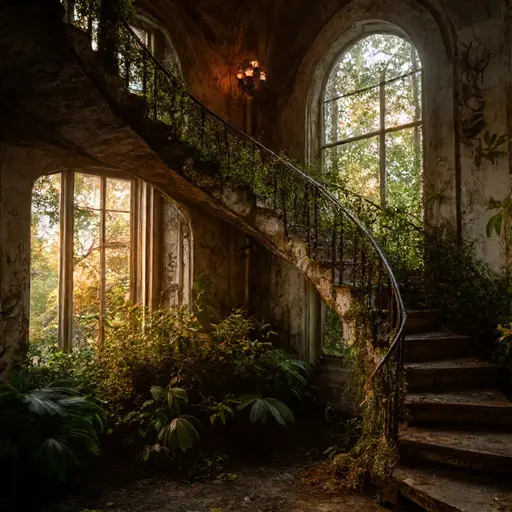
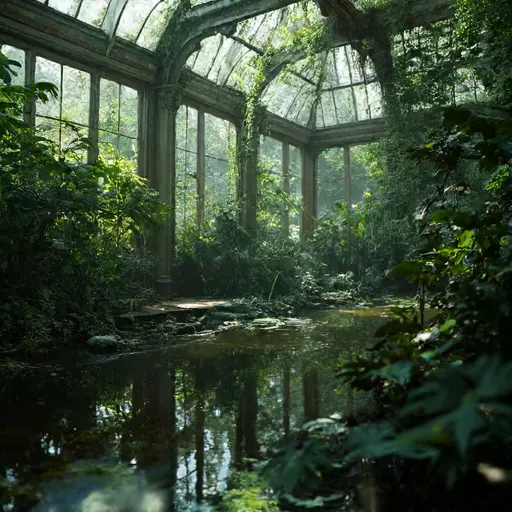
Ultra realistic textures, surreal yet grounded Victorian mangrove palace architecture, richly layered natural color gradients, cinematic aerial composition, photorealistic detail, Flux Dev optimized, physically believable structure, no floating elements, no exaggerated scale, atmosphere of elegant decay and tidal memory.