Aether-Reel: The Cinematographer’s Final Frame
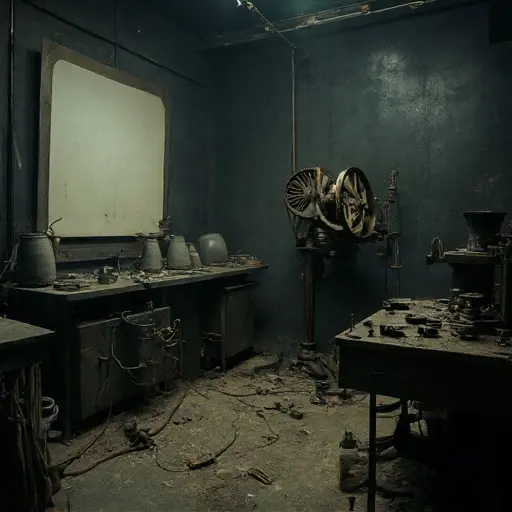
The moment the heavy, velvet-lined door to Aether-Reel swung inward, the air was immediately cold, dry, and heavy with the sharp, chemical odor of decomposing film stock and stale, recycled air. The name, combining the concept of the upper atmosphere with a film spool, perfectly captured the manor’s paradoxical nature: a lofty, visionary space dedicated to capturing fleeting motion. This abandoned Victorian house was structured not for living, but for the creation and presentation of controlled light, its windows meticulously shuttered and sealed to maintain perfect, controllable darkness.
The final inhabitant was Mr. Oberon Vale, a brilliant, but intensely reclusive early filmmaker and cinematographer of the late 19th century. Mr. Vale’s profession was the experimental creation of moving pictures, focusing on the manipulation of light, speed, and perspective. His singular obsession, however, was the creation of the ‘Eternal Loop’—a perfect, self-contained sequence of film that would capture a single moment of absolute, objective reality, played forever without decay or change. After a crucial piece of his earliest, most treasured footage was destroyed in a fire, he retreated to the manor. He dedicated his final years to resolving this single, terrifying goal. His personality was intensely visual, fearful of time’s ceaseless flow, and utterly consumed by the pursuit of cinematic immortality.
The Splicing Den
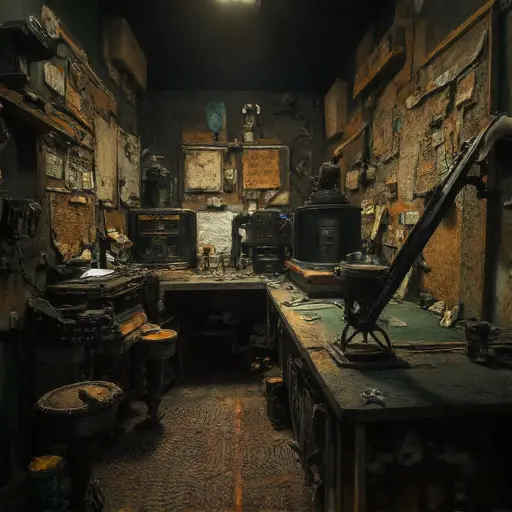
Mr. Vale’s mania culminated in the Splicing Den. This secure, light-tight room was where he spent his final days, cutting, gluing, and arranging frames into the ‘Eternal Loop.’ His journals, written in a small, precise hand that gradually shifted into frame-by-frame notations, were found tucked inside an empty film canister. He stopped trying to film reality and began trying to force the Eternal Loop into existence by sheer, meticulous arrangement, believing that the sequence of frames would achieve a philosophical stasis. “The truth is between the frames,” one entry read. “If the transition is perfect, the motion stops, and the moment is preserved. I must join the final, ultimate sequence.”
The house preserves his visual anxiety structurally. Many internal walls and ceilings are painted with complex optical patterns and grids, remnants of his tests to gauge the effects of motion and light on the human eye within the static environment.
The Final Frame in the Abandoned Victorian House
Mr. Oberon Vale was last heard working in the Splicing Den, followed by a soft, dry snapping sound and absolute quiet. He did not leave the manor. The next morning, the projection room was cold, the lens of the projector aimed at the empty screen, and the man was gone. No body was found, and the vast majority of his experimental film stock was missing.
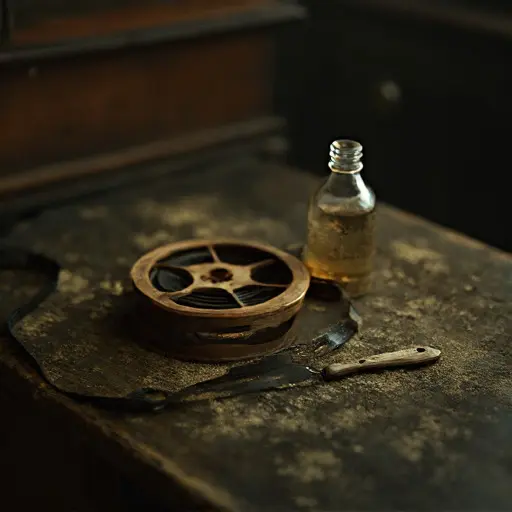
The ultimate chilling clue is the broken film loop. It is the final, perfect sequence, snapped cleanly at the splice. This abandoned Victorian house, with its blackened walls and ghostly, still machinery, stands as a cold, imposing testament to the cinematographer who pursued cinematic immortality, and who, in the end, may have successfully run his Eternal Loop—a sequence so perfect it contained the moment of his own permanent, silent, and final vanish.
