Abandoned Victorian Gothic Revival mansion on a formal stone forecourt
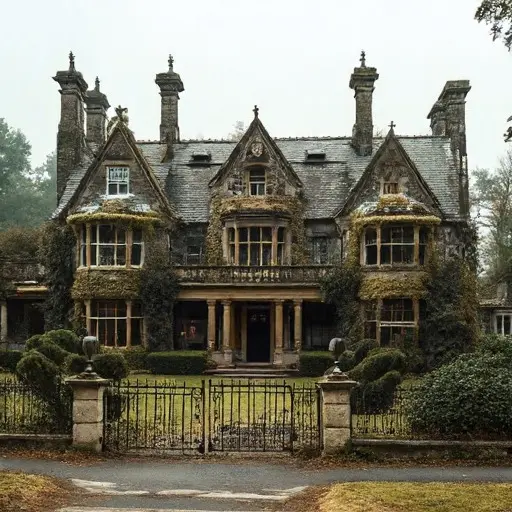
A tall Victorian Gothic Revival mansion is shown in a direct frontal composition, emphasizing its strict vertical alignment and monumental symmetry. The structure rises in layered tiers of darkened limestone, each block finely tooled yet softened by long exposure to weather, producing a muted surface palette of charcoal gray, smoky stone, and faint silver highlights. The overall impression is one of height and controlled tension, as if the building is continuously pulling itself upward.
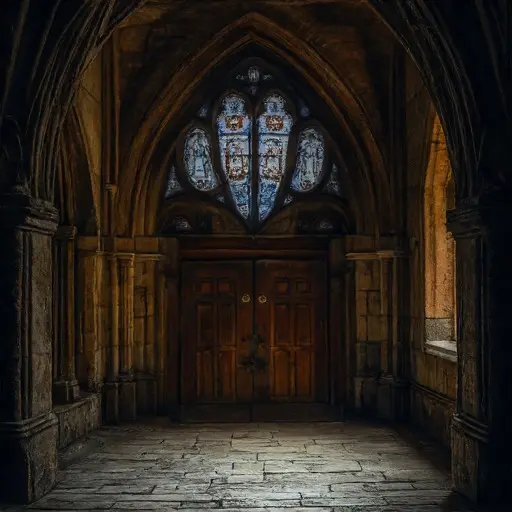
The central entrance is deeply recessed beneath a pointed arch portal formed by multiple concentric stone moldings. Each layer of carving becomes progressively finer toward the interior, where a heavy set of wooden doors sits in deep shadow, reinforced with oxidized iron bands.
Above this threshold, a tall stained-glass lancet window anchors the façade, its fragmented panes holding subdued tones of sapphire, moss green, and amber that still register faint color even under overcast skies.
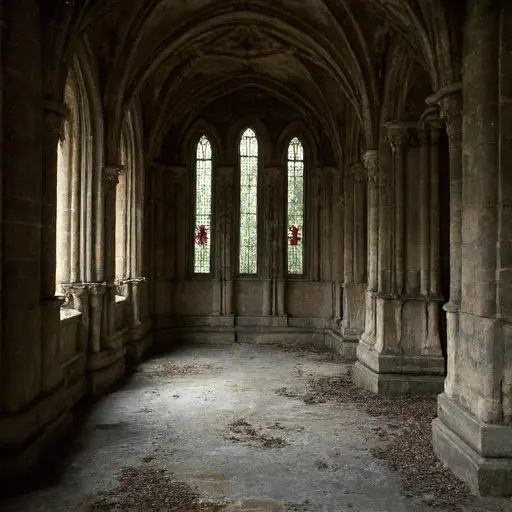
On both sides, symmetrical wings extend outward in measured repetition. Each level is marked by grouped lancet windows, arranged in pairs and triplets, set into thick stone frames that have eroded slightly at the edges. Between sections of wall, narrow buttresses rise into small pinnacles, some still intact and others subtly broken, reinforcing the building’s upward rhythm while showing uneven aging across its surface.
The roof is steep and fragmented, formed from overlapping slate planes that shift between graphite black and pale gray depending on moisture. Multiple chimneys rise in clustered formations, their brick softened by time and partially threaded with ivy that climbs in thin, controlled lines rather than uncontrolled overgrowth.
At ground level, a broad forecourt of uneven stone slabs stretches across the front of the mansion. The paving has slowly settled, creating subtle undulations that distort the geometry of the approach. A wrought iron fence with pointed finials encloses the estate, its central gate slightly misaligned, as though shifted by ground movement or long neglect. Gravel bands along the foundation host moss and small alpine plants that have taken root in the seams.
Beyond the house, a sparse arrangement of tall evergreens stands in ordered rows, reinforcing the vertical discipline of the architecture. The structure remains visually dominant even in abandonment, not through decay, but through its continued architectural authority over the landscape.