A settlement that forgot it was a single house
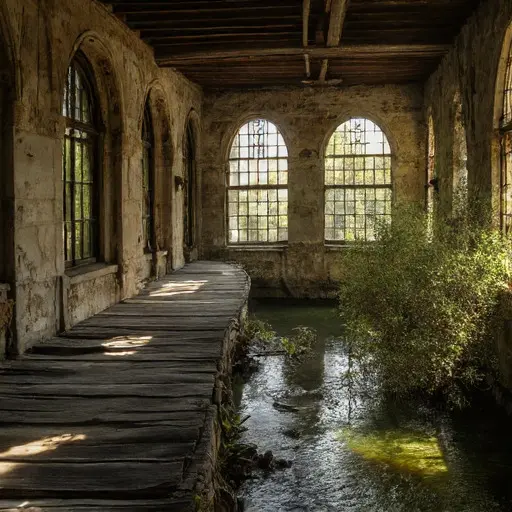
Inside one of the central pavilions, the interior feels less like a room and more like a suspended fragment of a riverside settlement. The floorboards sit slightly raised above the floodplain, supported by timber ribs that extend down into unseen water channels. Through tall sash windows, the delta constantly moves—reeds bend, channels split and rejoin, and light fractures into long horizontal bands across limewashed stone walls.
The atmosphere is quiet but never still; even the architecture seems to participate in the slow redistribution of water outside.
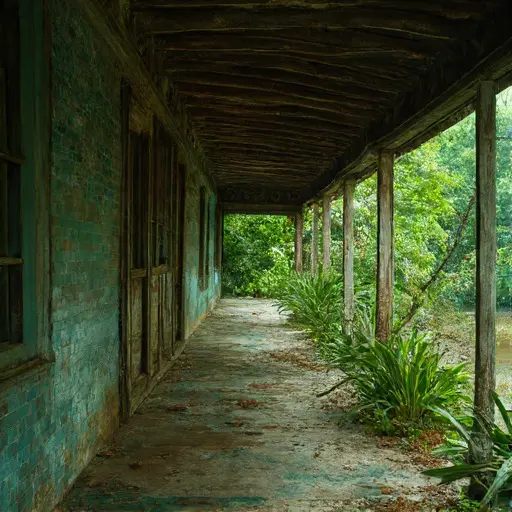
A veranda pavilion opens outward toward one of the braided channels, its perimeter defined by repeating timber columns that blur into perspective as they follow the levee’s curve. The walls are clad in patterned ceramic tiles, once ornamental but now softened into abstract fields of ultramarine, moss green, and faded amber. Moist air carries fine sediment that dulls surfaces without erasing their detail. Between columns, the river reflects fragments of architecture back into the space, as if the building is doubled and continuously rewritten by water.
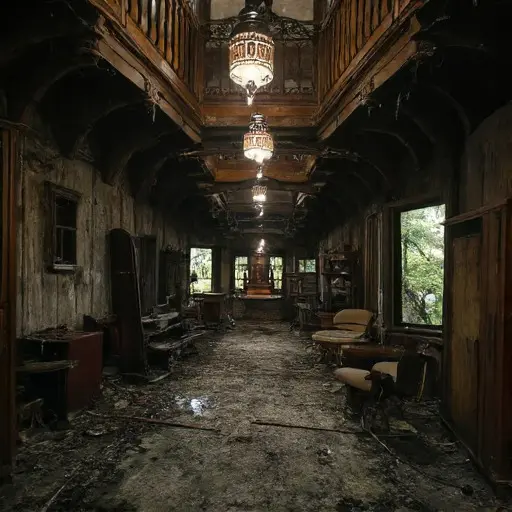
At a connecting node where multiple pavilions converge, a larger hall acts as the system’s quiet anchor. Elevated walkways pass through and around it, visible through arched openings like suspended arteries linking separate lives of the same structure. The space is lit by soft, diffuse daylight that enters from multiple directions, reflecting off worn brick, stone, and timber surfaces in overlapping gradients of rust, sand, and muted green. Everything here feels interconnected yet incomplete, as if the house is still deciding whether it should remain divided or become one again.