A Quiet Manor Beneath the Ash Canopy
An abandoned Victorian family manor sits deep within a shadowed forest basin where towering ash and oak trees intertwine overhead, forming a dense, vaulted canopy that filters daylight into a constant soft gray-green glow. The structure is a long, dignified residence built from pale limestone and muted slate-blue brick, its original strict symmetry subtly relaxed by later additions—a narrow reading wing, a glass conservatory for winter plants, and a discreet service corridor that wraps along the rear elevation. The roofline is complex but coherent, with intersecting gables and weathered slate tiles shifting into tones of charcoal, desaturated indigo, and softened pewter.
The façade is composed and restrained: evenly spaced arched windows framed in aged cream-painted wood, a central bay window projecting slightly from the main hall, and a modest wrought-iron balcony on the upper floor that shows a gentle, time-softened sag. Glass surfaces remain intact but dulled, reflecting only fragmented impressions of forest trunks and drifting mist beyond the grounds.
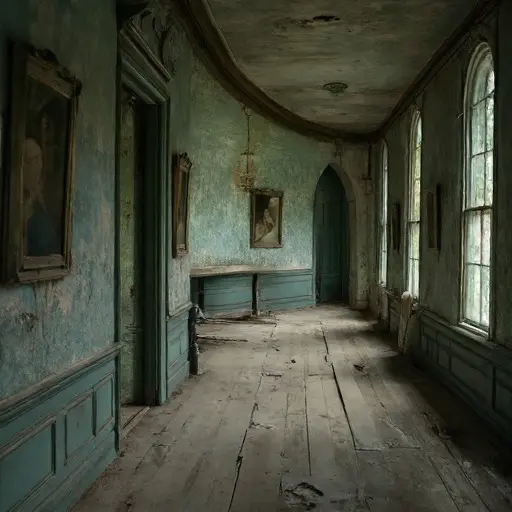
Inside, the manor remains carefully composed despite abandonment. The central hall runs like a spine through the building, connecting rooms arranged with quiet logic rather than grandeur. A library with tall built-in shelves occupies one wing, its volumes still aligned in disciplined rows beneath softened shadows. The dining room remains set as if paused mid-meal, while adjacent drawing rooms hold upholstered furniture in muted teal, dusty olive, and faded cream fabrics, all preserved under a thin, even layer of dust.
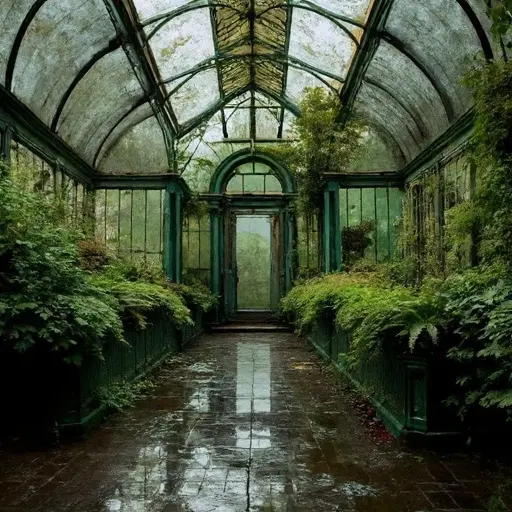
At the rear, the conservatory extends into the forest like a softened geometric extension of the house. Its iron framework remains intact, but the glass has aged into a translucent veil that diffuses light into cool gradients. Inside, plants have grown into a contained wilderness—ferns, ivy, and long-abandoned ornamental species forming a slow green accumulation that never escaped its enclosure. Elsewhere, ivy traces selective seams of exterior stone, respecting architectural lines rather than overwhelming them.
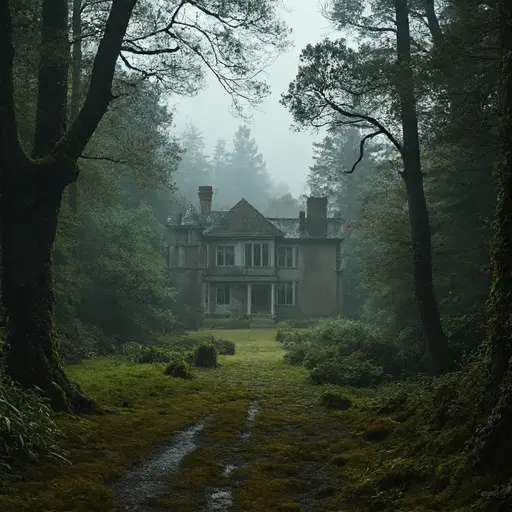
The surrounding grounds have transitioned into a softened woodland garden. Former gravel paths are now submerged beneath moss and leaf litter, and the remnants of a circular carriage drive are barely legible beneath creeping vegetation. The forest has approached with restraint rather than force, wrapping the manor in quiet continuity instead of destruction.
The atmosphere is still, overcast, and evenly diffused through layers of canopy and mist. No storms, no movement—only the slow, dignified merging of Victorian architecture and ancient forest, as if the manor has always belonged to the hollow it now occupies.