A Quiet Box of Stone on the Open Heath
An abandoned Victorian family house stands in a wide, gently rolling heathland where low shrubs, heather, and scattered gorse bushes stretch toward distant low hills under a calm, evenly lit sky. The terrain is open but textured, with soft variations in vegetation that shift in color from muted greens to dusty purples and pale sandy tones, depending on the soil beneath.
The house is a compact two-story Victorian residence built from rough-cast stucco over brick, giving its exterior a slightly granular, hand-finished texture. The stucco has weathered into a subdued palette of pale stone gray and softened ivory, with faint irregularities that reveal the building’s age without suggesting decay.
Its form is simple and slightly boxy, with a modest rectangular footprint and a symmetrical façade centered around a recessed entrance.
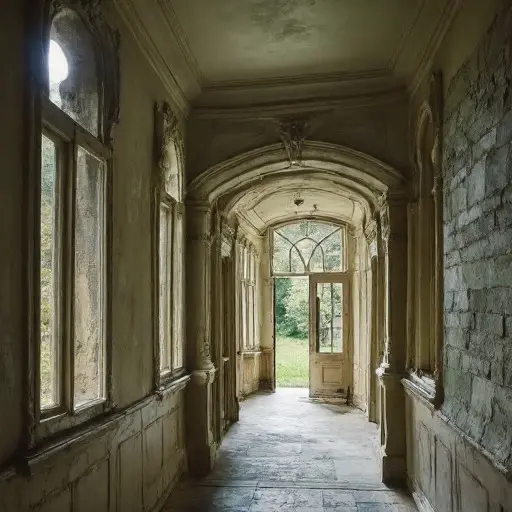
The entrance is framed by a shallow arch rendered in smooth plaster, leading to a solid wooden door painted in a faded muted slate tone. A small transom window sits above the door, allowing soft light into the interior hallway.
Windows are evenly spaced and uniform in size, arranged in a disciplined grid across both floors. Each is a traditional Victorian sash window with slender wooden frames painted in a dull off-white that contrasts gently with the stucco walls. The glass reflects the surrounding heath in softened, slightly hazy reflections.
The roof is a shallow pitched structure covered in weathered slate tiles that have settled into a consistent dark gray tone with subtle hints of green where moisture has lingered. A single chimney rises from one side of the roofline, constructed from matching stuccoed brick and capped with a simple stone slab.
A narrow gravel apron surrounds the base of the house, marking the boundary between structure and heathland. The gravel has partially dispersed into the surrounding soil, allowing grasses and small plants to reclaim its edges. There is no formal path, only faint traces of where footsteps once regularly passed.
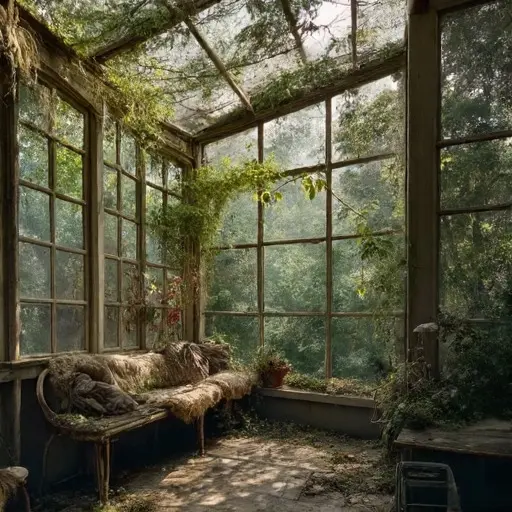
At the rear, a small conservatory extension is attached, built with a simple timber frame and large glass panes now slightly dulled by age. It sits quietly against the main structure, suggesting a space once used for plants or seasonal light rather than grandeur.
The surrounding heath is open and steady, with wind moving across low vegetation in soft, continuous motion. No trees dominate the immediate area, allowing long, uninterrupted sightlines toward distant hills and sky.
The atmosphere is calm, natural, and understated—an abandoned Victorian family house resting in quiet heathland, defined by simplicity, proportion, and the gentle persistence of the surrounding landscape.
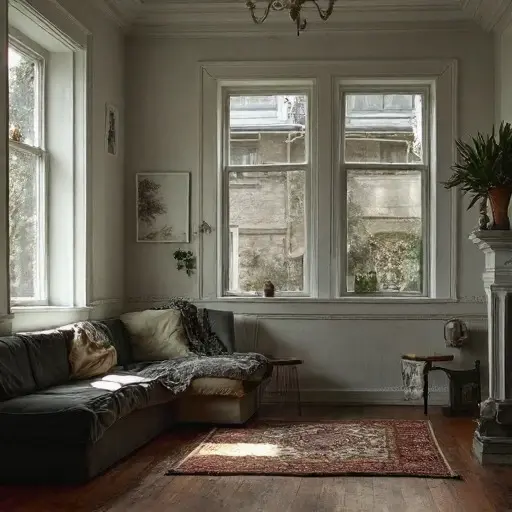
Interior glimpses: