A house that remembers water
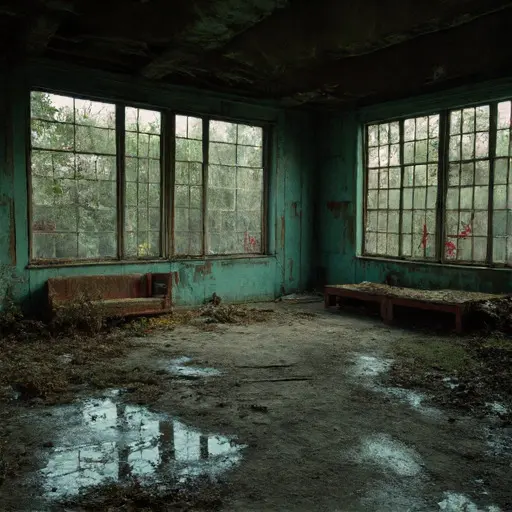
Within the central pavilion, the main hall stretches in a long, grounded line rather than rising upward, its ceiling kept low by necessity rather than design flourish. Timber beams run parallel like ribs of a stranded vessel, darkened by decades of fen moisture until they resemble polished driftwood. Light enters through wide horizontal panes that do not so much illuminate the room as dissolve into it, carrying the outside reeds and water channels into faint, wavering reflections across worn floorboards.
The sense is not of enclosure, but of being gently suspended between air and water.
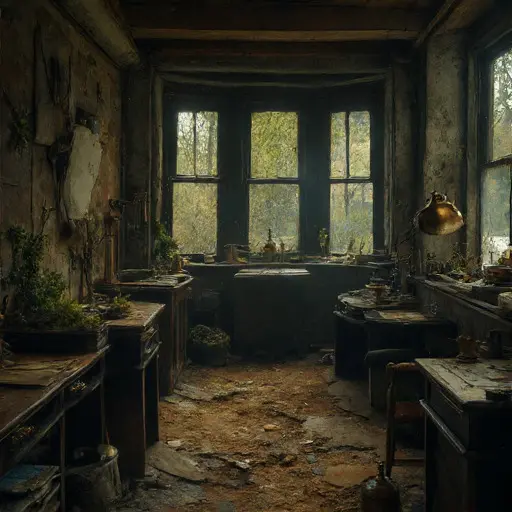
A smaller study chamber sits slightly offset from the main axis, accessed through a narrow covered walkway that creaks softly underfoot. Here, the walls are closer, lined with tar-treated shingles whose dark surfaces absorb most of the light, leaving only thin edges of reflection along their irregular grain. A simple wooden desk faces a long strip window where fen mist drifts past in slow, unbroken sheets. Objects within the room feel preserved rather than displayed—papers curled from humidity, ink softened at the edges, metal tools dulled to quiet browns and greens.
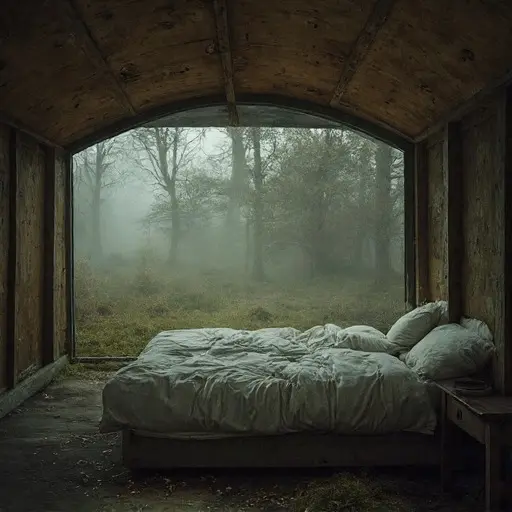
In one of the outer pavilions, a sleeping room rests closest to the bog surface, its floor slightly elevated on visible piles that descend into unseen depth. The bed is a low platform built into the room’s structure, as if the house grew around it rather than placed it. Outside the long window band, floating mats of peat and reeds drift slowly across dark water, occasionally breaking the reflection of the house into fragmented lines. Inside, everything is quiet, softened by constant moisture in the air, where even sound feels slightly delayed, as if it must pass through water before being heard.