A house that floats on color and silence
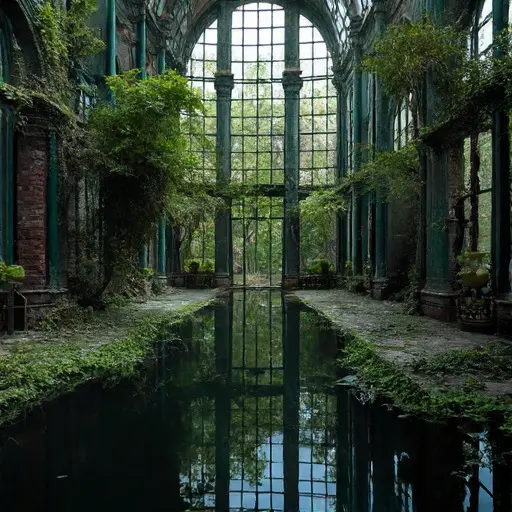
Inside the central pavilion, the house feels as if it is hovering just above the surface of the wetland rather than resting upon it. Black water pools slip between the stone islets below, visible through broad glass panels that extend nearly from floor to ceiling. The walls are built from layered glazed brick—cobalt, emerald, amethyst, and amber—each surface catching and bending light differently as moisture moves across it.
Porcelain tiles etched with faint Victorian botanical patterns soften the transitions between color fields, while iron ribs trace structural lines through the space like dark calligraphy. Mist drifts in from the open channels, briefly dissolving edges before retreating back into the water.
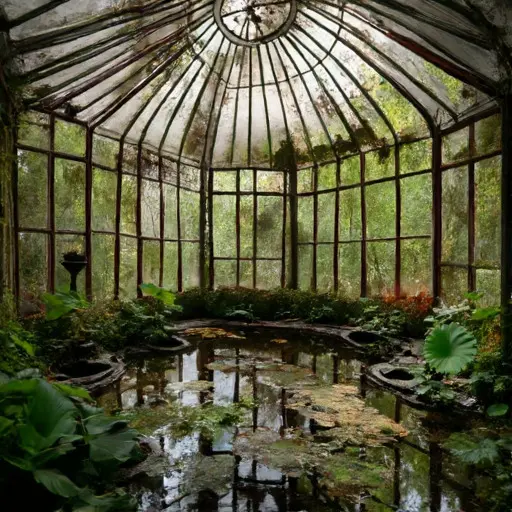
A smaller domed pavilion sits on one of the stone islets, its curved glass roof framed by copper ribs that have aged into turquoise-green patina. Beneath it, the room is almost entirely surrounded by reflection: lilies float in nearby channels, their shapes mirrored on the underside of the glass and fractured across porcelain wall panels. The space is softly luminous, dominated by opal whites and pale greens that shift with the movement of water outside. The boundary between interior and exterior becomes uncertain, as reflections of reeds and sky appear to drift through the room itself.
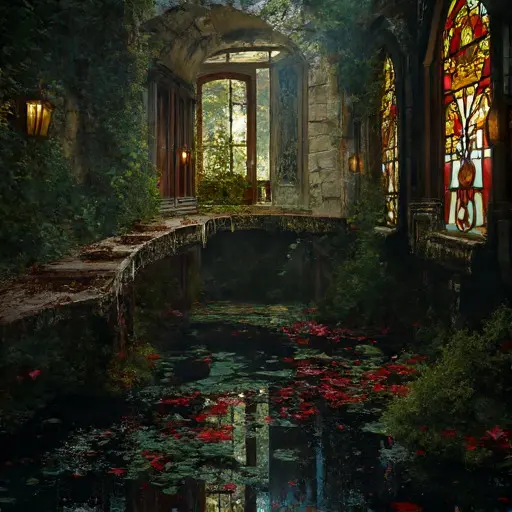
Between two pavilion clusters, a narrow arcing bridge spans the wet channels, constructed from stone slabs reinforced with iron ribs. Below, the water is almost black, reflecting fragmented bands of glazed brick and stained glass from the surrounding structures. As the walkway curves forward, each step reveals a new alignment of color—deep blues, greens, violets, and amber shifting like a slow mosaic in motion. The air here is humid and still, broken only by faint ripples moving through floating reeds that occasionally brush the base of the structure. The entire passage feels less like transit and more like moving through a suspended reflection.