A House Between Trunks and Quiet Water
An abandoned Victorian family house sits within a dense riverside grove where tall poplars and ancient ash trees grow close together, forming a vertical forest corridor that filters daylight into soft, shifting columns across the ground. The river runs quietly nearby, hidden in parts by vegetation, its presence suggested by occasional glints of reflected light and the soundless impression of movement through the landscape.
The house is a compact two-story Victorian residence built from pale buff brick that has aged into warm, subdued earth tones. Its structure is tightly composed, with a slightly compressed footprint that feels adapted to the narrow grove clearing rather than imposed upon it.
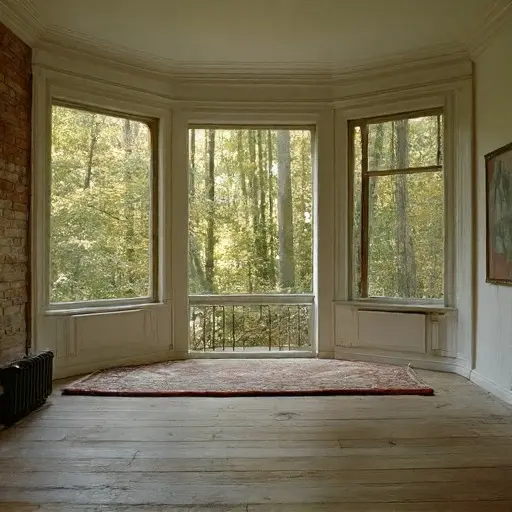
The façade is organized with restrained symmetry: a centered entrance, flanked by evenly spaced sash windows, and a single bay window that gently protrudes from the ground floor.
The bay window is modest in scale and octagonal in shape, adding subtle dimensionality without breaking the overall balance of the structure.
The roof is steep and simple, covered in weathered slate tiles that have softened into a palette of muted gray, faint greenish undertones, and darkened stone hues. A single chimney rises from the rear slope of the roof, slightly offset from center, its brickwork consistent with the rest of the house but darkened by age and moisture.
Window frames are thin and painted in a faded off-white that has dulled over time, blending gently with the brickwork. The glass remains intact and reflective, capturing fragmented views of tree trunks, canopy gaps, and patches of sky filtered through the grove.
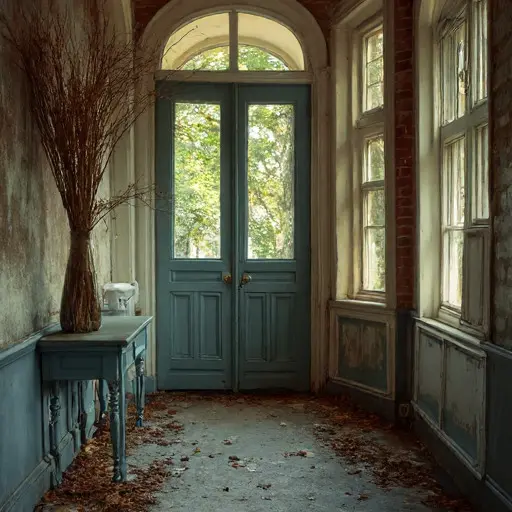
A small stone step leads up to the front door, which is simple and wooden, painted in a subdued deep slate blue. The entrance is sheltered by a shallow hooded canopy supported by understated timber brackets, offering minimal protection from rain without decorative excess.
On one side of the house, a narrow side passage runs between the building and the surrounding trees, leading toward a small outbuilding partially obscured by foliage. This secondary structure is low and functional, likely once used for storage or utility purposes, and is built from matching brick with a simple pitched roof.
The ground around the house is natural and undisturbed, with roots weaving through soil, moss gathering near the foundation, and ferns growing in shaded pockets. There is no formal garden, only the gradual blending of structure and woodland edge.
The surrounding grove is quiet, enclosed, and steady, with vertical tree trunks forming a natural rhythm that echoes the house’s own proportions. The atmosphere is calm and intimate—an abandoned Victorian family home resting quietly in a riverside woodland corridor, preserved in structure and gently absorbed by its environment.
Interior glimpses: