A Fieldstone House That Learned the Shape of Wind
An abandoned Victorian family house stands alone in a wide, gently sloping meadow where tall grasses sway in slow waves and scattered hawthorn bushes mark the old lines of forgotten field boundaries. The landscape is open and quiet, with soft daylight, clear air, and a distant tree line that frames the horizon without enclosing the space.
The house is a modest two-story Victorian farmhouse built from pale fieldstone and irregular hand-cut limestone, giving the exterior a textured, grounded appearance. The stonework is left largely unornamented, with subtle variations in tone—warm gray, soft beige, and faint hints of ochre—suggesting material gathered from the surrounding land itself.
The structure is simple and slightly elongated, with a central living core and a small attached side room that was likely added later for practical use.
The overall silhouette is low and stable, with a strong horizontal emphasis that feels suited to rural life rather than urban formality.
The roof is steeply pitched and covered in weathered wooden shingles that have softened into a muted blend of brown-gray and silvered drift tones. The edges of the roof extend slightly beyond the walls, forming shallow overhangs that cast gentle shadows across the upper façade. A single brick chimney rises from near the center ridge, its surface uneven and naturally worn.
Windows are small, functional sash openings arranged with practical spacing rather than strict symmetry. Their wooden frames are painted in a faded off-white that has thinned over time, revealing the grain beneath. The glass is slightly rippled, catching reflections of sky and meadow in softened, distorted patches of light.
A simple wooden porch sits at the front entrance, constructed from rough-hewn planks and supported by plain timber posts. It is unadorned, serving purely as shelter from rain and wind. The front door is heavy oak, darkened with age, its surface marked by subtle wear patterns from long use.
A narrow dirt path leads from the porch into the meadow, blending gradually into the grass as it stretches outward. There are no fences or formal borders, only the natural transition between cultivated space and open field.
The surrounding meadow is calm and expansive, with gentle wind, scattered wildflowers, and the distant movement of grasses under steady light. The atmosphere is grounded, quiet, and natural—an abandoned Victorian rural family home resting in open countryside, shaped by simplicity, utility, and the land around it.
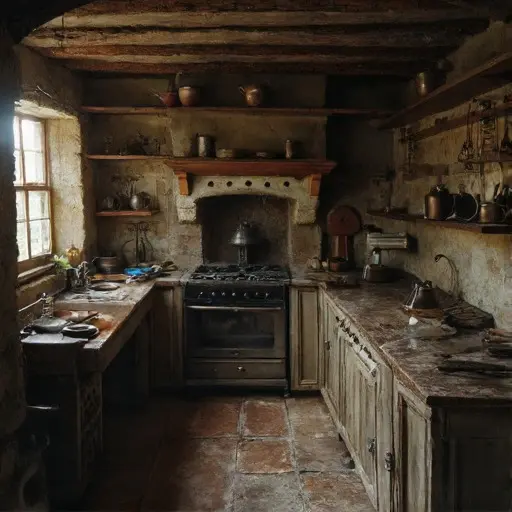
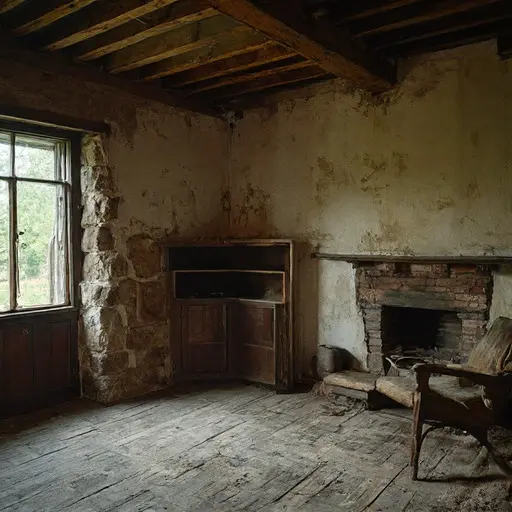
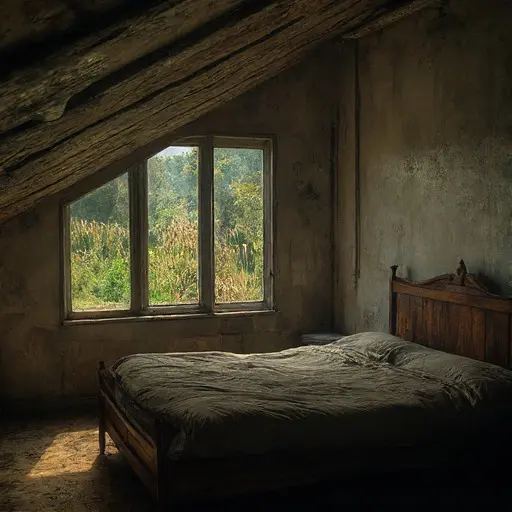
Interior glimpses: