The Forgotten Renaissance Villa Beneath the Olive Trees
Hidden within a quiet forest neighborhood, an abandoned Italian Renaissance Revival Victorian estate rests behind moss-covered walls, ancient trees, and forgotten garden paths. Constructed from warm cream marble, pale peach limestone, dark olive-green metal roofing, and deep red brick structural accents, the three-story residence remains a graceful reminder of a refined architectural era slowly returning to nature.
The home was designed with a balance of elegance and symmetry, blending Renaissance-inspired details with Victorian craftsmanship. Rounded loggias open toward the gardens, carved stone arches frame the entrances, and elegant columned balconies extend across the façade. A central circular tower rises above the property, while a glass-domed atrium connects the main wings and creates a luminous heart within the abandoned residence.
Time has softened the original precision of the architecture. The façades now curve gently with age, columns sit slightly unevenly, and the great glass dome has tilted subtly above the central structure. Terraces step outward into the surrounding garden, creating a flowing connection between the residence and the landscape that has grown around it.
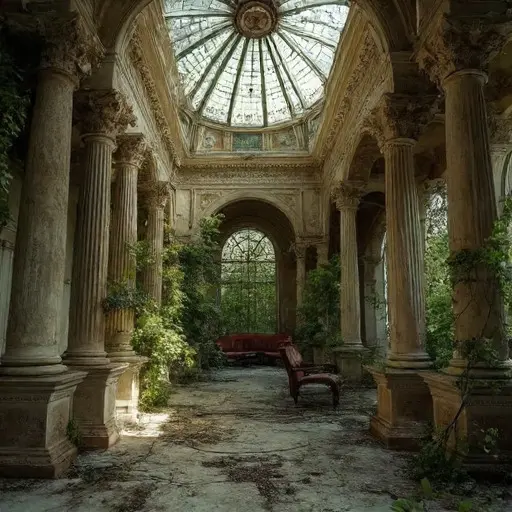
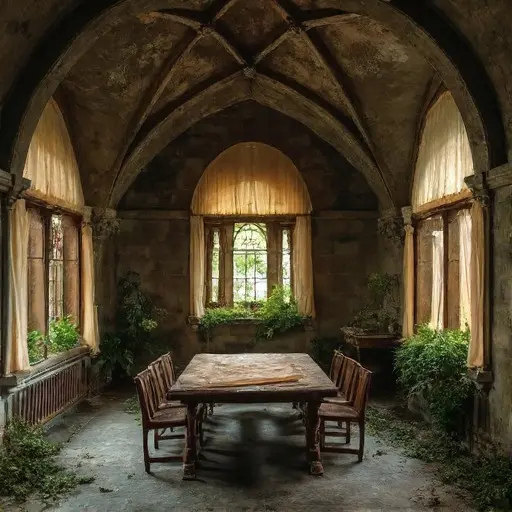
Inside, the forgotten villa reveals traces of a once-grand family residence. Marble floors, carved stone details, and elegant archways remain throughout the interior, while abandoned furnishings sit beneath layers of dust. The glass atrium allows soft daylight to fall across empty halls where vines and plants have slowly begun to reclaim the spaces.
The surrounding estate grounds have transformed into a peaceful woodland garden. Ancient olive trees stretch across the property, towering cypress trees create natural corridors, and moss-covered garden walls surround winding limestone paths that disappear beneath wild vegetation. The landscape feels carefully designed yet completely surrendered to nature.
Beside the gardens, a faded white stone pergola stands near a forgotten reflecting pool. The still water mirrors the surrounding trees and weathered architecture, while fallen leaves and wild plants cover the once-maintained edges. Near the entrance courtyard, a rusted deep-red iron bench rests beneath climbing vines, quietly surrounded by overgrown greenery.
The glass-domed atrium remains the defining feature of the abandoned estate. Once a gathering space filled with light and conversation, it now serves as a hidden garden enclosed within the house itself. Broken panels, creeping vines, and natural growth have transformed the elegant structure into a living space where architecture and wilderness exist together.
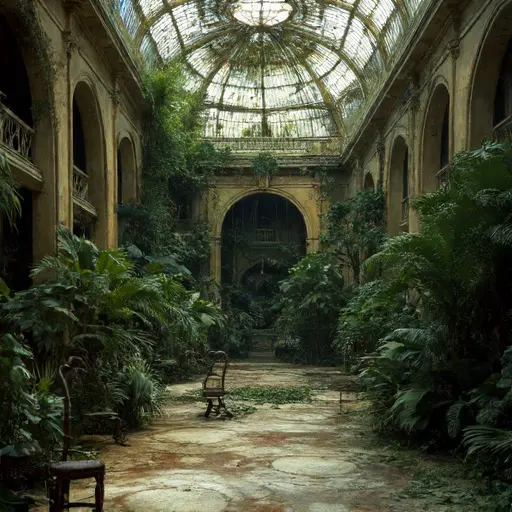
The abandoned Italian Renaissance Revival Victorian house now stands as a quiet monument to beauty, craftsmanship, and time. Surrounded by olive trees, cypress forests, and forgotten gardens, the residence feels like a lost estate preserved in silence. Its curved stonework, weathered terraces, and reclaimed landscapes tell the story of a home where human artistry and nature have slowly become one.
Photorealistic documentary-style full-frame photography, wide three-quarter architectural view from the garden path, natural lens rendering, true-to-life color grading, subtle film grain, moderate depth of field.