The Burgundy Mansard House Beyond the Birch Trees
At the quiet edge of a forest neighborhood, where tall birch trees and old maple branches surround forgotten garden paths, stands an abandoned Second Empire Victorian family house that preserves the elegance of a vanished era. Hidden behind mossy stone walls and overgrown vegetation, the residence remains a striking reminder of nineteenth-century craftsmanship slowly transformed by time.
The three-story home is built from white limestone, rich burgundy-red brick panels, and a weathered charcoal mansard roof crowned with aged copper cresting. The contrast between the pale stone, deep red masonry, and dark roofing creates a powerful architectural presence, combining formal Victorian refinement with the softened appearance of long abandonment.
The façade is defined by curved dormer windows, ornate iron balconies, carved window surrounds, and a broad rounded corner tower that gives the house its distinctive silhouette.
The tower rises above the front elevation with a quiet grandeur, while decorative details throughout the exterior reveal the careful artistry of its original construction.
Years of settling have gently reshaped the structure. The façade curves outward in a subtle bow, roof sections no longer align perfectly, and a slightly leaning chimney adds to the home’s naturally altered character. The veranda wraps around the front beneath faded decorative railings, following the softened contours of the building like an extension of its original design.
The veranda once served as a graceful gathering space overlooking the gardens, but it now rests beneath peeling finishes and weathered surfaces. The decorative railings show signs of age, while climbing plants and fallen leaves slowly merge the structure with its surroundings.
Behind the house, a faded clothesline stretches between weathered posts, with old fabric remnants hanging quietly in the still air. Nearby, a cracked stone fountain sits beside an overgrown flower garden, its stagnant reflective water mirroring the surrounding greenery and abandoned pathways.
The landscape surrounding the property feels both forgotten and peaceful. Birch trunks rise through the garden, maple leaves gather along stone paths, and moss spreads across old boundary walls. The house remains enclosed within a natural setting that has gradually reclaimed the spaces once carefully maintained by its former residents.
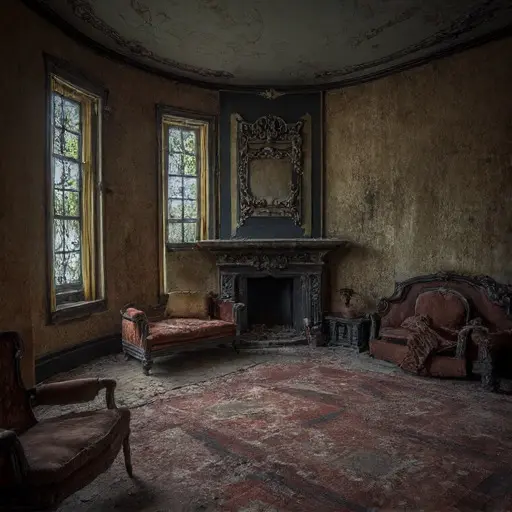
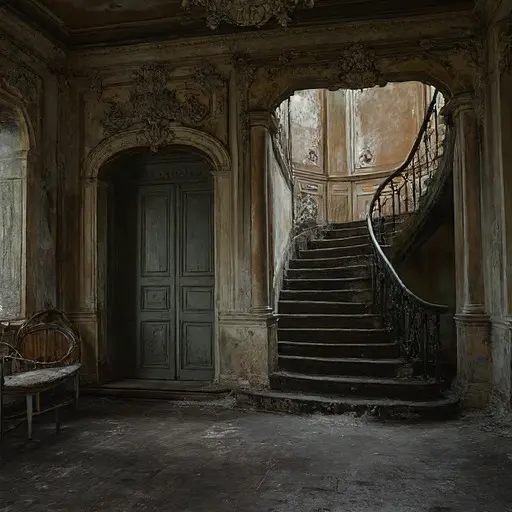
Inside, the mansion reveals the refined proportions and decorative richness typical of the Second Empire Victorian style. Tall ceilings, curved architectural elements, and intricate woodwork create rooms that still suggest the elegance of formal family life from another century.
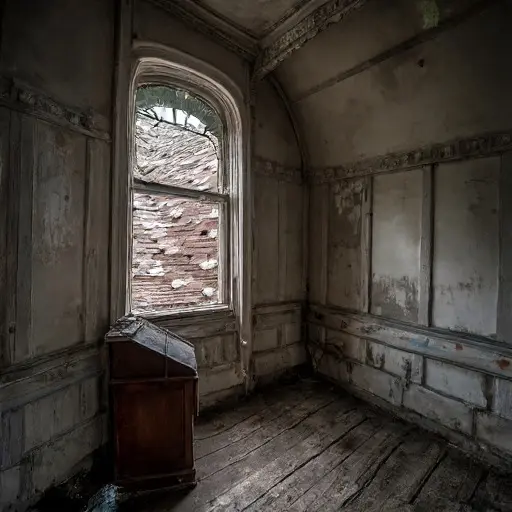
The empty interiors hold a quiet atmosphere, with forgotten spaces illuminated only by soft daylight filtering through aging windows. The contrast between the elaborate craftsmanship and the absence of daily life gives the rooms a feeling of preserved memory rather than complete decay.
The Burgundy Mansard House Beyond the Birch Trees stands as a remarkable example of Victorian architectural ambition softened by decades of silence. Its white limestone walls, burgundy brick accents, and charcoal mansard roof continue to define its presence among the surrounding woodland.
Although abandoned, the residence remains graceful and imposing. Surrounded by old trees, forgotten gardens, and moss-covered pathways, it serves as a quiet architectural record of craftsmanship, family history, and the slow passage of time.