The Sandstone Manor of the Quiet Woodland Village
At the edge of a peaceful woodland village, hidden among mature walnut trees and overgrown garden walls, stands an abandoned Romanesque Revival Victorian family house that carries the quiet dignity of another era. The three-story residence rests along a narrow village road, its massive stone forms softened by time, moss, and the slow return of nature.
The house is built from pale golden sandstone, dark green serpentine stone accents, and carefully carved white marble window surrounds. These materials create a warm yet weathered palette, where the golden masonry contrasts with deep green detailing and the aged red clay tiles above. The exterior remains imposing while showing the gentle signs of decades of settling and neglect.
The architecture is defined by monumental rounded arches, carved stone columns, and a broad circular turret that dominates the entrance. The heavy Romanesque influences give the home a sense of permanence, yet age has reshaped its appearance. The front wall bows slightly outward, the turret leans subtly over the entrance, and the roofline follows uneven curves softened by years of exposure.
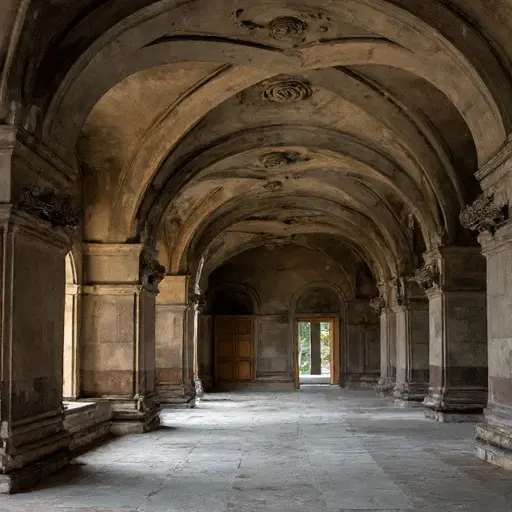
The porch wraps around a rounded garden courtyard, creating a sheltered transition between the house and the surrounding landscape. Weathered stone surfaces, moss-covered edges, and aged wooden details reveal the gradual transformation of the residence from a family home into a forgotten architectural relic.
The roof of red clay tiles has developed a softened appearance, with moss spreading along the ridges and corners. Small irregularities in the roof shape reflect the natural aging process, adding to the organic silhouette of the structure. The combination of curved stonework and uneven surfaces gives the manor a distinctive character that feels shaped by both craftsmanship and time.
Beyond the entrance, the surrounding grounds have slowly reclaimed the property. Stone walls divide abandoned gardens filled with wild plants, while dense forest rises behind the village homes. The quiet woodland setting creates a peaceful atmosphere where the old manor appears almost hidden within its environment.
Beside the sandstone wall, a rusted vintage bicycle rests beneath creeping vegetation, its faded metal frame blending into the surrounding textures. Near the ivy-covered fence, a weathered wooden birdhouse stands on a crooked post, offering a small reminder of the life that once surrounded the property.
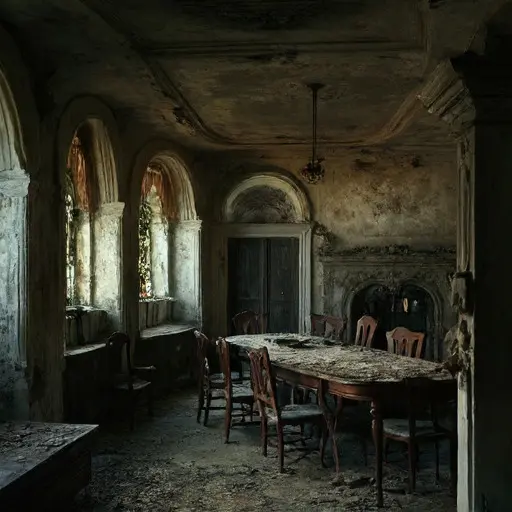
Inside, the residence preserves the atmosphere of a once-grand family estate. Large interior spaces are shaped by the same rounded architectural language found outside, with curved transitions, heavy stone features, and carefully crafted details that reflect the confidence of Victorian-era design.
The rooms reveal layers of craftsmanship through carved surfaces, worn flooring, and aged decorative elements. Although abandoned, the house still carries traces of elegance through its marble accents, stone arches, and the quiet scale of its original design.
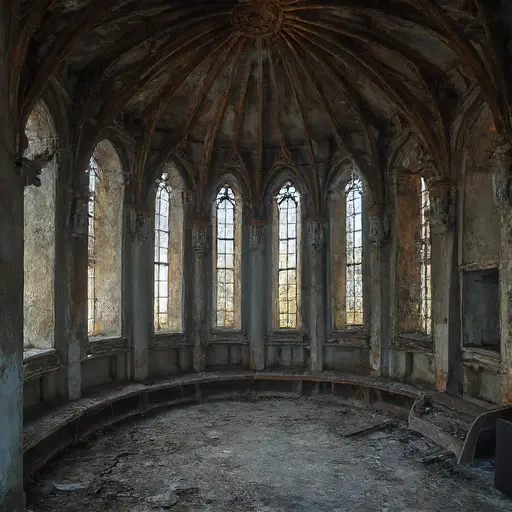
The Sandstone Manor of the Quiet Woodland Village remains a powerful example of Romanesque Revival Victorian architecture, where massive stone construction meets the delicate effects of time. Its golden sandstone walls, green stone accents, and curved forms continue to stand among the trees as a silent reminder of a forgotten family home.
Surrounded by forest, gardens, and village paths, the abandoned residence has become part of the landscape itself. Every weathered arch, moss-covered tile, and overgrown pathway preserves a fragment of its history, allowing the manor to remain a place where architecture and nature exist together.